CGPSC Syllabus 2025: Prelims & Mains Pattern + PDF Download
Complete CGPSC syllabus 2025 — stage-wise Prelims & Mains pattern, paper-wise topics, marks, negative marking, Hindi syllabus + free PDF download.

The CGPSC syllabus for the State Service Examination is divided into three stages — Preliminary (2 objective papers of 200 marks each), Mains (7 descriptive papers of 200 marks each = 1400 marks) and a 150-mark Interview. The Prelims tests General Studies and Aptitude (CSAT), while the Mains tests language, essay and five General Studies papers, with a strong Chhattisgarh-centric focus running through every stage. Below you get the complete, official, paper-wise CGPSC syllabus 2025 with exam pattern, marks, weightage, a Hindi version, a free PDF download, and a topic-to-book mapping so you can plan your preparation end to end.
The Chhattisgarh Public Service Commission (CGPSC), headquartered in Raipur, conducts the State Service Examination (Rajya Seva) to recruit candidates for posts such as Deputy Collector (State Civil Services), Deputy Superintendent of Police, District Excise Officer, Commercial Tax Officer, Naib Tehsildar and other Class I and Class II services of the Chhattisgarh government. Whether you are a first-time aspirant or a re-attempter, understanding the exact CGPSC syllabus and exam pattern is the single most important step before you buy books or join coaching. This guide consolidates everything the official notification (psc.cg.gov.in) lays out and adds the analysis, tables and Hindi support that most pages skip.
Last reviewed: June 2026 by the Competer editorial team, compiled from the official CGPSC State Service Examination notification published on psc.cg.gov.in. Marks, papers and the three-stage structure below reflect the latest advertised pattern; treat the current year’s official advertisement as the final authority on cut-offs and eligibility.
CGPSC Syllabus 2025: Quick Overview & Selection Process
The CGPSC syllabus 2025 is organised around a three-stage selection process. Each stage filters candidates progressively, and only marks from the Mains and Interview count toward the final merit list — the Prelims is purely a screening (qualifying-cum-shortlisting) test. Here is the high-level map before we dive into each stage in detail.
| Stage | Nature | Papers | Total Marks | Counts in Merit? |
|---|---|---|---|---|
| Stage I — Preliminary | Objective (MCQ) | 2 papers | 400 | No (screening only) |
| Stage II — Mains | Descriptive (written) | 7 papers | 1400 | Yes |
| Stage III — Interview | Personality Test | — | 150 | Yes |
| Final Merit | Mains + Interview | — | 1550 | — |
A few things to internalise right away: the Prelims marks do not add to your final score — they only decide whether you qualify for the Mains. The final selection is based on the combined total of 1400 (Mains) + 150 (Interview) = 1550 marks. The Chhattisgarh-specific component (history, culture, tribes, geography, economy, polity and current affairs of Chhattisgarh) is woven into both Prelims and Mains and is often the deciding factor between selection and rejection, because static national GK is where most aspirants are already competitive.
CGPSC Prelims Syllabus & Exam Pattern 2025
The CGPSC Prelims syllabus is split across two objective papers, each carrying 200 marks for a combined 400 marks. Both papers are conducted on the same day in two sessions, each of two hours’ duration. Paper I is General Studies and Paper II is the Aptitude Test (the CGPSC version of CSAT). Here is the exact Prelims exam pattern.
| Paper | Subject | Questions | Marks | Duration | Negative Marking |
|---|---|---|---|---|---|
| Paper I | General Studies | 100 | 200 | 2 hours | 1/3 (0.33) per wrong answer |
| Paper II | Aptitude Test (CSAT) | 100 | 200 | 2 hours | 1/3 (0.33) per wrong answer |
| Total | — | 200 | 400 | 4 hours | — |
Each question carries 2 marks. There is negative marking of one-third (1/3, i.e. 0.33 mark) for every incorrect answer in both papers — so blind guessing is penalised. To qualify, a candidate must generally score at least 33% in Paper I, while Paper II (Aptitude) is qualifying in nature requiring a minimum of around 23% (33% for general where applicable, with relaxation for reserved categories as per the notification). Always confirm the exact cut-off rule in the current year’s official advertisement, as the Commission periodically revises the qualifying threshold for the Aptitude paper.
CGPSC Prelims Paper I: General Studies Syllabus
Paper I (General Studies) is the heart of the Prelims and blends national static GK with heavy Chhattisgarh-specific content. The broad areas are:
- History of India and the Indian National Movement — ancient, medieval and modern India; the freedom struggle.
- History of Chhattisgarh and contribution to the freedom movement — dynasties of the region, the 1857 revolt in Chhattisgarh, tribal revolts, and the formation of the state in 2000.
- Indian Polity, Economy and Constitution — Parliament, Panchayati Raj, fundamental rights, directive principles, planning, budgeting and economic reforms.
- Geography of India — physical, social and economic geography.
- Geography of Chhattisgarh — physiography, rivers (Mahanadi, Indravati, Shivnath), climate, soils, forests and biodiversity.
- General Science and Technology — everyday science, environment and ecology, and recent developments.
- Current Affairs — national, international and especially Chhattisgarh state events, schemes and appointments.
- Chhattisgarh-specific GK — literature, music, dance (Panthi, Raut Nacha, Karma, Pandwani), festivals, tribes (Gond, Halba, Kanwar, Baiga, Oraon), administrative set-up, mineral and forest resources, industries, and welfare schemes of the state government.
CGPSC Prelims Paper II: Aptitude (CSAT) Syllabus
Paper II is the Aptitude Test, comparable to the UPSC CSAT. It checks reasoning, comprehension and decision-making ability. The major components are:
- Comprehension and interpersonal skills including communication.
- Logical reasoning and analytical ability.
- Decision-making and problem-solving.
- General mental ability.
- Basic numeracy (numbers, magnitudes, data interpretation) up to Class X level.
- Hindi language comprehension skills (passage-based, at Class X level — no separate translation is provided for this section).
Because Paper II is qualifying, many aspirants under-prepare it and then narrowly miss the cut-off. Treat it seriously: practising CSAT-style comprehension and quantitative aptitude — even from UPSC-oriented resources like the Vajiram CSAT Complete Booklet Set — builds the speed you need to clear the qualifying bar comfortably.
CGPSC Mains Syllabus & Exam Pattern 2025
The CGPSC Mains syllabus is the decisive stage. It consists of seven descriptive papers, each of 200 marks, totalling 1400 marks, with each paper running for three hours. Unlike the Prelims, the Mains is entirely written (long and short answers, essays), and every mark counts toward your final rank. Here is the paper-wise Mains exam pattern.
| Paper | Subject | Marks | Duration |
|---|---|---|---|
| Paper I | Language (Hindi, English & Chhattisgarhi) | 200 | 3 hours |
| Paper II | Essay (Nibandh) | 200 | 3 hours |
| Paper III | General Studies I — History, Constitution & Public Administration | 200 | 3 hours |
| Paper IV | General Studies II — Science, Technology & Environment | 200 | 3 hours |
| Paper V | General Studies III — Economy & Geography | 200 | 3 hours |
| Paper VI | General Studies IV — Philosophy, Logic, Sociology & Psychology | 200 | 3 hours |
| Paper VII | General Studies V — Public Welfare, Schemes & Organisations | 200 | 3 hours |
| Total | — | 1400 | 21 hours |
Mains Paper I — Language (Hindi, English & Chhattisgarhi)
Paper I tests language proficiency across three languages. The typical structure includes a Hindi section, an English section and a Chhattisgarhi section, evaluating grammar, comprehension, precis writing, letter/report drafting, idioms and translation. The objective is to confirm that an officer can communicate effectively in the official and regional languages of the state. Candidates should practise precis and official drafting in Hindi, as it carries the largest weight, and revise Chhattisgarhi vocabulary and grammar specific to the region.
Mains Paper II — Essay (Nibandh)
The Essay paper requires candidates to write long essays on a choice of topics drawn from national issues, Chhattisgarh-specific themes, socio-economic problems, governance, science and contemporary affairs. Marks are awarded for structure, balanced argument, factual accuracy and language. Practising essays on Chhattisgarh’s development, tribal welfare, Naxalism, mineral economy and women’s empowerment pays off here. A focused resource like the Vajiram Essay Notes helps you build essay frameworks, introductions and conclusions you can adapt to state-specific prompts.
Mains Paper III — General Studies I (History, Constitution & Public Administration)
This paper combines three big blocks:
- History & Culture — history of India and the world; history, culture, archaeology, literature, music, dance, painting and architecture of Chhattisgarh; tribal society and movements.
- Constitution & Polity — the Indian Constitution, Union and State legislature, executive and judiciary, federalism, local self-government and Panchayati Raj (with emphasis on PESA in Chhattisgarh’s Scheduled Areas).
- Public Administration — concepts, theories, district administration, accountability, e-governance and administrative set-up of Chhattisgarh.
Strong polity fundamentals are non-negotiable here. Many CGPSC toppers build their base from standard UPSC-grade polity material such as the Vajiram Polity Notes, then layer Chhattisgarh-specific governance on top.
Mains Paper IV — General Studies II (Science, Technology & Environment)
Paper IV covers general science (physics, chemistry, biology at the conceptual level), the role of science and technology in development, information and communication technology, biotechnology, space, defence and nuclear technology, energy resources, and environment and biodiversity. The Chhattisgarh angle includes the state’s forests, wildlife sanctuaries and national parks, mineral wealth, and environmental challenges arising from mining and industry. Current developments in science and technology — especially those relevant to the state — are frequently asked.
Mains Paper V — General Studies III (Economy & Geography)
This paper integrates economics and geography:
- Indian Economy — planning, fiscal and monetary policy, agriculture, industry, banking, inclusive growth and budgeting.
- Chhattisgarh Economy — agriculture and forestry, minerals, industries, public finance, infrastructure, and state economic indicators.
- Geography — physical, economic and social geography of India and the world.
- Geography of Chhattisgarh — relief, drainage, climate, natural vegetation, agriculture, minerals and demographic patterns.
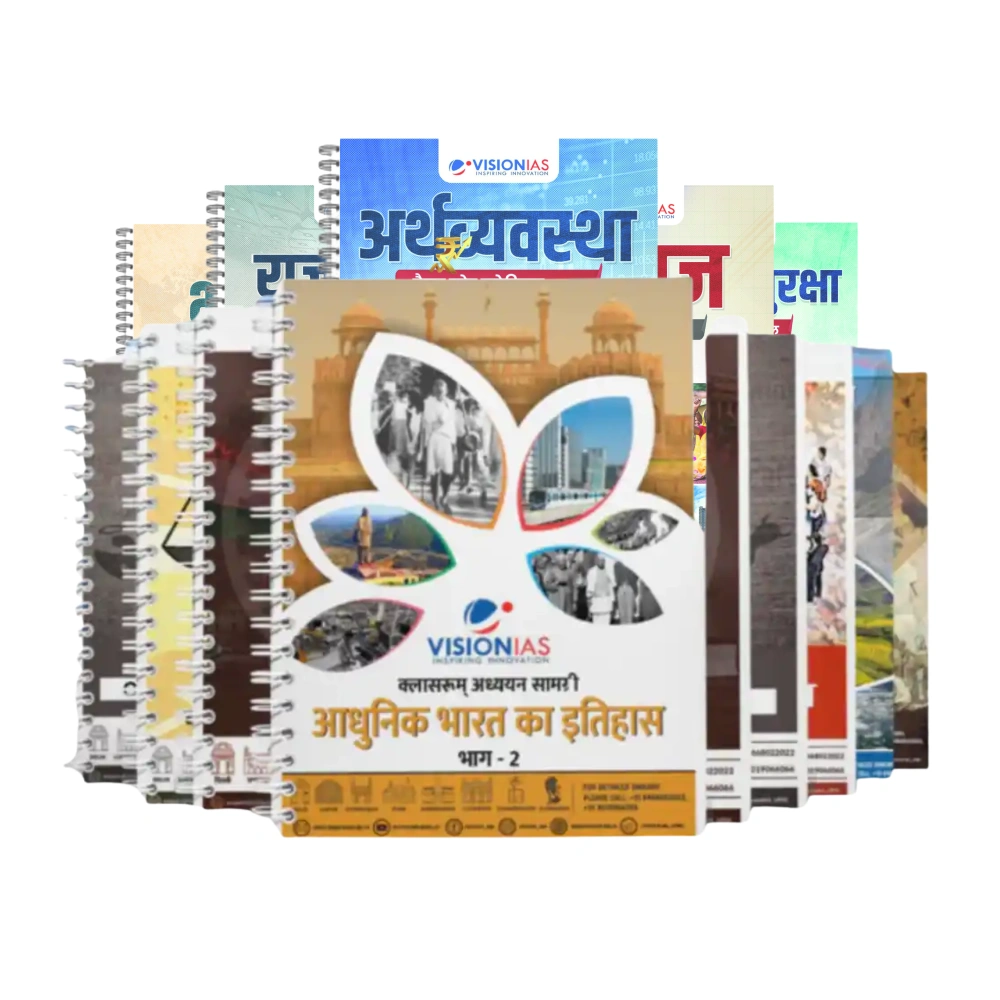
Economics is a high-yield area, and a focused booklet set like the Vision IAS Economics Notes gives you the conceptual clarity to convert these questions into top marks, after which you supplement with state economic survey data.
Mains Paper VI — General Studies IV (Philosophy, Logic, Sociology & Psychology)
Paper VI is conceptual and includes Indian philosophy and the philosophy of the Vedas and Upanishads, ethics, logic and reasoning, sociology (social structure, social change, social problems, tribal society of Chhattisgarh) and basic psychology. It assesses your understanding of human values, social institutions and analytical reasoning. The sociology and tribal-society portion has a clear Chhattisgarh flavour and rewards candidates who study the state’s communities and social movements closely.
Mains Paper VII — General Studies V (Public Welfare, Schemes & Organisations)
The final General Studies paper focuses on governance and welfare: human resource development, health, education, social-sector schemes of the central and Chhattisgarh governments, voluntary organisations and self-help groups, statutory and regulatory bodies, public services and welfare administration. Expect direct questions on flagship Chhattisgarh schemes, so maintaining an updated note of state government programmes is essential through the prep cycle.
CGPSC Interview (Personality Test): 150 Marks
Candidates who clear the Mains are called for the Interview, also known as the Personality Test, which carries 150 marks. The interview board assesses general awareness, clarity of thought, leadership, balance of judgement, depth of interest in Chhattisgarh’s affairs, and suitability for administrative service. Your final rank is decided by adding the Interview marks to your Mains total of 1400, giving a grand total of 1550 marks. Because the interview is a substantial 150 marks (nearly 10% of the final total), it can move you up or down several ranks — prepare your DAF, hobbies and Chhattisgarh current affairs thoroughly.
CGPSC Prelims vs Mains: Quick Comparison
Aspirants often confuse the demands of the two written stages. This comparison table makes the differences skimmable so you can calibrate your preparation correctly.
| Feature | Prelims | Mains |
|---|---|---|
| Type of questions | Objective (MCQ) | Descriptive (written) |
| Number of papers | 2 | 7 |
| Total marks | 400 | 1400 |
| Duration per paper | 2 hours | 3 hours |
| Negative marking | Yes (1/3) | No |
| Counts in final merit | No | Yes |
| Language medium | Hindi & English | Hindi, English & Chhattisgarhi |
| Primary skill tested | Recall + accuracy | Analysis + expression |
CGPSC Subject-Wise Weightage & Previous-Year Analysis
Knowing where marks concentrate helps you prioritise. Based on previous-year trends, here is an approximate weightage distribution across the Prelims General Studies paper. Treat these as planning estimates, not official figures, since the Commission does not publish a fixed blueprint.
| Area | Approx. Prelims Weightage | Priority |
|---|---|---|
| Chhattisgarh GK (history, culture, geography, economy, polity) | 35–40% | Very High |
| Indian Polity & Constitution | 12–15% | High |
| Indian & CG History | 10–12% | High |
| Geography (India + CG) | 10–12% | High |
| Economy (India + CG) | 8–10% | Medium |
| Science & Technology | 8–10% | Medium |
| Current Affairs | 10–12% | High |
The single biggest takeaway: roughly 35–40% of the Prelims hinges on Chhattisgarh-specific GK. This is the area where dedicated state material and current affairs matter more than any national textbook, and it is the most reliable place to gain an edge over the competition.
CGPSC Syllabus 2025: Latest Pattern & Eligibility Updates
For the 2024–25 cycle, the core structure — 2 Prelims papers, 7 Mains papers and a 150-mark interview — remains intact, but aspirants should note a few points the older guides gloss over:
- Aptitude (CSAT) qualifying nature: Paper II of the Prelims is qualifying; you must clear the minimum threshold (around 23–33% depending on category and the year’s rule) but its marks do not contribute to the Prelims merit beyond qualification.
- Negative marking confirmed: 1/3 (0.33) negative marking applies to both Prelims papers.
- Age & attempts: The minimum age is generally 21 and the upper age limit (with relaxations for reserved categories and Chhattisgarh domicile) is specified afresh each year; the number of attempts and age relaxation rules are notification-specific, so verify them in the current advertisement.
- Domicile advantage: Chhattisgarh domicile candidates receive age relaxation and reservation benefits as per state rules.
Because the Commission can revise thresholds and eligibility from year to year, always cross-check the latest official notification on psc.cg.gov.in before finalising your strategy.
CGPSC Syllabus PDF Download (Free, Ungated)
You can download the complete CGPSC syllabus 2025 — Prelims plus all seven Mains papers — as a clean, copy-paste-friendly PDF. Competer offers this as a free, ungated reference so you do not have to dig through Scribd or gated portals. Save it, print it, and tick off topics as you finish them. For the authoritative version, the official syllabus is also published with the annual advertisement on the Commission’s website (psc.cg.gov.in). Use the official PDF as the final word and this guide as your study companion and revision checklist.
CGPSC सिलेबस 2025 (Hindi Summary)
हिंदी माध्यम के अभ्यर्थियों के लिए CGPSC सिलेबस का संक्षिप्त सार: छत्तीसगढ़ राज्य सेवा परीक्षा तीन चरणों में होती है — प्रारंभिक परीक्षा (Prelims), मुख्य परीक्षा (Mains) और साक्षात्कार (Interview)।
- प्रारंभिक परीक्षा: 2 वस्तुनिष्ठ (objective) प्रश्नपत्र — पेपर I सामान्य अध्ययन (200 अंक) और पेपर II योग्यता/एप्टीट्यूड (200 अंक)। कुल 400 अंक, प्रत्येक पेपर 2 घंटे, प्रत्येक गलत उत्तर पर 1/3 ऋणात्मक अंकन।
- मुख्य परीक्षा: 7 वर्णनात्मक (descriptive) प्रश्नपत्र, प्रत्येक 200 अंक — कुल 1400 अंक, प्रत्येक पेपर 3 घंटे। इसमें भाषा (हिंदी, अंग्रेज़ी, छत्तीसगढ़ी), निबंध और सामान्य अध्ययन के पाँच पेपर शामिल हैं।
- साक्षात्कार: 150 अंक। अंतिम चयन मुख्य परीक्षा + साक्षात्कार = 1550 अंकों के आधार पर होता है।
छत्तीसगढ़ का इतिहास, संस्कृति, जनजातियाँ, भूगोल, अर्थव्यवस्था और शासन — दोनों चरणों में सबसे महत्वपूर्ण भाग है। हिंदी माध्यम के अभ्यर्थी मानक नोट्स जैसे Vision IAS Hindi GS Notes और Drishti IAS Hindi Study Material से आधार तैयार कर सकते हैं और फिर राज्य-विशेष सामग्री जोड़ सकते हैं।
Best Books & Study Material for the CGPSC Syllabus
The CGPSC syllabus overlaps heavily with the UPSC and other state PSC syllabi, so high-quality GS material gives you a ready-made foundation; you then add Chhattisgarh-specific state GK on top. Here is a practical topic-to-material map.
| Syllabus Area | Recommended Material Type | Why It Helps |
|---|---|---|
| Polity & Constitution | Standard polity notes | Covers Parliament, federalism, Panchayati Raj used in Prelims & Mains GS-I |
| Economy (India + CG) | Economics notes + state economic survey | Builds core concepts before layering state data |
| Geography & Environment | GS geography + environment booklets | Common to Prelims and Mains GS-II/III |
| Current Affairs | Monthly magazines | National + state events for Prelims and essay |
| Aptitude (CSAT) | CSAT practice booklets | Clears the qualifying Paper II comfortably |
| Hindi-medium prep | Hindi GS study material | Aligns with Hindi-medium CGPSC papers |
For a complete GS base in Hindi, many CGPSC aspirants rely on the Drishti IAS Hindi Study Material, supplement current affairs with a monthly magazine, and reserve dedicated hours for Chhattisgarh-specific GK from state-focused sources. English-medium candidates can build the same foundation and then map every topic back to the Chhattisgarh angle.
How to Prepare for the CGPSC Syllabus 2025: Strategy
A syllabus is only useful when paired with a plan. Here is a clean, sequential strategy that has worked for selected candidates:
- Read the syllabus first, then NCERTs: Internalise the paper-wise topics, then build basics from Class 6–12 NCERTs for history, geography, polity, economy and science.
- Make Chhattisgarh your strong suit: Allocate dedicated daily time to CG history, geography, polity, economy, art, culture, tribes and current affairs — this is where merit is decided.
- Integrate Prelims and Mains: Study each subject for both stages together; revise objective facts for Prelims and practise answer-writing for Mains in the same cycle.
- Don’t ignore Paper II (CSAT): Practise comprehension and basic numeracy weekly so the qualifying paper never becomes a risk.
- Practise answer-writing early: Mains carries 1400 marks; daily writing of 2–3 answers in Hindi/English builds speed and structure.
- Revise with tests: Take regular mock tests for both Prelims and Mains; analyse mistakes and maintain a current-affairs register focused on Chhattisgarh.
- Track schemes & current affairs: Keep an updated note of central and Chhattisgarh government welfare schemes for GS-V and the interview.
Common Mistakes CGPSC Aspirants Make
- Over-preparing national static GK while neglecting Chhattisgarh-specific topics.
- Treating the Aptitude paper casually and then missing the qualifying cut-off.
- Starting answer-writing only a month before the Mains.
- Ignoring the Chhattisgarhi language section of Mains Paper I.
- Relying on outdated material that misses recent pattern and scheme updates.
Is the CGPSC Syllabus Similar to UPSC?
Yes and no. The CGPSC syllabus shares a large common core with UPSC — history, polity, geography, economy, science, environment and current affairs all overlap, which is why UPSC-grade GS notes work brilliantly as a foundation. The key differences are: CGPSC has a strong, non-negotiable Chhattisgarh-specific layer in every stage; the Mains structure (7 papers of 200 marks each, including language and a combined essay) differs from UPSC’s 9-paper format with optional subjects; and CGPSC has no optional subject. In short, your UPSC preparation transfers about 60–70% of the way, and the remaining 30–40% is dedicated state-focused study. This overlap is exactly why investing in robust GS booklets is efficient even for a state-PSC-only aspirant.
Frequently Asked Questions
What is the syllabus of CGPSC?
The CGPSC syllabus covers three stages: Prelims (Paper I General Studies and Paper II Aptitude/CSAT, 200 marks each), Mains (7 descriptive papers of 200 marks each — Language, Essay and five General Studies papers covering history, constitution, public administration, science, technology, environment, economy, geography, philosophy, sociology, psychology and welfare schemes) and a 150-mark Interview. Chhattisgarh-specific history, culture, geography, economy and current affairs are woven throughout.
How many papers are there in CGPSC Prelims and Mains?
The CGPSC Prelims has 2 objective papers (General Studies and Aptitude), each of 200 marks, totalling 400 marks. The CGPSC Mains has 7 descriptive papers, each of 200 marks, totalling 1400 marks, followed by a 150-mark interview.
Is there negative marking in CGPSC Prelims?
Yes. Both Prelims papers carry a negative marking of one-third (1/3, i.e. 0.33 mark) for every incorrect answer. Each correct answer carries 2 marks, so unmarked questions are safer than reckless guesses.
Can I write the CGPSC Mains exam in Hindi?
Yes. Candidates can write the CGPSC Mains in Hindi, and the language paper itself tests Hindi, English and Chhattisgarhi. Hindi-medium aspirants form a large share of CGPSC candidates, and standard Hindi GS material is widely available for preparation.
How many marks is the CGPSC exam (Prelims, Mains, Interview)?
The Prelims is 400 marks (screening only), the Mains is 1400 marks and the Interview is 150 marks. The final merit is based on Mains plus Interview, totalling 1550 marks; the Prelims marks do not count toward the final selection.
What is the qualifying percentage for CGPSC Prelims?
Candidates generally need to score at least 33% in Paper I (General Studies), while Paper II (Aptitude) is qualifying in nature with a minimum of around 23% (subject to category-wise rules). The exact qualifying threshold and any relaxation for reserved categories should be confirmed in the current year’s official notification on psc.cg.gov.in.
Is the CGPSC syllabus similar to UPSC?
The CGPSC syllabus shares roughly 60–70% of its core with UPSC — history, polity, geography, economy, science, environment and current affairs all overlap, so UPSC-grade GS material works well as a base. The differences are significant though: CGPSC adds a heavy Chhattisgarh-specific layer at every stage, has no optional subject, and uses a 7-paper Mains (200 marks each) with a combined language and essay paper rather than UPSC’s 9-paper format. Build the common GS foundation, then dedicate focused time to Chhattisgarh-centric study.
Which books are best for the CGPSC syllabus?
Start with Class 6–12 NCERTs for fundamentals, then layer standard GS notes — polity, economy, geography and environment booklets — to cover the Prelims and Mains General Studies papers. Hindi-medium aspirants can use Hindi GS study material such as Vision IAS Hindi GS Notes or Drishti IAS Hindi Study Material, and CSAT practice booklets for the qualifying Paper II. Crucially, supplement all of this with dedicated Chhattisgarh state GK (history, culture, tribes, geography, economy and schemes) and a monthly current-affairs magazine, since 35–40% of the Prelims rests on state-specific content that no national textbook fully covers.
Recommended Study Material
Continue Reading
OJAS GPSC Syllabus 2026: Class 1-2 Pattern + PDF Download
The OJAS GPSC syllabus for the Class 1-2 (Gujarat Administrative Service / Gujarat Civil Service) exam covers a…
Best Sociology Optional Books for UPSC 2026: Paper-Wise Topper Booklist
The best sociology optional books for UPSC are a short, curated set: Haralambos & Holborn and Giddens' Sociology…
TNPSC Group 1 Syllabus 2026: Prelims, Mains + PDF
The tnpsc group 1 syllabus covers a three-stage selection process — an objective Preliminary exam (200 questions, 300…