UPSC Exam Pattern 2026: Prelims, Mains, Marks & Merit
UPSC exam pattern 2026: Prelims, Mains & Interview stages, papers, marks, negative marking, CSAT qualifying rule and the 2025-mark final merit. Free cheat sheet.

The UPSC exam pattern follows a three-stage selection process: the Preliminary examination (objective, screening), the Main examination (descriptive, 1750 merit marks), and the Personality Test or Interview (275 marks). Only Mains and Interview marks — a combined total of 2025 marks — decide your final rank; Prelims marks are used only to screen you into Mains and are not added to the final merit. This guide breaks down every paper, mark, duration, question count and marking rule for the UPSC Civil Services Examination (CSE) 2026, and maps each stage to the exact study material you need.
Free download: we’ve compressed this entire structure into a one-page printable UPSC exam pattern cheat sheet (Prelims + Mains + Interview marks flow) that you can save and stick above your study desk — grab the PDF link in the study-material section below.
Key Facts: UPSC Exam Pattern 2026 in Brief
- Stages: 3 — Prelims (screening) → Mains (written) → Interview / Personality Test.
- Prelims: 2 objective papers, 400 marks, 1/3rd negative marking, not counted in the final merit.
- Mains: 9 descriptive papers — 7 merit papers (1750 marks) + 2 qualifying language papers (600 marks).
- Interview: 275 marks, no minimum qualifying mark, added directly to the merit total.
- Final merit: 1750 (Mains) + 275 (Interview) = 2025 marks.
- Qualifying gates: CSAT needs 33%; each language paper (Paper A & B) needs 25%.
- Attempts: General 6, OBC 9, SC/ST unlimited — within their respective age limits.
UPSC Exam Pattern at a Glance: The 3-Stage Selection Process
The Union Public Service Commission (UPSC) conducts the Civil Services Examination in three successive stages. You must clear each stage to reach the next — there is no shortcut and no lateral entry between stages. This is why the IAS exam pattern (prelims, mains, interview) is best understood as a funnel: roughly 10-11 lakh apply, about 5 lakh sit for Prelims, ~13,000-15,000 qualify for Mains, ~2,500-2,800 reach the Interview, and around 1,000-1,100 finally make the merit list.
| Stage | Nature | Papers | Total Marks | Counted in Final Merit? | Purpose |
|---|---|---|---|---|---|
| Stage 1 — Prelims | Objective (MCQ) | 2 papers | 400 | No (screening only) | Shortlist candidates for Mains |
| Stage 2 — Mains | Descriptive (written) | 9 papers | 1750 (merit) + 600 (qualifying) | Yes — 1750 marks | Test depth, analysis, answer writing |
| Stage 3 — Interview | Personality Test | — | 275 | Yes — 275 marks | Assess personality & suitability |
The final rank is calculated on 1750 (Mains) + 275 (Interview) = 2025 marks. Keep this number in mind — everything below explains how you get there.
UPSC Prelims Exam Pattern 2026: Papers, Marks & Duration
The UPSC Prelims exam pattern 2026 consists of two objective-type (MCQ) papers held on the same day in two sessions. Both papers are compulsory and each carries 200 marks, for a combined 400 marks. However — and this is the single most misunderstood rule in the entire exam — only General Studies Paper I decides your Prelims cutoff. Paper II (CSAT) is merely qualifying.
| Paper | Subject | Questions | Marks | Duration | Nature |
|---|---|---|---|---|---|
| Paper I | General Studies (GS) | 100 | 200 | 2 hours (9:30–11:30 AM) | Merit — decides cutoff |
| Paper II | CSAT (Aptitude) | 80 | 200 | 2 hours (2:30–4:30 PM) | Qualifying — min 33% |
Candidates with benchmark disability get 20 minutes of compensatory time per hour (i.e., 2 hours 40 minutes per paper). Both papers are set bilingually in Hindi and English.
What does GS Paper I cover?
GS Paper I tests current events of national and international importance, History of India and the Indian National Movement, Indian and World Geography, Indian Polity and Governance, Economic and Social Development, Environmental Ecology & Biodiversity, and General Science. It is the paper that makes or breaks your Prelims because the cutoff is drawn on this paper alone.
What does CSAT Paper II cover?
CSAT (Civil Services Aptitude Test) covers comprehension, interpersonal and communication skills, logical reasoning and analytical ability, decision-making and problem-solving, general mental ability, and basic numeracy plus data interpretation (Class X level). Since 2023, CSAT has become notably tougher — reasoning and quant-heavy — which is why lakhs of humanities-background aspirants now fail it despite it being “only qualifying.”
UPSC CSAT Exam Pattern & Qualifying Marks: Why “Qualifying” Still Eliminates People
CSAT is qualifying only — you need a minimum of 33% (66 out of 200 marks) to pass it. Score even one mark below 33% and you are out of the race entirely, no matter how brilliantly you did in GS Paper I. This is the trap: because CSAT marks are not counted in the cutoff, aspirants under-prepare for it, then get eliminated on a paper that “doesn’t count.”
Here is the exact logic UPSC applies, in order:
| Step | Rule | Outcome |
|---|---|---|
| 1 | Score ≥ 33% in CSAT (Paper II)? | If No → disqualified immediately |
| 2 | If Yes, your GS Paper I score is compared against the cutoff | CSAT score is now ignored |
| 3 | GS Paper I ≥ category cutoff? | If Yes → qualify for Mains |
In short: CSAT is a pass/fail gate, and GS Paper I is the actual ranking round of Prelims. Treat CSAT as a subject you must reliably clear — a targeted Vision IAS CSAT Test Series that drills comprehension and quant under timed conditions is the cheapest insurance against a “qualifying” paper ending your attempt.
Negative Marking in UPSC Prelims: The 1/3rd Penalty Rule
Yes, there is negative marking in the UPSC Prelims — and it applies to both GS Paper I and CSAT Paper II. For every wrong answer, one-third of the marks assigned to that question is deducted. There is no penalty for questions you leave unattempted, and there is no negative marking anywhere in the descriptive Mains papers.
| Outcome | GS Paper I (2 marks/Q) | CSAT Paper II (2.5 marks/Q) |
|---|---|---|
| Correct answer | +2.00 | +2.50 |
| Wrong answer | −0.66 (1/3rd) | −0.83 (1/3rd) |
| Unattempted / left blank | 0.00 | 0.00 |
| Question with multiple answers marked | Treated as wrong → −0.66 | Treated as wrong → −0.83 |
The strategic takeaway: educated guessing still pays off. If you can eliminate two of four options, the probability tilts in your favour and attempting is mathematically sound. Blind guessing across the whole paper, however, will bleed marks fast. Most toppers attempt 85-95 of the 100 GS questions after eliminating options.
UPSC Mains Exam Pattern and Marks: 9 Papers Explained
The UPSC Mains exam pattern is entirely descriptive (written, not MCQ) and spans nine papers written over five to seven days. Of these nine, two are qualifying language papers and seven count towards your merit total of 1750 marks. Each paper is three hours long.
| Paper | Subject | Marks | Duration | Counted in Merit? |
|---|---|---|---|---|
| Paper A | Compulsory Indian Language | 300 | 3 hours | Qualifying (min 25%) |
| Paper B | English | 300 | 3 hours | Qualifying (min 25%) |
| Paper I | Essay | 250 | 3 hours | Yes |
| Paper II | General Studies I | 250 | 3 hours | Yes |
| Paper III | General Studies II | 250 | 3 hours | Yes |
| Paper IV | General Studies III | 250 | 3 hours | Yes |
| Paper V | General Studies IV (Ethics) | 250 | 3 hours | Yes |
| Paper VI | Optional Subject — Paper 1 | 250 | 3 hours | Yes |
| Paper VII | Optional Subject — Paper 2 | 250 | 3 hours | Yes |
Merit total = Essay (250) + GS I–IV (4 × 250 = 1000) + Optional Papers 1 & 2 (2 × 250 = 500) = 1750 marks.
The two qualifying language papers (Paper A & B)
Paper A is a Compulsory Indian Language chosen from the languages in the 8th Schedule of the Constitution, and Paper B is English. You only need to score 25% in each to qualify. Marks here are not added to your merit total, but if you fail either, UPSC will not even evaluate your other seven Mains papers — an instant elimination that catches out overconfident aspirants every year. Candidates from Arunachal Pradesh, Manipur, Meghalaya, Mizoram, Nagaland and Sikkim are exempt from Paper A.
GS Papers I–IV: what each one tests
The four General Studies papers are the backbone of Mains scoring. A quick map:
| GS Paper | Core Themes | Indicative High-Weight Areas |
|---|---|---|
| GS I | Heritage, History, Geography, Society | Modern Indian history, art & culture, Indian society, geography |
| GS II | Polity, Governance, IR, Social Justice | Constitution, governance, international relations, welfare schemes |
| GS III | Economy, Environment, Sci-Tech, Security | Indian economy, agriculture, disaster management, internal security |
| GS IV | Ethics, Integrity & Aptitude | Ethics theory + case studies (case studies carry ~50% of the paper) |
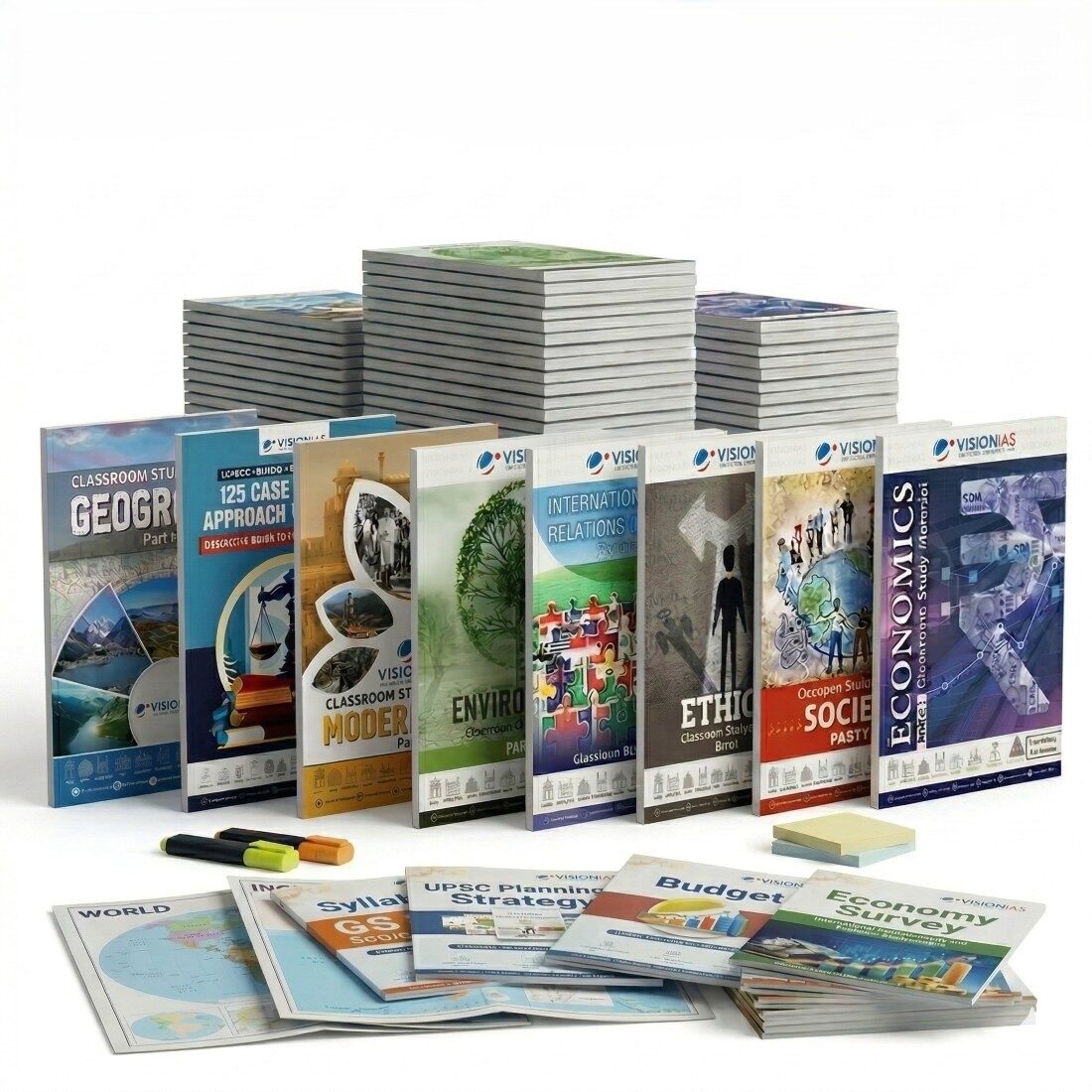
Because the GS syllabus is vast and overlapping, a single consolidated, exam-ready notes set saves months of scattered reading. A complete Prelims-plus-Mains package such as the Vision IAS UPSC CSE 2026–27 Complete GS Notes (57 booklets) covers all four GS papers plus Prelims in one aligned set.
UPSC Optional Subjects List: Choosing Your 500-Mark Bet
Two of your seven merit papers (500 marks — nearly 29% of the Mains merit total) come from a single optional subject you choose. UPSC offers 48 optional subjects: 25 core subjects plus the literatures of 23 languages. Your optional can swing your rank dramatically, so pick with strategy, not sentiment.
| Category | Popular Optional Subjects |
|---|---|
| Humanities (high scoring, overlap with GS) | Political Science & International Relations (PSIR), Sociology, Geography, History, Public Administration, Anthropology, Philosophy |
| Literature | Hindi, English, Tamil, Telugu, Urdu, and 18 other 8th-Schedule languages |
| Science & Technical | Zoology, Botany, Physics, Chemistry, Mathematics, Geology, Medical Science, Engineering (Civil/Mechanical/Electrical) |
| Commerce & others | Economics, Commerce & Accountancy, Management, Law, Agriculture, Statistics, Psychology |
How to choose an optional subject (a simple 4-filter test)
Run any candidate optional through four filters: (1) Interest & background — will you enjoy 8-10 months with it? (2) GS overlap — PSIR overlaps GS II, Sociology overlaps GS I & II, Geography overlaps GS I & III, saving revision time. (3) Availability of material & mentorship — a well-supported optional is easier to master. (4) Scoring trend — check recent toppers’ marks. Once decided, get a focused notes set — for instance Shubhra Ranjan PSIR Optional notes for Political Science aspirants — rather than assembling coverage from a dozen sources.
UPSC Interview / Personality Test: The Final 275 Marks
The Personality Test — commonly called the Interview — carries 275 marks and is the third and final stage. There is no minimum qualifying mark, but these marks are added directly to your Mains merit, so they materially decide your rank and service (IAS vs IPS vs IFS vs allied services). A board chaired by a UPSC member interviews you for roughly 30 minutes.
The Interview is not a knowledge test — it assesses mental alertness, clarity of thought, balance of judgement, depth of interest, social cohesion, leadership and intellectual and moral integrity. Questions typically flow from your Detailed Application Form (DAF): your hometown, graduation subject, hobbies, work experience and current affairs. A strong Interview (180+) can lift you dozens of ranks; a weak one (below 130) can cost you your preferred service.
UPSC CSE Marking Scheme & Final Merit Calculation
Here is the complete UPSC CSE marking scheme and how the final merit is built, stage by stage — the marks flow from 400 → 1750 → 275:
| Stage | Marks | Role in Final Rank |
|---|---|---|
| Prelims (GS I + CSAT) | 400 | Screening only — 0 marks carried forward |
| Mains — Qualifying (Paper A + B) | 600 | Must clear 25% each; 0 marks carried forward |
| Mains — Merit (7 papers) | 1750 | Added to final total |
| Personality Test (Interview) | 275 | Added to final total |
| Final Merit Total | 2025 | Determines rank & service allocation |
How normalisation and scaling work
UPSC uses moderation/scaling to ensure fairness across the two sets of optional papers and different examiners. In practice, this means raw marks in optionals and GS may be adjusted so that no candidate is unfairly advantaged by an “easy” or “strict” evaluator. This is also why final marks look compressed — the gap between rank 1 and rank 100 is often just 60-80 marks out of 2025, and every single Mains answer counts.
Prelims vs Mains: Key Differences Compared
Understanding the difference between UPSC Prelims and Mains reshapes how you prepare — Prelims rewards recognition and elimination; Mains rewards articulation and depth.
| Feature | Prelims | Mains |
|---|---|---|
| Question type | Objective (MCQ) | Descriptive (written answers) |
| Number of papers | 2 | 9 (7 merit + 2 qualifying) |
| Total marks | 400 (screening) | 1750 merit + 600 qualifying |
| Negative marking | Yes (1/3rd per wrong answer) | No |
| Counts in final merit | No | Yes |
| Core skill tested | Accuracy, elimination, speed | Analysis, structure, answer writing |
| Duration per paper | 2 hours | 3 hours |
Recommended Study Material Mapped to Each Stage (+ Free Pattern PDF)
The fastest way to align your preparation with the UPSC exam pattern is to match resources to what each stage actually rewards. Here is a stage-wise booklist you can act on today. Free lead magnet: download our one-page printable “UPSC Exam Pattern Cheat Sheet 2026” (all papers, marks, timings and negative-marking rules on a single page) — the download button sits at the top of every UPSC product page on Competer.
| Stage / Paper | What to prioritise | Recommended resource |
|---|---|---|
| Prelims — GS I | Static + current affairs, MCQ practice | Complete GS notes + monthly current affairs magazine |
| Prelims — CSAT | Timed comprehension & quant drilling | Dedicated CSAT test series |
| Prelims — revision | Topic-wise PYQ analysis | Forum IAS Prelims PYQ Toolkit |
| Mains — GS I–IV | Structured notes + answer writing | Prelims+Mains combined GS notes |
| Mains — Optional | Subject-specific standard notes | Subject-wise optional notes (PSIR, Sociology, Geography, etc.) |
| Mains — practice | Weekly answer writing under evaluation | Mains test series |
For PYQ-led Prelims revision — arguably the highest-return activity in the last 90 days — the Forum IAS UPSC Prelims Toolkit with topic-wise PYQs (1992–2025) lets you see exactly how UPSC repeats and reframes concepts. And because Mains marks are 86% of your final score, weekly evaluated practice through a Vision IAS Mains Test Series is where ranks are actually won.
Preparation Timeline Tied to the Exam Pattern
A realistic first-attempt timeline should span 12-15 months and be sequenced against the pattern, not against random syllabus chunks. Start answer writing far earlier than most aspirants dare to.
| Phase | Duration | Focus |
|---|---|---|
| Months 1–5 | Foundation | NCERTs + standard GS notes; pick & start optional; begin daily current affairs |
| Months 4–onward | Answer writing | Start Mains answer writing early — 2-3 answers/day; don’t wait for Prelims |
| Months 6–9 | Consolidation | Finish optional; revise GS; begin Prelims & Mains test series |
| Last 3 months to Prelims | Prelims sprint | Full-length mocks, CSAT practice, PYQ revision, current affairs revision |
| Prelims → Mains gap (~3 months) | Mains intensive | Daily answer writing, essay practice, optional revision, mock Mains |
| Mains → Interview (~2 months) | Personality Test | DAF-based prep, mock interviews, current affairs opinion-building |
Attempts, Eligibility & Exam-Day Logistics
The number of attempts depends on category. General category candidates get 6 attempts up to age 32; OBC candidates get 9 attempts up to age 35; SC/ST candidates get unlimited attempts up to age 37. Benchmark-disability (PwBD) candidates get 9 attempts (unlimited for SC/ST-PwBD), with age relaxation up to 42. Merely appearing for Prelims Paper I counts as an attempt; not appearing at all does not.
On logistics: both Prelims papers are bilingual (Hindi/English). In Mains, you may write GS, Essay and Optional papers in any language listed in the 8th Schedule or in English, irrespective of your Compulsory Language paper. The exam cycle typically runs Prelims (late May/June) → Mains (September) → Interview (early next year), so track the annual UPSC Notification and Exam Calendar closely for exact 2026 dates.
Common Aspirant Mistakes with the UPSC Exam Pattern
Even well-read aspirants lose attempts to pattern-level errors, not knowledge gaps:
- Ignoring CSAT until it’s too late — treating a “qualifying” paper casually, then failing the 33% gate.
- Reckless guessing in Prelims — forgetting the 1/3rd negative marking compounds fast.
- Neglecting the language papers — failing Paper A or B means your other 7 Mains papers are never even evaluated.
- Starting answer writing too late — Mains is 1750 of 2025 marks, yet many begin practice only after Prelims.
- Choosing an optional by “scoring reputation” alone — without checking interest, overlap and material availability.
- Under-preparing for the Interview — 275 unminimised marks can decide your service; it is not a formality.
Frequently Asked Questions
What is the exam pattern for UPSC?
The UPSC exam pattern has three stages: Prelims (2 objective papers, 400 marks, screening only), Mains (9 descriptive papers, 1750 merit marks) and the Interview/Personality Test (275 marks). The final rank is based on Mains plus Interview, totalling 2025 marks; Prelims marks are not carried forward.
How many papers are there in UPSC Prelims and Mains?
Prelims has 2 papers — General Studies Paper I and CSAT Paper II. Mains has 9 papers — two qualifying language papers (Indian Language and English), one Essay, four General Studies papers (GS I–IV) and two Optional Subject papers. Of the nine Mains papers, seven count towards the 1750 merit marks.
Is there negative marking in the UPSC exam?
Yes, in Prelims. One-third (0.66 marks in GS I, 0.83 in CSAT) is deducted for every wrong answer in both objective papers. There is no penalty for unattempted questions, and there is no negative marking in the descriptive Mains papers.
Is CSAT qualifying or counted in the merit?
CSAT (Prelims Paper II) is qualifying only. You must score at least 33% (66/200) to pass it, but its marks are not counted in your cutoff or final merit. The Prelims cutoff is decided solely by General Studies Paper I — yet failing CSAT still eliminates you from the exam.
What is the passing/qualifying percentage for CSAT and the language papers?
CSAT (Prelims Paper II) requires a minimum of 33% (66 of 200 marks). In Mains, the two compulsory language papers — Paper A (Indian Language) and Paper B (English) — each require 25% (75 of 300 marks). All three are qualifying: their marks are not added to the merit, but failing any one of them removes you from the process, and in Mains your other papers are not even evaluated.
What is the total marks of the UPSC exam (Mains + Interview)?
The final merit is calculated out of 2025 marks — 1750 from the seven merit Mains papers plus 275 from the Personality Test (Interview). Prelims (400 marks) and the two qualifying language papers (600 marks) do not add to this total.
What is the difference between UPSC Prelims and Mains?
Prelims is a 2-paper objective (MCQ) screening test of 400 marks with 1/3rd negative marking, and its marks are not counted in the final rank. Mains is a 9-paper descriptive (written) examination — 7 merit papers worth 1750 marks plus 2 qualifying language papers — with no negative marking, and it is counted in the final merit. Prelims rewards accuracy and elimination; Mains rewards analysis and answer writing.
How many attempts are allowed for the UPSC exam?
General category candidates get 6 attempts (up to age 32), OBC candidates get 9 attempts (up to age 35), and SC/ST candidates get unlimited attempts (up to age 37). PwBD candidates get 9 attempts with extended age limits. Appearing in Prelims Paper I counts as one attempt.
How many optional subjects does UPSC offer, and how many do I choose?
UPSC offers 48 optional subjects — 25 core subjects plus the literatures of 23 languages. You choose exactly one optional subject, which is examined in two papers (Paper VI and Paper VII) worth 250 marks each, i.e. 500 merit marks in total.
Can I write the UPSC Mains exam in Hindi?
Yes. You may write the Essay, General Studies and Optional papers in Hindi, in English, or in any other language listed in the 8th Schedule of the Constitution, regardless of the medium of your compulsory language paper. Paper B (English) and Paper A (Compulsory Indian Language) must be written in those respective languages.
Recommended Study Material

Continue Reading
UGC NET Paper 1 Syllabus 2026: 10 Units + Weightage & PDF
The ugc net paper 1 syllabus has 10 compulsory units — Teaching Aptitude, Research Aptitude, Comprehension, Communication, Mathematical…
BPSC Syllabus 2026: Prelims, Mains, Optional + PDF
The BPSC syllabus covers a three-stage Combined Competitive Examination (CCE): a single 150-mark objective Prelims (General Studies), a…
Sociology Optional Syllabus 2026: Paper 1 & 2 + PDF
The sociology optional syllabus for UPSC Mains has two papers of 250 marks each (500 marks total): Paper…