UPSC Mains Syllabus 2026: All 9 Papers + PDF Download
Complete topic-wise UPSC Mains syllabus 2026 for all 9 papers (Essay, GS 1-4, Optional, language) with marks, exam pattern, optional subject list and free PDF download.

The upsc mains syllabus for the Civil Services Examination 2026 consists of 9 descriptive papers — one Essay paper, four General Studies papers (GS I to GS IV), two Optional subject papers, and two qualifying language papers (English and one Indian language). Of these, 7 papers count for the merit ranking (1,750 marks total) and the 2 language papers are qualifying only (you must score 25% in each). Combined with the 275-mark Personality Test (interview), the final selection is decided out of 2,025 marks. This guide gives you the complete, official, topic-wise syllabus for every paper, the exact marks and exam pattern, the full optional subject list, a free printable PDF and checklist, and a clear map of which study material covers each section so you can start preparing today.
UPSC Mains is the second and most decisive stage of the Civil Services Examination (CSE) conducted by the Union Public Service Commission. Unlike Prelims — which is objective and only a screening test — Mains is fully written, and its marks carry forward to the final list. Mastering the syllabus (not just reading it once, but mapping every keyword to notes, answers and revision) is what separates rank-holders from repeat attempters. The topic heads below are reproduced from the official UPSC CSE notification (Appendix-II); always cross-check against the latest year’s notification on upsc.gov.in before you finalise your plan.
UPSC Mains Exam Pattern and Marks 2026
Before the topic-wise breakdown, understand the upsc mains exam pattern and marks. The Mains examination is conducted offline in pen-and-paper (descriptive) mode. Each paper is of 3 hours duration; visually impaired and benchmark-disability candidates get compensatory time. Question papers (except the language papers) are set in both Hindi and English, and you may write your answers in any one language listed in the Eighth Schedule of the Constitution.
There are nine papers in all. Papers A and B are qualifying — their marks are not counted in your merit total, but you must clear the minimum (25%) in each or your other papers will not be evaluated. The remaining seven papers (Essay, GS I-IV and Optional Paper I & II) are the merit papers totalling 1,750 marks.
| Paper | Subject | Duration | Marks | Counts For |
|---|---|---|---|---|
| Paper A | Compulsory Indian Language (Eighth Schedule) | 3 hours | 300 | Qualifying (25%) |
| Paper B | English | 3 hours | 300 | Qualifying (25%) |
| Paper I | Essay | 3 hours | 250 | Merit |
| Paper II | General Studies I | 3 hours | 250 | Merit |
| Paper III | General Studies II | 3 hours | 250 | Merit |
| Paper IV | General Studies III | 3 hours | 250 | Merit |
| Paper V | General Studies IV (Ethics) | 3 hours | 250 | Merit |
| Paper VI | Optional Subject – Paper I | 3 hours | 250 | Merit |
| Paper VII | Optional Subject – Paper II | 3 hours | 250 | Merit |
The arithmetic is simple but worth memorising: 7 merit papers × 250 = 1,750 marks, plus the Personality Test of 275 marks, gives a grand total of 2,025 marks on which the final rank list is prepared. The two qualifying language papers (300 marks each) do not add to this total. Cut-offs vary every year, but a written-stage score of around 750-800/1750 generally puts a general-category candidate in striking distance of selection.
| Component | Marks |
|---|---|
| Written Examination (7 merit papers) | 1,750 |
| Personality Test / Interview | 275 |
| Grand Total | 2,025 |
A note on the qualifying papers: they are designed to test basic reading-and-comprehension ability in English and in one Indian language. They are not difficult, but every year candidates fail to clear the 25% threshold in the Indian language paper out of complacency. Do not ignore them. Candidates from certain North-Eastern states (Arunachal Pradesh, Manipur, Meghalaya, Mizoram, Nagaland) and Sikkim are exempted from the compulsory Indian language paper.
UPSC Mains Syllabus 2026 at a Glance: What Is the Syllabus for UPSC Mains?
If you have only sixty seconds, here is the answer to “what is the syllabus for UPSC Mains?” The four General Studies papers cover almost the entire universe of Indian governance and current affairs: GS I is history, geography, art-culture and society; GS II is polity, constitution, governance, social justice and international relations; GS III is economy, agriculture, science-technology, environment, disaster management and internal security; and GS IV is ethics, integrity and aptitude with case studies. The Essay paper tests structured argumentation on abstract and current themes, while the two Optional papers go into deep specialisation of a single subject you choose. The two language papers test functional language ability.
- Essay (250): two essays (~1,000-1,200 words each) on abstract and current themes.
- GS I (250): Indian heritage & culture, modern & world history, Indian society, world & physical geography.
- GS II (250): Constitution, polity, governance, social justice, international relations.
- GS III (250): economy, agriculture, science & technology, environment, disaster management, internal security.
- GS IV (250): ethics, integrity, aptitude, emotional intelligence and case studies.
- Optional Paper I & II (250 + 250): one subject chosen from the official optional list.
- Language Papers A & B (300 each, qualifying): one Indian language + English, 25% minimum.
What makes the Mains syllabus deceptively hard is that the official UPSC notification lists topics in just a few lines per paper, yet each line can generate dozens of questions. “Salient features of Indian Society” is one phrase; it has produced questions on urbanisation, secularism, regionalism, women’s empowerment, globalisation and the family system. That is why a good aspirant treats the syllabus as a living checklist, not a paragraph to read once. We give you that checklist below, and at the end a free PDF you can print and tick off.
UPSC Mains GS Paper 1 Syllabus (Heritage, History, Geography, Society)
The upsc mains gs paper 1 syllabus covers Indian Heritage and Culture, History and Geography of the World and Society. It is the most static and content-heavy of the four GS papers, which is good news — once you build the foundation it does not change much year to year. The paper is divided into four broad blocks.
Indian Heritage and Culture
Salient aspects of Art Forms, Literature and Architecture from ancient to modern times. This includes Indian classical dances, music gharanas, painting schools (Mughal, Rajput, Pahari), temple architecture (Nagara, Dravida, Vesara), Indus Valley town planning, Buddhist and Jain art, and the contribution of folk and tribal art.
Modern Indian History and the Freedom Struggle
Modern Indian history from about the middle of the eighteenth century (around 1750s) to the present — significant events, personalities and issues. The Freedom Struggle: its various stages and important contributors from different parts of the country. Post-independence consolidation and reorganisation within the country (integration of princely states, linguistic reorganisation of states).
World History
History of the world from the 18th century — the Industrial Revolution, world wars, redrawal of national boundaries, colonisation and decolonisation, political philosophies like communism, capitalism and socialism, and their forms and effect on society.
Indian Society and Geography
Salient features of Indian Society and the diversity of India; role of women and women’s organisations; population and associated issues; poverty and developmental issues; urbanisation, their problems and remedies; effects of globalisation on Indian society; social empowerment, communalism, regionalism and secularism. On the geography side: salient features of world physical geography; distribution of key natural resources across the world (including South Asia and the Indian subcontinent); factors responsible for the location of primary, secondary and tertiary sector industries; and important geophysical phenomena such as earthquakes, tsunamis, volcanic activity, cyclones, along with geographical features and their location, and changes in critical geographical features (including water-bodies and ice-caps) and in flora and fauna.
| GS-I Block | Approx. Weightage (Trend) | Best-Mapped Material |
|---|---|---|
| Art & Culture | High (50-75 marks) | Vision/Drishti Culture booklet + NCERT “An Introduction to Indian Art” |
| Modern & World History | High (50-75 marks) | GS history booklets + Spectrum / NCERT |
| Indian Society | Medium (40-50 marks) | Society section of GS notes + current affairs |
| Geography | Medium-High (50-75 marks) | Geography GS booklet + NCERT + atlas |
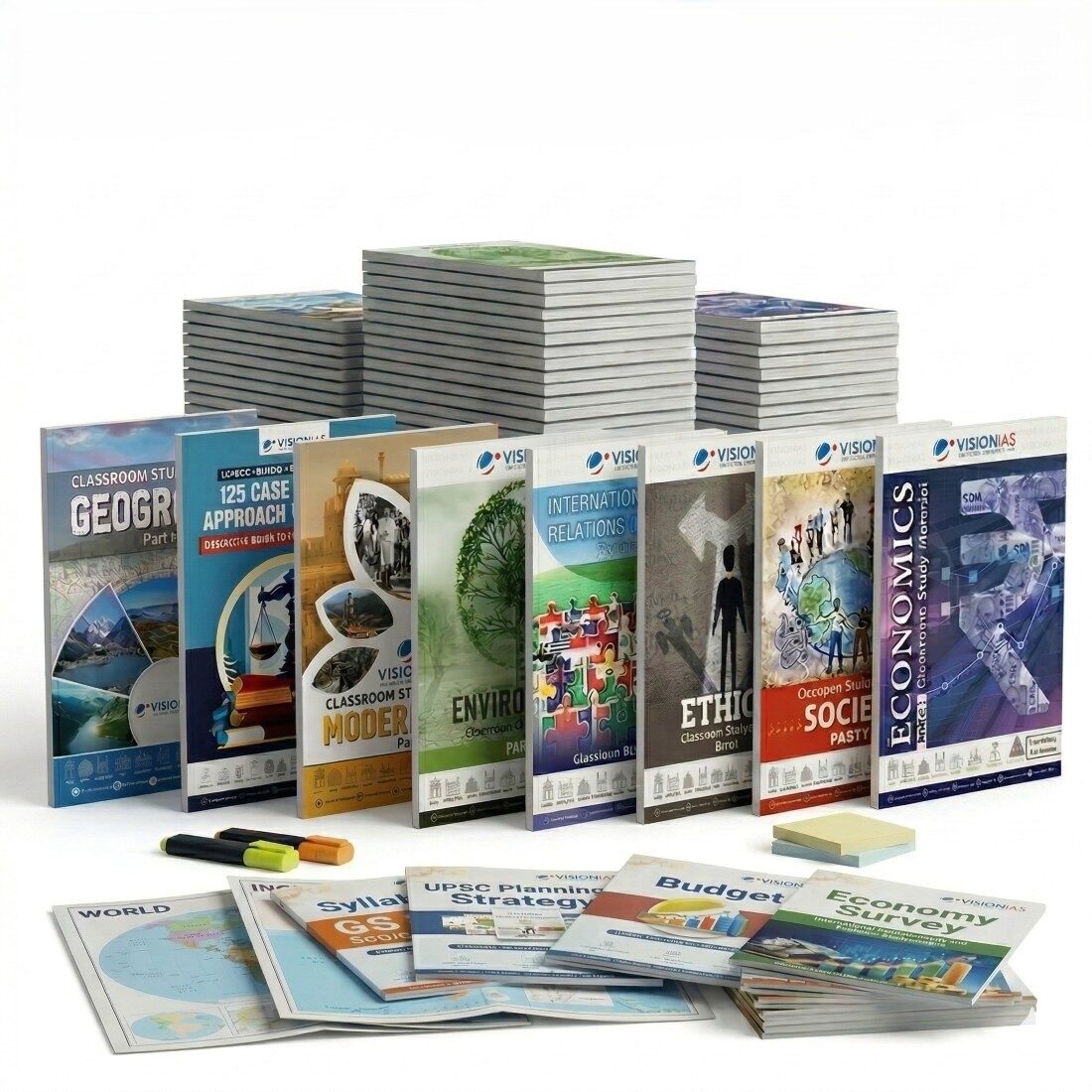
Because GS-I is so content-driven, a curated, topic-wise booklet set saves months of compiling. Aspirants who want one ready-made foundation often pick up a comprehensive set like the Vision IAS Complete GS Notes (Prelims + Mains), which carries dedicated culture, history, society and geography booklets aligned to exactly these headings.
UPSC Mains GS Paper 2 Syllabus (Governance, Constitution, Polity, Social Justice, IR)
The upsc mains gs paper 2 syllabus is the polity, governance and international relations paper. It is the most current-affairs-sensitive of the static GS papers because governance schemes, Supreme Court judgments and foreign-policy developments change every year. The official syllabus divides it into the following heads.
Constitution and Polity
Indian Constitution — historical underpinnings, evolution, features, amendments, significant provisions and basic structure. Functions and responsibilities of the Union and the States, issues and challenges pertaining to the federal structure, devolution of powers and finances up to local levels and challenges therein. Separation of powers between various organs, dispute redressal mechanisms and institutions. Comparison of the Indian constitutional scheme with that of other countries. Parliament and State legislatures — structure, functioning, conduct of business, powers and privileges and issues arising out of these. Structure, organisation and functioning of the Executive and the Judiciary; Ministries and Departments of the Government; pressure groups and formal/informal associations and their role in the polity.
Governance, Transparency and Accountability
Important aspects of governance, transparency and accountability, e-governance applications, models, successes, limitations and potential; citizens’ charters, transparency and accountability and institutional and other measures. Role of civil services in a democracy. Salient features of the Representation of People’s Act. Appointment to various Constitutional posts, powers, functions and responsibilities of various Constitutional Bodies. Statutory, regulatory and various quasi-judicial bodies.
Social Justice and Welfare
Government policies and interventions for development in various sectors and issues arising out of their design and implementation. Development processes and the development industry — the role of NGOs, SHGs, various groups and associations, donors, charities, institutional and other stakeholders. Welfare schemes for vulnerable sections of the population by the Centre and States and the performance of these schemes; mechanisms, laws, institutions and bodies constituted for the protection and betterment of these vulnerable sections. Issues relating to the development and management of Social Sector/Services relating to Health, Education and Human Resources. Issues relating to poverty and hunger.
International Relations
India and its neighbourhood relations. Bilateral, regional and global groupings and agreements involving India and/or affecting India’s interests. Effect of policies and politics of developed and developing countries on India’s interests; the Indian diaspora. Important International institutions, agencies and fora — their structure and mandate.
| GS-II Theme | What It Tests | Static Anchor |
|---|---|---|
| Constitution & Polity | Articles, amendments, basic structure, federalism | Laxmikanth + Polity booklet |
| Governance | RTI, e-governance, citizens’ charters, civil services | 2nd ARC reports + GS-II notes |
| Social Justice | Welfare schemes, health, education, vulnerable sections | Current affairs + government schemes compilation |
| International Relations | Neighbourhood, groupings, global institutions | IR booklet + monthly current affairs |
Because half of GS-II is dynamic, pairing a static polity booklet with a current-affairs magazine is the smart approach. A monthly compilation such as the Vision IAS Current Affairs Magazine keeps your governance, schemes and IR notes refreshed with the latest judgments and summits.
UPSC Mains GS Paper 3 Syllabus (Economy, Agriculture, Sci-Tech, Environment, Security)
The upsc mains gs paper 3 syllabus is the broadest of all GS papers, spanning the economy, agriculture, science and technology, environment, disaster management and internal security. It is the paper where current affairs and static concepts blend most tightly, so it rewards aspirants who connect newspaper developments to underlying concepts.
Economy and Agriculture
Indian Economy and issues relating to planning, mobilisation of resources, growth, development and employment. Inclusive growth and issues arising from it. Government Budgeting. Major crops and cropping patterns in various parts of the country; different types of irrigation and irrigation systems; storage, transport and marketing of agricultural produce and issues and related constraints; e-technology in the aid of farmers. Issues related to direct and indirect farm subsidies and minimum support prices; Public Distribution System — objectives, functioning, limitations, revamping; issues of buffer stocks and food security; technology missions; economics of animal-rearing. Food processing and related industries in India — scope and significance, location, upstream and downstream requirements, supply chain management. Land reforms in India.
Infrastructure, Science and Technology
Effects of liberalisation on the economy, changes in industrial policy and their effects on industrial growth. Infrastructure: Energy, Ports, Roads, Airports, Railways etc. Investment models. Science and Technology — developments and their applications and effects in everyday life. Achievements of Indians in science and technology; indigenisation of technology and developing new technology. Awareness in the fields of IT, Space, Computers, robotics, nano-technology, bio-technology and issues relating to intellectual property rights.
Environment, Disaster Management and Internal Security
Conservation, environmental pollution and degradation, environmental impact assessment. Disaster and disaster management. Linkages between development and spread of extremism. Role of external state and non-state actors in creating challenges to internal security. Challenges to internal security through communication networks, the role of media and social-networking sites in internal security challenges, basics of cyber-security; money-laundering and its prevention. Security challenges and their management in border areas; linkages of organised crime with terrorism. Various Security forces and agencies and their mandate.
| GS-III Segment | Nature | Recommended Coverage |
|---|---|---|
| Economy | Static + Dynamic | Economy booklet + Economic Survey + Budget |
| Agriculture | Mostly Static | GS-III agriculture notes + current schemes |
| Science & Tech | Dynamic | Current affairs S&T + ISRO/DRDO updates |
| Environment | Static + Dynamic | Environment booklet + Shankar IAS |
| Internal Security | Static + Dynamic | Security notes + current affairs |
For the economy core, a focused booklet such as the Vision IAS Economics Notes covers planning, budgeting, growth and inclusive-development concepts that recur in GS-III year after year, and pairs neatly with the Economic Survey for the dynamic part.
UPSC Mains GS Paper 4 Ethics Syllabus (Integrity, Aptitude + Case Studies)
The upsc mains gs paper 4 ethics syllabus is unique — it tests not what you know but how you think and decide. Officially titled “Ethics, Integrity and Aptitude,” GS-IV examines a candidate’s attitude and approach to issues relating to integrity, probity in public life, and the problem-solving approach to various conflicts faced in dealing with society. The paper is split into two halves: Section A is theory (around 130 marks) and Section B is case studies (around 120 marks).
What is the syllabus of GS Paper 4 (Ethics) in UPSC Mains?
The official topics are: Ethics and Human Interface — essence, determinants and consequences of Ethics in human actions; dimensions of ethics; ethics in private and public relationships; Human Values — lessons from the lives and teachings of great leaders, reformers and administrators; role of family, society and educational institutions in inculcating values. Attitude — content, structure, function; its influence and relation with thought and behaviour; moral and political attitudes; social influence and persuasion. Aptitude and foundational values for Civil Service — integrity, impartiality and non-partisanship, objectivity, dedication to public service, empathy, tolerance and compassion towards the weaker sections. Emotional Intelligence — concepts, and their utilities and application in administration and governance. Contributions of moral thinkers and philosophers from India and the world. Public/Civil Service Values and Ethics in Public Administration: status and problems; ethical concerns and dilemmas in government and private institutions; laws, rules, regulations and conscience as sources of ethical guidance; accountability and ethical governance; strengthening of ethical and moral values in governance; ethical issues in international relations and funding; corporate governance. Probity in Governance — concept of public service; philosophical basis of governance and probity; information sharing and transparency in government, Right to Information, Codes of Ethics, Codes of Conduct, Citizen’s Charters, Work culture, Quality of service delivery, utilisation of public funds, challenges of corruption. Finally, Case Studies on the above issues.
| GS-IV Section | Approx. Marks | Key Skill Tested |
|---|---|---|
| Section A – Theory | ~130 | Definitions, thinkers, keyword recall, examples |
| Section B – Case Studies | ~120 | Stakeholder analysis, options, ethical reasoning |
Ethics is the highest-scoring GS paper for well-prepared candidates because answers can be enriched with keywords, thinkers and real administrative examples. A compact, exam-ready resource like the Drishti IAS Ethics Notes gives you ready definitions, thinker quotations and case-study frameworks mapped to exactly the headings above, which is far faster than building an ethics file from scratch.
UPSC Mains Essay Paper Syllabus and Structure
The Essay paper (Paper I, 250 marks) carries no “syllabus” in the conventional sense. Candidates are required to write two essays, each of roughly 1,000-1,200 words, choosing one from each of two sections (Section A and Section B) that typically offer four topics apiece. Each essay carries 125 marks. Topics range from abstract philosophical themes (“Wisdom finds truth”) to socio-economic and governance issues (“Digital economy: a leveller or a source of economic inequality”).
UPSC explicitly instructs that essays must keep “closely to the subject of the essay, to arrange ideas in orderly fashion, and to write concisely. Credit will be given for effective and exact expression.” In other words, the Essay paper rewards structure, balance, coherent argumentation and clean language more than raw information. A strong essay has a hooking introduction, multi-dimensional body (social, economic, political, environmental, ethical, international angles), and a forward-looking conclusion.
Because the Essay paper overlaps heavily with GS content, dedicated practice plus a model-essay compilation pays off. The Vajiram Essay Notes provides essay frameworks, quotations and sample structures that help you organise abstract topics quickly under exam pressure.
UPSC Mains Optional Subject Syllabus List 2026
Every candidate must choose one optional subject, which is examined in two papers (Paper VI and Paper VII) of 250 marks each — 500 marks in total. The optional accounts for nearly 29% of the written merit total, so the choice is strategically crucial. The upsc mains optional subject syllabus list includes the following subjects.
Full List of Optional Subjects
| Category | Optional Subjects |
|---|---|
| Humanities | History, Geography, Political Science & International Relations (PSIR), Sociology, Public Administration, Psychology, Philosophy, Anthropology, Economics, Law, Management, Commerce & Accountancy |
| Languages & Literature | Literature of any one language: Assamese, Bengali, Bodo, Dogri, Gujarati, Hindi, Kannada, Kashmiri, Konkani, Maithili, Malayalam, Manipuri, Marathi, Nepali, Odia, Punjabi, Sanskrit, Santhali, Sindhi, Tamil, Telugu, Urdu, English |
| Sciences | Agriculture, Animal Husbandry & Veterinary Science, Botany, Chemistry, Physics, Mathematics, Statistics, Zoology, Geology, Medical Science |
| Engineering | Civil Engineering, Electrical Engineering, Mechanical Engineering |
Each optional has its own detailed two-paper syllabus prescribed by UPSC. Paper I and Paper II divide the subject into broad theory and applied/contemporary halves (the exact split varies by subject). For literature optionals, candidates may write in the language concerned or, where permitted, in English.
How to Choose Your Optional Subject
Use this simple decision aid. Pick an optional based on (1) genuine interest and aptitude, (2) overlap with GS to save time, (3) availability of quality material and guidance, (4) past results and scoring trends, and (5) length and stability of the syllabus. Subjects like PSIR, Sociology and Public Administration overlap significantly with GS-I and GS-II, which is why they are popular among generalists.
| Popular Optional | GS Overlap | Syllabus Length | Mapped Material |
|---|---|---|---|
| PSIR | High (GS-II, IR) | Medium | Shubhra Ranjan PSIR Notes |
| Sociology | Medium (GS-I Society) | Short-Medium | SS Pandey / Vikash Ranjan Sociology Notes |
| Public Administration | High (GS-II, IV) | Medium | Vajiram Public Administration Notes |
| Geography | High (GS-I, III) | Long | Geography Optional Notes |
| Economics | High (GS-III) | Long | Vajiram Economics Optional Notes |
Which optional subject has the shortest or easiest syllabus?
There is no universally “easiest” optional — difficulty is relative to your background. However, Sociology is widely regarded as having one of the shortest and most manageable syllabuses, with strong GS-I overlap and accessible material, which is why it consistently attracts engineers and non-humanities graduates. PSIR and Public Administration are also considered comparatively concise and high-overlap. “Easiest” should never override genuine interest, because you will spend 400-600 hours on the optional. Aspirants exploring this choice often start with a faculty-wise comparison and a ready booklet set such as SS Pandey Sociology Notes or the Shubhra Ranjan PSIR Notes before committing.
Qualifying Language Papers: English and Indian Language Syllabus
Papers A and B are qualifying. The Compulsory Indian Language paper (Paper A, 300 marks) and the English paper (Paper B, 300 marks) test your ability to read and understand serious discursive prose and to express ideas clearly in the respective language. Both follow a similar pattern.
| Component | Indian Language (Paper A) | English (Paper B) |
|---|---|---|
| Essay | ~100 marks | ~100 marks |
| Reading comprehension | ~60 marks | ~60 marks |
| Precis writing | ~60 marks | ~60 marks |
| Translation & grammar/usage | ~80 marks | ~80 marks |
You must score at least 25% (75/300) in each to qualify. Marks here do not count toward merit, but failing either paper means your GS and Optional answer scripts are not even evaluated — a heartbreak that ends several campaigns each year. A few weeks of targeted practice in the final months is enough for most candidates.
Is the UPSC Prelims and Mains Syllabus the Same?
No — but they overlap heavily, and exploiting that overlap is the single biggest efficiency hack in UPSC preparation. Prelims is objective (two papers: GS Paper 1 and CSAT) and only screens you for Mains; its marks are not added to the final total. Mains is descriptive and decides your rank. The subjects (polity, economy, history, geography, environment, science-tech, current affairs) are shared, but the depth and the skill tested differ sharply.
| Dimension | UPSC Prelims | UPSC Mains |
|---|---|---|
| Format | Objective (MCQ) | Descriptive (written) |
| Papers | 2 (GS + CSAT) | 9 (Essay, GS I-IV, 2 Optional, 2 language) |
| Counts for merit? | No (screening only) | Yes |
| Skill tested | Recognition, elimination, facts | Analysis, structure, expression |
| Depth | Broad and factual | Deep and analytical |
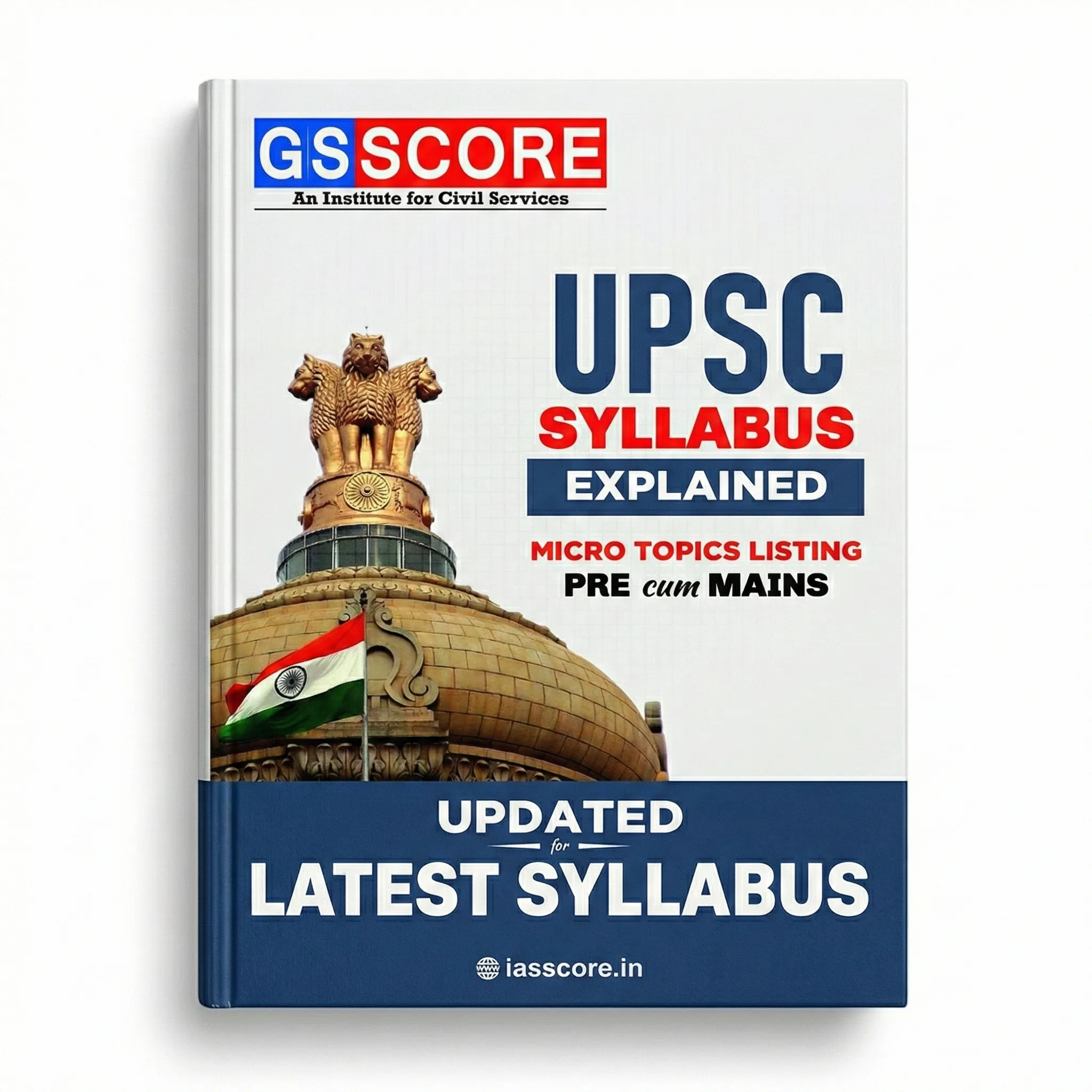
The practical takeaway: study once for both. When you read polity or economy, build factual recall for Prelims and answer-writing depth for Mains simultaneously. This is exactly why integrated Prelims + Mains booklet sets, like the comprehensive Vision IAS Prelims + Mains GS Notes, are popular — one source serves both stages. For a clean reference that lays out the official Prelims and Mains syllabus side by side, the GS Score Latest Syllabus Booklet is handy.
How to Analyse and Cover the UPSC Mains Syllabus
Owning the syllabus is not the same as covering it. Toppers do three things differently. First, they deconstruct every keyword — they break a one-line topic like “effects of globalisation on Indian society” into sub-themes and map each to notes, current affairs and previous-year questions. Second, they practise answer writing against the syllabus, not just reading, because Mains is a writing exam. Third, they track and revise using a syllabus checklist so nothing is missed in the final month.
Trend and Weightage Analysis
An often-ignored edge is mapping how many marks each section attracts. Over recent years, GS-II and GS-III have leaned heavily on current affairs, GS-I art-culture and history remain static high-yield zones, and GS-IV ethics rewards keyword-rich, example-backed answers. Reading the previous-year papers alongside the syllabus reveals these patterns. A topic-wise PYQ resource such as the Forum IAS PYQ Toolkit helps you see which sub-topics repeat, so you can prioritise high-frequency areas.
How long does it take to complete the UPSC Mains syllabus?
For a first-time aspirant studying full-time, building a base across all GS papers, the Essay and one Optional typically takes 12-18 months, including at least two full revisions and consistent answer-writing practice. Working professionals usually need 18-24 months at 4-5 focused hours a day. The static portion can be covered in 6-8 months; the rest of the time goes into current affairs, optional depth, revision and — most importantly — answer writing under timed conditions.
Answer Writing, PYQs and Mock Tests
You cannot “finish” the Mains syllabus without writing answers. Begin answer-writing early, ideally alongside each section you complete, and join a Mains test series to simulate the 3-hour, ~20-question reality. A structured programme like the Vision IAS Mains Test Series gives you sectional and full-length tests with model answers, which is the fastest way to convert syllabus knowledge into marks.
Topic-Wise Syllabus-to-Material Map (Competer Checklist)
This is the gap most syllabus pages leave open: they list topics but never tell you which material covers each one. Use this quick map as your buying-and-tracking checklist. Print the PDF below, tick each topic as you finish it, and revise from the mapped resource.
| Paper | Core Topics | Suggested Material |
|---|---|---|
| GS-I | Art-culture, history, geography, society | Vision/Drishti GS booklets + NCERTs |
| GS-II | Polity, governance, social justice, IR | Polity booklet + current affairs magazine |
| GS-III | Economy, agriculture, S&T, environment, security | Economy + environment booklets + survey |
| GS-IV | Ethics, integrity, aptitude, case studies | Dedicated Ethics notes |
| Essay | Abstract + current themes | Essay notes + answer practice |
| Optional | Subject-specific two papers | Faculty-wise optional notes |
Aspirants who want a single, comprehensive foundation across all four GS papers (mapped to these exact headings) most often choose a complete set such as the Vajiram GS Notes (27 booklets) or the Vision IAS Complete GS Notes, then add an optional booklet set and a current-affairs magazine on top.
UPSC Mains Syllabus PDF Download (Free 2026)
You can get the official, clean upsc mains syllabus pdf download directly from the UPSC website inside the annual Civil Services Examination notification (the syllabus appears in the appendix/Section II of the notification). Because coaching sites often gate the clean PDF behind sign-ups, the simplest free route is to download the official UPSC notification PDF and extract the Mains section, or use a single-page printable compilation that puts all nine papers on one document with a tick-box checklist.
For an exam-ready, latest-pattern printed reference that you can mark up and revise from without screens, the GS Score Latest Syllabus Booklet 2026-27 compiles the complete official Prelims and Mains syllabus in one place — a clean, printable alternative to juggling PDFs. Pair it with the topic-tracking checklist above and you have a ready revision tracker tied to every syllabus line.
| What You Need | Where to Get It Free / Printable |
|---|---|
| Official Mains syllabus (all 9 papers) | UPSC CSE notification PDF (Appendix-II) |
| Optional subject syllabus | UPSC notification, subject-wise annexure |
| Single-page printable syllabus + checklist | GS Score syllabus booklet / Competer compilation |
| Previous-year question papers | UPSC website + PYQ toolkit |
Personality Test (Interview) Overview
After clearing the written Mains, qualified candidates are called for the Personality Test, worth 275 marks. There is no fixed syllabus. The board assesses mental and social traits — clarity of expression, balance of judgement, depth and variety of interests, social cohesion, leadership and intellectual integrity. Questions draw on your Detailed Application Form (DAF): your background, graduation subject, hobbies, home state, work experience and current affairs. The interview, added to the 1,750 written marks, produces the final 2,025-mark merit total from which the rank list and service allocation are decided.
Common Mistakes Aspirants Make With the Mains Syllabus
First, treating the syllabus as a one-time read instead of a daily checklist — the single biggest reason for unbalanced preparation. Second, ignoring the qualifying language papers until it is too late. Third, choosing an optional by hearsay rather than by interest, overlap and material availability. Fourth, over-collecting material and under-writing answers; Mains rewards the pen, not the highlighter. Fifth, neglecting current affairs integration in GS-II and GS-III. Sixth, postponing the Essay and Ethics papers as “easy” when they are often the difference between a rank and a miss. Anchor your entire preparation to the official syllabus, map every topic to one trusted source, write regularly, and revise on a schedule — that is the whole game.
Frequently Asked Questions
What is the syllabus for UPSC Mains?
The UPSC Mains syllabus spans 9 descriptive papers: an Essay paper; four General Studies papers — GS I (history, geography, art-culture, society), GS II (polity, governance, social justice, international relations), GS III (economy, agriculture, science-technology, environment, internal security) and GS IV (ethics, integrity and aptitude); two Optional subject papers; and two qualifying language papers (one Indian language and English). The official topic heads are listed in Appendix-II of the UPSC Civil Services Examination notification.
How many papers are there in UPSC Mains and which ones count for merit?
UPSC Mains has 9 papers in total: two qualifying language papers (Indian language and English, 300 marks each) and seven merit papers — Essay, General Studies I-IV and two Optional papers, each worth 250 marks. Only the seven merit papers (1,750 marks) count toward the final ranking; the two language papers are merely qualifying with a 25% minimum.
How many total marks is the UPSC Mains exam and the interview?
The seven merit papers total 1,750 marks. Adding the Personality Test (interview) of 275 marks gives a grand total of 2,025 marks, on which the final merit list is prepared. The two qualifying language papers (300 marks each) do not add to this total.
Is the UPSC Prelims and Mains syllabus the same?
No. They share subjects like polity, economy, history, geography and current affairs, but Prelims is objective and only screens candidates, while Mains is descriptive and decides your rank. Mains demands far greater depth, analysis and answer-writing skill, although the heavy overlap lets aspirants study both stages from a single integrated source.
What is the syllabus of GS Paper 4 (Ethics) in UPSC Mains?
GS Paper 4 covers Ethics and Human Interface, Human Values, Attitude, Aptitude and foundational values for civil service, Emotional Intelligence, contributions of moral thinkers, public/civil-service values, ethics in public administration, probity in governance, and case studies. The 250-mark paper has a theory section (~130 marks) and a case-study section (~120 marks).
Can I download the UPSC Mains syllabus PDF for free?
Yes. The official upsc mains syllabus pdf download is available free inside the UPSC Civil Services Examination notification (Appendix-II) on upsc.gov.in. For a clean, single-document printable version with all nine papers, you can also use a compiled syllabus booklet rather than juggling the full notification PDF.
Which optional subject has the shortest or easiest syllabus for UPSC Mains?
Sociology is widely regarded as having one of the shortest, most accessible syllabuses with good GS-I overlap, which is why many engineers and science graduates pick it. PSIR and Public Administration are also comparatively concise and high-overlap. However, no optional is universally “easiest” — choose based on genuine interest, aptitude and material availability, since you will spend hundreds of hours on it.
How long does it take to complete the UPSC Mains syllabus?
A full-time first-time aspirant usually needs 12-18 months to build a base across all GS papers, the Essay and one Optional, including two revisions and regular answer writing. Working professionals typically need 18-24 months at 4-5 focused hours a day. The static portion can be covered in 6-8 months; the remaining time goes into current affairs, optional depth, revision and timed answer-writing practice.
Recommended Study Material
Continue Reading
Best Study Material for UPSC 2026: Subject-Wise Buying Guide
The best study material for UPSC is a four-layer stack: NCERT textbooks (Class 6–12), one standard reference book…
Best Current Affairs Magazine for UPSC 2026: Ranked, Priced & Compared
The best current affairs magazine for UPSC in 2026 is the Vision IAS Monthly Current Affairs Magazine —…
CGPSC Syllabus 2025: Prelims, Mains, Exam Pattern + PDF Download
The CGPSC syllabus for the Chhattisgarh State Service Examination (SSE) spans three stages: Prelims — two objective papers…