UPSC Syllabus 2026: Prelims, Mains, Optional + PDF
Complete UPSC syllabus 2026 — topic-wise Prelims (GS + CSAT), Mains GS I–IV, Essay, optional subjects, exam pattern, weightage and a free PDF download.

The UPSC syllabus for the Civil Services Examination (CSE) is divided into three stages: the Preliminary Examination (2 objective papers, 400 marks, screening only), the Main Examination (9 descriptive papers, 1750 marks counted for merit) and the Personality Test/Interview (275 marks). Together the merit-deciding portion carries 2025 marks (1750 Mains + 275 Interview), while Prelims marks are used only to qualify for Mains and are not added to the final rank.
Across these stages you study roughly a dozen broad subjects — history, geography, polity and governance, economy, environment, science & technology, current affairs, ethics, and one optional subject of your choice — plus CSAT aptitude and two language papers. This guide lays out the official UPSC syllabus 2026 topic-by-topic for every paper, maps each portion to the exact study material that covers it, shows previous-year weightage so you know what is high-yield, and gives you a printable tracker plus a free PDF download link. The structure follows the official CSE notification published by UPSC each February; use this page as the single blueprint for your whole preparation.
UPSC Syllabus 2026: The Three Stages at a Glance
The Union Public Service Commission conducts CSE in three sequential stages. You must clear each to reach the next, but only Mains and Interview marks decide your final rank. Understanding this structure is the first step to decoding the upsc syllabus 2026.
| Stage | Purpose | Papers | Total Marks | Counted for Merit? |
|---|---|---|---|---|
| Prelims (CSE-P) | Screening test | 2 (GS + CSAT) | 400 | No — qualifying only |
| Mains (CSE-M) | Written selection | 9 (7 counted + 2 qualifying) | 1750 | Yes |
| Personality Test | Interview | — | 275 | Yes |
| Final Merit | Rank | — | 2025 | Mains + Interview |
The Prelims-to-Mains funnel is steep: roughly 12-13 times the number of vacancies clear Prelims, and about 2-2.5 times clear Mains to be called for the Interview. That is why the strategy for each stage differs even though the underlying subjects overlap heavily.
UPSC Exam Pattern 2026: Papers, Marks & Marking
Before the topic lists, fix the exam pattern in your head. It tells you how much time and negative-marking risk each paper carries.
| Paper | Type | Marks | Duration | Negative Marking |
|---|---|---|---|---|
| Prelims GS Paper I | Objective (100 Q) | 200 | 2 hours | 1/3 per wrong answer |
| Prelims GS Paper II (CSAT) | Objective (80 Q) | 200 | 2 hours | 1/3 per wrong answer (33% qualifying) |
| Mains Paper A — Indian Language | Descriptive | 300 | 3 hours | Qualifying (25%) |
| Mains Paper B — English | Descriptive | 300 | 3 hours | Qualifying (25%) |
| Essay | Descriptive | 250 | 3 hours | Counted |
| GS Paper I-IV | Descriptive | 250 each (1000) | 3 hours each | Counted |
| Optional Paper I & II | Descriptive | 250 each (500) | 3 hours each | Counted |
| Personality Test | Interview | 275 | — | — |
Two things trip up beginners. First, the two language papers (Paper A and Paper B) are qualifying — you need 25% but the marks are never added to your total. Second, CSAT is also qualifying (33%), yet failing it means your GS Paper I is not even evaluated, so it cannot be ignored.
UPSC Prelims Syllabus 2026: GS Paper I
The upsc prelims syllabus for General Studies Paper I is the broadest static-plus-dynamic net in the entire exam. The official UPSC notification lists seven areas. Here is the topic-wise breakdown with indicative weightage based on recent papers.
| Subject | Key Topics | Approx. Weightage (100 Q) |
|---|---|---|
| Current Affairs | National & international events of significance | 15-20 |
| History | Ancient, Medieval, Modern India, Freedom Struggle, Art & Culture | 15-18 |
| Geography | Physical, Indian & World Geography, mapping | 10-15 |
| Polity & Governance | Constitution, political system, Panchayati Raj, rights issues | 15-18 |
| Economy | Sustainable development, poverty, inclusion, demographics, budgeting | 15-18 |
| Environment & Ecology | Biodiversity, climate change, conservation (no specialisation needed) | 12-15 |
| Science & Technology | General science, everyday applications, recent developments | 8-12 |
The single biggest shift in recent Prelims is that Environment and Economy now rival Polity and History. Environment is almost fully current-affairs driven, which is why a monthly magazine such as the Vision IAS Current Affairs Magazine (January 2026) pays off directly in the objective paper, not just Mains. To drill topic-wise trends, the Forum IAS Prelims Toolkit with topic-wise PYQ (1992-2025) lets you see exactly which sub-topics repeat.
UPSC CSAT Syllabus 2026: GS Paper II
The upsc csat syllabus (Civil Services Aptitude Test) is Prelims Paper II. It is qualifying at 33% (66 of 200 marks), but the rise in difficulty since 2023 has made it a genuine hurdle, not a formality. It has 80 questions and carries 1/3 negative marking.
| CSAT Component | What It Tests |
|---|---|
| Comprehension | English passages — inference, tone, main idea |
| Interpersonal & Communication Skills | Situation-based judgement (via passages) |
| Logical Reasoning & Analytical Ability | Syllogisms, statements-conclusions, arrangements |
| Decision Making & Problem Solving | Ethical/administrative scenarios (no negative marking on these) |
| General Mental Ability | Series, coding-decoding, blood relations, directions |
| Basic Numeracy (Class X level) | Numbers, percentages, ratio, time-work, averages |
| Data Interpretation | Tables, charts, graphs, sufficiency |
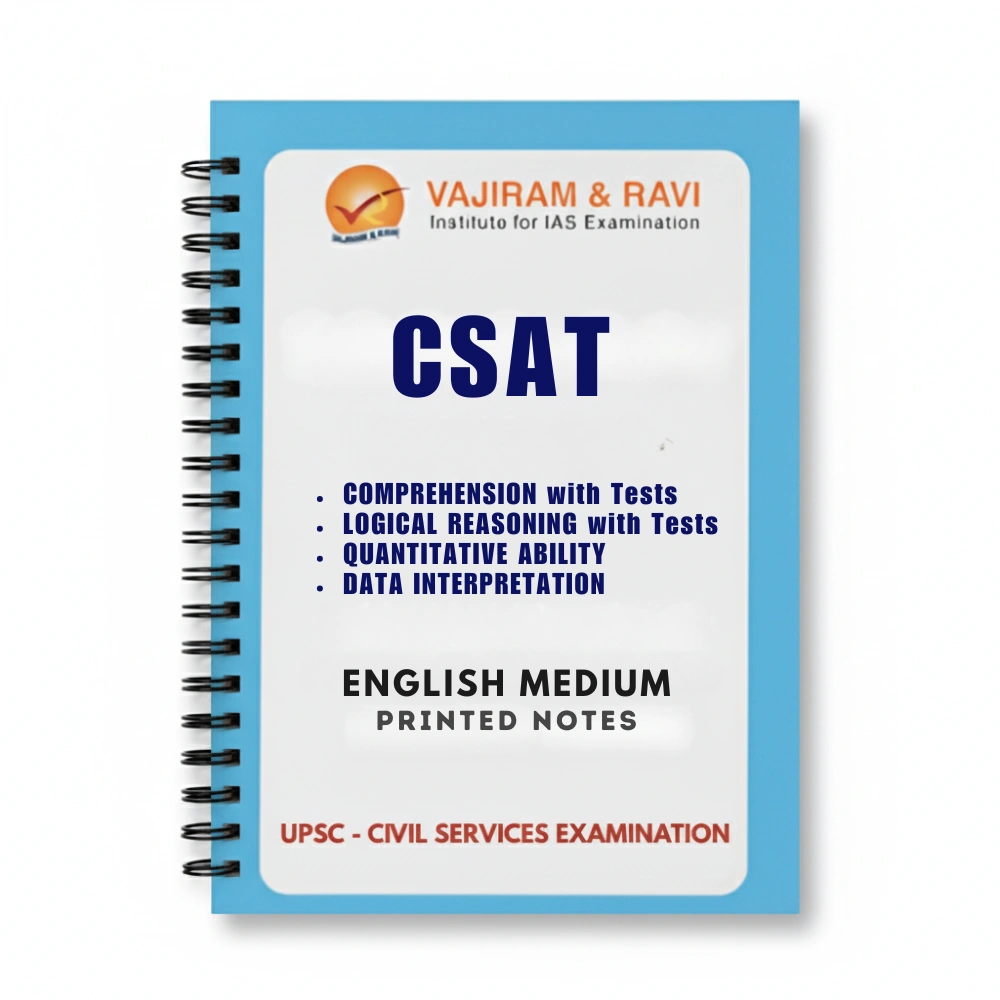
Non-mathematics graduates who neglect CSAT are the most common failure story of the last two cycles. A dedicated resource like the Vajiram CSAT Complete Booklet Set with practice questions plus timed mock tests is the safest way to lock in the 33% and protect your GS Paper I from going unevaluated.
UPSC Mains Syllabus 2026: The 9 Papers
The upsc mains syllabus is where selection actually happens. There are nine papers: two qualifying language papers, one Essay, four General Studies papers, and two optional papers. Here is how the 1750 counted marks split.
| Paper | Subject | Marks | Nature |
|---|---|---|---|
| Paper A | Compulsory Indian Language | 300 | Qualifying |
| Paper B | English | 300 | Qualifying |
| Paper I | Essay | 250 | Merit |
| Paper II | GS I — Heritage, History, Geography, Society | 250 | Merit |
| Paper III | GS II — Polity, Governance, IR | 250 | Merit |
| Paper IV | GS III — Economy, Tech, Environment, Security | 250 | Merit |
| Paper V | GS IV — Ethics, Integrity, Aptitude | 250 | Merit |
| Paper VI & VII | Optional Subject (Paper I & II) | 500 | Merit |
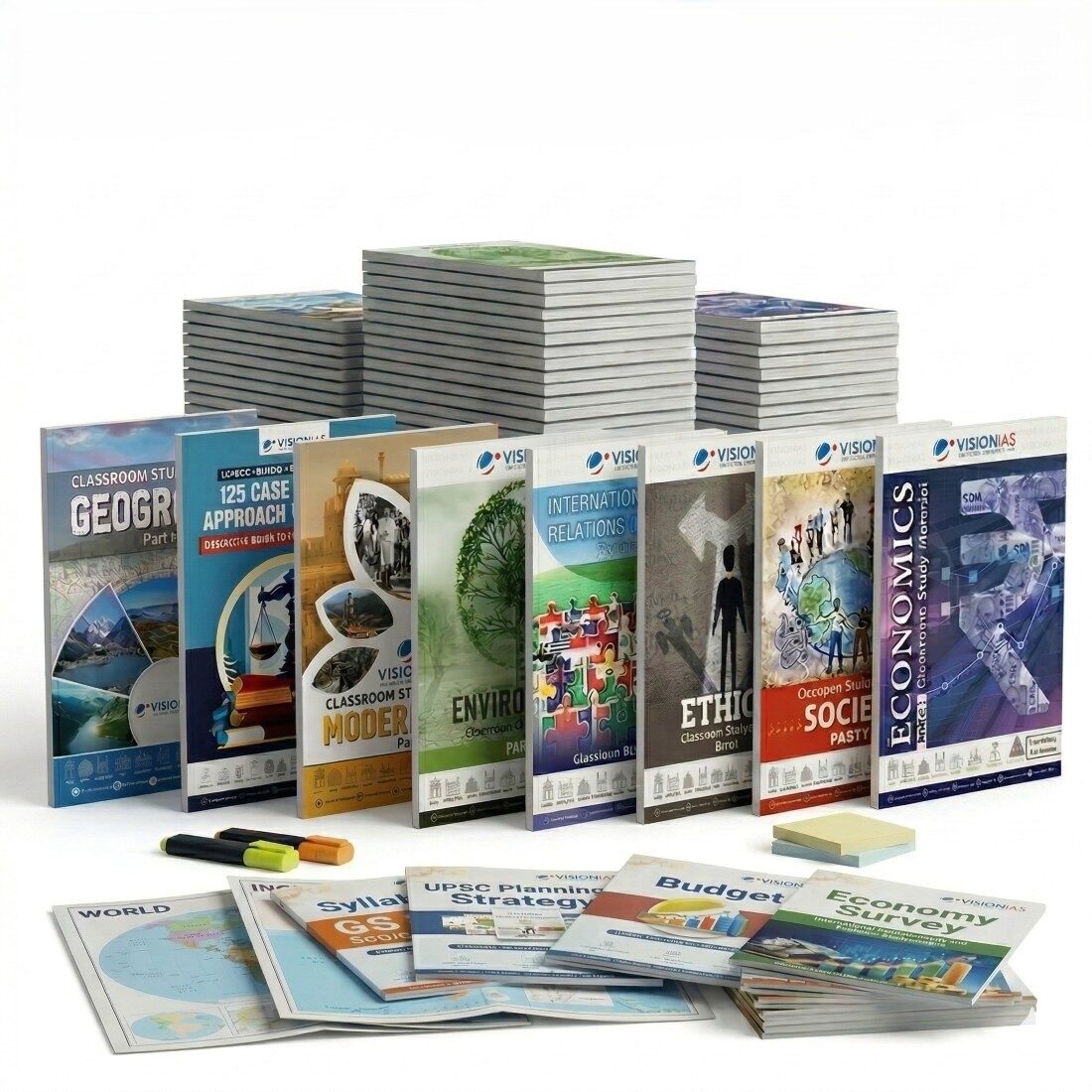
A full GS foundation is unavoidable here, and it is where a consolidated printed set saves months of scattered note-making. The Vision IAS Complete GS Notes (Prelims + Mains, 57 booklets) maps to almost every GS Mains sub-topic below, which is why it is the workhorse resource for most aspirants.
GS Paper I — Indian Heritage, History, Geography & Society
- Indian culture — art forms, literature and architecture from ancient to modern times.
- Modern Indian history from mid-18th century — significant events, personalities, issues.
- The Freedom Struggle — its stages and important contributors from different parts of the country.
- Post-independence consolidation and reorganisation within the country.
- History of the world — 18th century events (industrial revolution, world wars, colonisation, decolonisation), political philosophies like communism, capitalism, socialism.
- Salient features of Indian society, diversity, role of women, population, poverty, urbanisation.
- Effects of globalisation on Indian society; social empowerment, communalism, regionalism, secularism.
- Physical geography of the world; distribution of natural resources; factors for industrial location.
- Geophysical phenomena — earthquakes, tsunamis, cyclones; changes in critical geographical features.
GS Paper II — Governance, Constitution, Polity, Social Justice & IR
- Indian Constitution — historical underpinnings, evolution, features, amendments, basic structure.
- Functions and responsibilities of the Union and States; federal structure; devolution to local levels.
- Separation of powers; dispute redressal; comparison with other countries’ constitutions.
- Parliament and State legislatures — structure, functioning, powers, privileges, issues.
- Executive and judiciary — ministries, pressure groups, judicial appointments.
- Representation of People’s Act; constitutional and non-constitutional bodies (statutory, regulatory, quasi-judicial).
- Government policies for development; issues in social sector — health, education, human resources.
- Governance, transparency, accountability, e-governance, citizens’ charters, role of civil services.
- India and its neighbourhood; bilateral, regional and global groupings; effect of policies of developed and developing countries; international institutions.
GS Paper III — Economy, Technology, Environment, Security & Disaster Management
- Indian economy — planning, resource mobilisation, growth, development, employment.
- Inclusive growth, government budgeting; land reforms; effects of liberalisation.
- Infrastructure — energy, ports, roads, airports, railways; investment models.
- Agriculture — MSP, PDS, subsidies, cropping patterns, storage, transport, e-technology for farmers.
- Food processing, animal rearing economics; science and technology developments and their applications.
- Awareness in IT, space, computers, robotics, nano-tech, biotech and IPR issues.
- Conservation, environmental pollution and degradation, environmental impact assessment.
- Disaster and disaster management; linkages between development and spread of extremism.
- Internal security — role of external state and non-state actors, cyber security, money-laundering, border management, security forces and agencies.
GS Paper IV — Ethics, Integrity & Aptitude
GS IV is the most scoring GS paper because the syllabus is short and the content is stable. It tests attitude and approach through theory plus case studies.
- Ethics and human interface — essence, determinants and consequences; dimensions; human values; role of family, society and educational institutions.
- Attitude — content, structure, function; moral and political attitudes; social influence and persuasion.
- Aptitude and foundational values for civil service — integrity, impartiality, non-partisanship, objectivity, dedication, empathy, tolerance and compassion.
- Emotional intelligence — concepts, utilities and application in administration and governance.
- Contributions of moral thinkers and philosophers from India and the world.
- Public/civil service values and ethics in public administration; corruption; codes of ethics and conduct.
- Probity in governance — RTI, work culture, service delivery, challenges of corruption.
- Case studies on the above issues (usually 6 cases, ~120 marks).
Because the theory half repeats heavily, a compact set like the Drishti IAS Ethics Notes (GS Paper IV) is enough to build a quotation bank and case-study framework, saving you from over-reading this paper.
UPSC Optional Subjects List 2026 & How to Choose
Every candidate picks one optional subject with two papers (Paper I and Paper II, 250 marks each). UPSC offers 48 optionals — 25 literature subjects plus 23 core subjects. Getting the upsc cse syllabus optional subjects choice right influences 500 merit marks and a big chunk of your study time.
| Category | Popular Optionals |
|---|---|
| Humanities | PSIR, Sociology, Geography, History, Public Administration, Philosophy, Anthropology |
| Sciences | Zoology, Chemistry, Physics, Mathematics, Botany, Geology, Statistics |
| Commerce & Management | Commerce & Accountancy, Management, Economics |
| Engineering & Medical | Civil, Mechanical, Electrical Engineering, Medical Science |
| Literature (any listed language) | Hindi, English, Tamil, Telugu, Urdu, Sanskrit + 19 more |
Use a four-factor decision framework rather than following the crowd:
- GS overlap: PSIR overlaps GS II and Essay; Sociology overlaps GS I and II; Geography overlaps GS I and III. Overlap effectively doubles your study return.
- Scoring trend: Check the last three years’ toppers’ optionals; consistency matters more than one high scorer.
- Material & guidance availability: An optional with no reliable notes is a silent risk.
- Your background and interest: You will spend 300-400 hours here — sustained interest keeps you going.
If you lean toward the most popular pick, PSIR, a structured set such as the Shubhra Ranjan PSIR Notes 2026 covers both papers and leverages the GS II overlap. Sociology and Geography aspirants have similarly complete printed sets, so material availability should rarely be your bottleneck.
Essay & Qualifying Language Papers
The Essay paper (250 marks) requires two essays of ~1000-1200 words each from separate sections, spanning philosophical, social, economic and political themes. Marks here swing final ranks sharply because scoring is holistic — structure, balance and substantiation matter as much as content. A ready framework and fodder bank, like the Vajiram Essay Notes, shortens the runway considerably.
Papers A and B (Indian Language and English, 300 each) test class 10-12 level comprehension, précis, translation, grammar and short composition. They are qualifying at 25% — you only need to pass — but a fail here disqualifies you regardless of how well you did in GS. Devote a few weeks of practice, not months.
Personality Test (Interview): 275 Marks, No Fixed Syllabus
The Interview carries 275 marks and has no prescribed syllabus. The board assesses mental alertness, critical assimilation, clarity of judgement, balance, depth of interest, leadership and intellectual integrity. Questions draw from your Detailed Application Form (DAF) — home state, education, hobbies, service preference — plus current affairs. Since it typically spreads around 40% of maximum marks, the Interview is a decisive rank-mover, so DAF-based mock interviews and daily news reading are the preparation, not any book.
How to Decode the UPSC Syllabus for Preparation
Toppers repeat one line: the syllabus is the syllabus. Every question, static or dynamic, traces back to a keyword in the official document. Here is how to convert that document into a study plan.
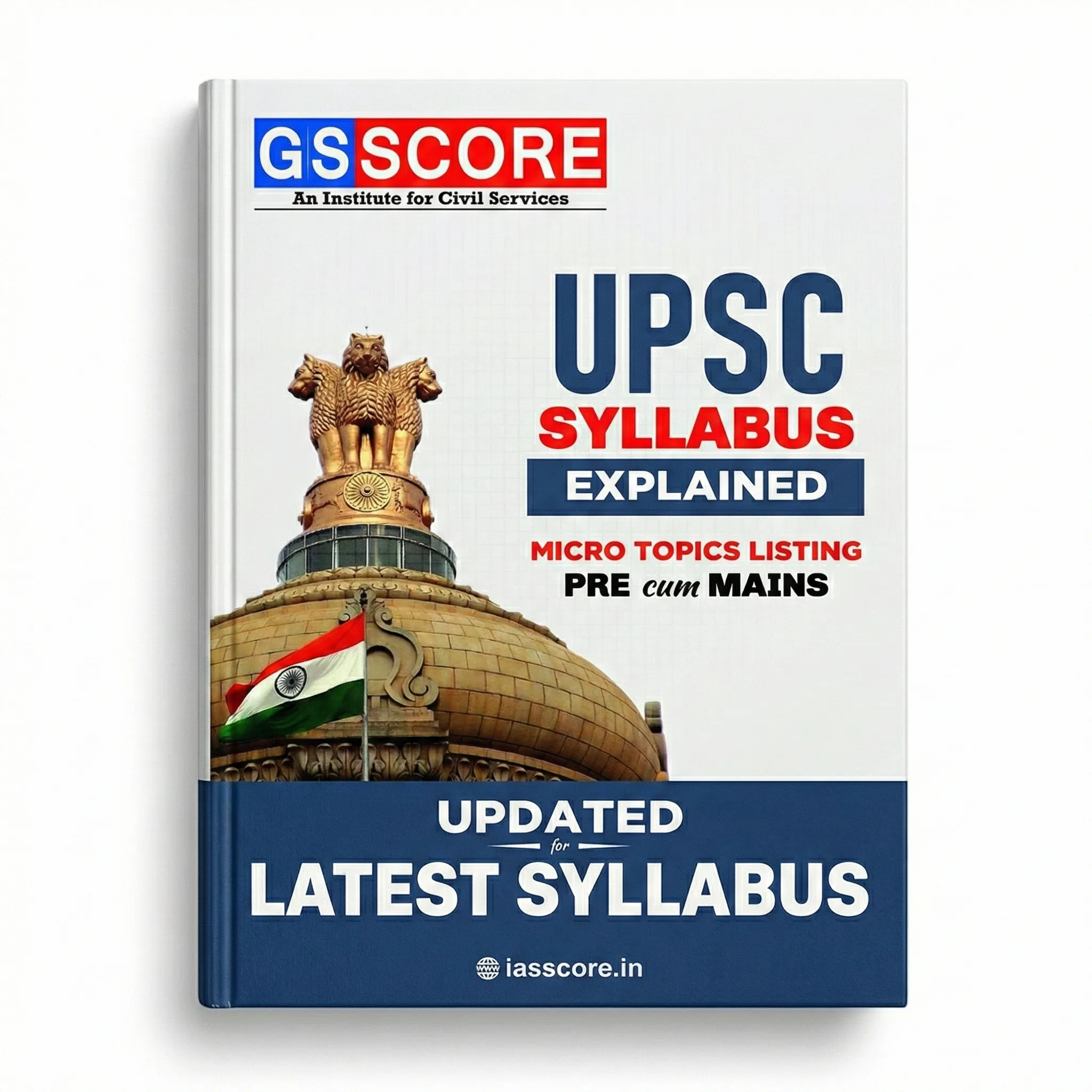
- Print the official syllabus and keep it on your desk. Before reading any resource, find where that topic sits in the syllabus. A clean printed copy such as the GS Score Latest Syllabus Booklet 2026-27 works as your master index.
- Map static vs dynamic. History, Polity theory, Geography basics are static — finish once, revise often. Economy, Environment, S&T, IR are dynamic — pair every static topic with current affairs.
- Link current affairs to syllabus keywords. When you read news, tag it to a GS paper heading (e.g. a new tribunal to “quasi-judicial bodies”, GS II). This is the current-affairs-to-syllabus linkage most aspirants miss.
- Solve PYQs topic-wise before studying, not after. They reveal depth and the high-yield vs rarely-asked split.
- Revise 3+ times. Coverage without revision is the single biggest reason for repeat attempts.
Printable UPSC Syllabus Tracker (Tick-Box)
Copy this into a sheet and tick each cell as you finish reading, make notes, and complete first revision.
| Paper / Subject | Read | Notes Made | Revised 1 | PYQ Solved |
|---|---|---|---|---|
| GS I — History | ☐ | ☐ | ☐ | ☐ |
| GS I — Geography | ☐ | ☐ | ☐ | ☐ |
| GS II — Polity & Governance | ☐ | ☐ | ☐ | ☐ |
| GS II — International Relations | ☐ | ☐ | ☐ | ☐ |
| GS III — Economy | ☐ | ☐ | ☐ | ☐ |
| GS III — Environment & Security | ☐ | ☐ | ☐ | ☐ |
| GS IV — Ethics | ☐ | ☐ | ☐ | ☐ |
| CSAT — Reasoning & Numeracy | ☐ | ☐ | ☐ | ☐ |
| Optional — Paper I & II | ☐ | ☐ | ☐ | ☐ |
| Essay & Current Affairs | ☐ | ☐ | ☐ | ☐ |
Syllabus Overlap with State PSC & CAPF
A major hidden advantage of mastering the UPSC syllabus is that it doubles as preparation for allied exams. State PSCs (BPSC, UPPCS, MPPSC, etc.) and CAPF (AC) borrow heavily from the same GS foundation, so your notes travel across exams.
| Exam | Overlap with UPSC GS | Key Difference |
|---|---|---|
| State PSC (e.g. BPSC, UPPCS) | High — Polity, Economy, History, Geography common | Adds state-specific history, geography & current affairs |
| CAPF Assistant Commandant | Moderate — GS Paper I mirrors UPSC GS static areas | Paper II is essay + comprehension; physical & medical tests |
| UGC NET (some subjects) | Partial — for optional-related subjects | Research-methodology and teaching-aptitude focus |
This is why building strong core GS notes once is more efficient than chasing exam-specific crash material — the same base serves CSE, state services and CAPF with only a state/current-affairs top-up.
IAS Syllabus PDF Download
For offline planning you can download the complete ias syllabus pdf covering both Prelims and Mains directly from UPSC’s official notification at upsc.gov.in (the CSE notification released each February carries the full annexed syllabus, and it is the authoritative source you should verify against). If you prefer a clean, print-ready booklet you can annotate and carry, the GS Score Latest Syllabus Booklet 2026-27 reproduces the entire official syllabus in one place — handy as the desk reference described in the decoding section above.
Can You Finish the UPSC Syllabus in One Year?
Yes — thousands do it, but only with disciplined sequencing. A realistic one-year timeline looks like this:
| Phase | Duration | Focus |
|---|---|---|
| Foundation | Months 1-5 | NCERTs + standard GS + optional Paper I |
| Consolidation | Months 6-8 | Complete GS + optional Paper II + daily current affairs |
| Prelims Sprint | Months 9-10 | Revision + CSAT + full-length Prelims mocks |
| Mains Focus | Post-Prelims (2.5-3 months) | Answer writing, Essay, GS + optional mains mocks |
The one-year plan is feasible only if you start answer-writing early and treat mock tests as learning tools, not scorecards. Aspirants with a working job or a weak optional usually need 14-18 months, and there is no shame in that — a well-prepared second attempt beats a rushed first one.
Frequently Asked Questions
What is the UPSC syllabus for 2026?
The UPSC syllabus 2026 covers three stages: Prelims (GS Paper I on history, geography, polity, economy, environment, science and current affairs, plus CSAT), Mains (Essay, four GS papers, two language papers and one optional subject with two papers), and the Interview. It is unchanged in structure from previous years and follows the official CSE notification.
Is the UPSC Prelims and Mains syllabus the same?
No. The subjects overlap — both cover history, polity, geography, economy and environment — but Prelims is objective and factual across two papers, while Mains is descriptive across nine papers with far greater analytical depth, plus Ethics, Essay and an optional subject that do not appear in Prelims.
How many subjects are there in the UPSC syllabus?
Broadly there are around a dozen core subjects: history, geography, Indian polity and governance, economy, environment and ecology, science and technology, current affairs and CSAT aptitude at Prelims level, then ethics, the essay and one optional subject at Mains level, along with two qualifying language papers. In exam terms this maps to 2 Prelims papers and 9 Mains papers.
Is CSAT counted in the Prelims cut-off?
No. CSAT (Prelims Paper II) is only qualifying — you must score at least 33% (66/200). It is not added to the Prelims cut-off, which is decided solely by your GS Paper I score. However, failing CSAT means GS Paper I is not evaluated, so you must clear it.
Are Prelims marks added to the final UPSC rank?
No. Prelims is only a screening stage. Once you qualify, your Prelims marks are discarded. The final merit is calculated from Mains (1750) and the Personality Test (275), totalling 2025 marks.
How many optional subjects do I have to choose in UPSC Mains?
You choose exactly one optional subject, which has two papers (Paper I and Paper II) of 250 marks each, totalling 500 marks. UPSC offers 48 optional subjects, including 25 literature options, and you select based on GS overlap, scoring trend, material availability and your own interest.
What is the total marks of the UPSC Civil Services Exam?
The merit-deciding total is 2025 marks — 1750 for Mains plus 275 for the Interview. Prelims (400 marks) and the two qualifying language papers (600 marks) do not count toward the final rank.
Can I complete the UPSC syllabus in one year?
Yes, it is possible with disciplined sequencing — roughly five months of foundation, three of consolidation, a two-month Prelims sprint and a focused post-Prelims Mains phase. Full-time aspirants who start answer-writing early and revise repeatedly can finish in a year, while working professionals or those with a demanding optional often need 14-18 months.
Recommended Study Material

Continue Reading

HPSC Syllabus 2026: HCS Prelims & Mains Pattern + PDF
The HPSC syllabus for the 2026 Haryana Civil Services (HCS) exam runs across three stages: a Prelims with…
Best Current Affairs Magazine for UPSC 2026: Ranked, Priced & Compared
The best current affairs magazine for UPSC in 2026 is the Vision IAS Monthly Current Affairs Magazine —…
HPSC Syllabus 2026: HCS Prelims, Mains Pattern + PDF
The HPSC syllabus for the Haryana Civil Services (HCS) exam is built around three stages — a Prelims…