HPSC Syllabus 2026: HCS Prelims & Mains Pattern + PDF
Complete HPSC syllabus 2026 for HCS Prelims & Mains — new exam pattern, GS-I to GS-IV topics, Haryana GK, CSAT, weightage, old-vs-new changes and official PDF link.

The HPSC syllabus for the 2026 Haryana Civil Services (HCS) exam runs across three stages: a Prelims with two objective papers (General Studies for merit + CSAT qualifying at 33%), a Mains with six descriptive papers of 100 marks each (600 marks total), and a Personality Test / Interview worth 75 marks. The headline change in the 2026 pattern is that the optional subject has been scrapped and replaced by four General Studies papers (GS-I to GS-IV) in the Mains — so your final rank now rests on 675 marks (Mains 600 + Interview 75).
This guide gives you the full, up-to-date hpsc hcs syllabus 2026: the revised exam pattern, a paper-by-paper topic breakdown for GS-I to GS-IV, a dedicated Haryana GK section, CSAT depth, weightage trends, an old-vs-new comparison, a booklist mapped to each section, and exactly where to download the official hpsc hcs syllabus pdf from hpsc.gov.in. Every figure below should still be cross-checked against the latest official notification, since HPSC publishes the definitive scheme inside its advertisement PDF.
HPSC HCS Syllabus 2026: Quick Overview
The Haryana Public Service Commission (HPSC) conducts the Haryana Civil Services (HCS) Executive Branch and Allied Services examination to recruit officers for the Haryana state administration. From the 2026 cycle onward, HPSC has aligned the HCS Mains closer to the UPSC-style General Studies model — a shift that reshapes how aspirants must prepare. The selection remains a three-stage process, but the marks distribution, paper structure and the removal of the optional subject are the headline changes.
| Stage | Nature | Marks | Role in Selection |
|---|---|---|---|
| Preliminary Exam | Objective (MCQ) | Paper I: 100 (merit) + Paper II CSAT: qualifying | Screening only — marks not counted in final merit |
| Main Exam | Descriptive (written) | 6 papers × 100 = 600 | Counted in final merit |
| Personality Test | Interview | 75 | Counted in final merit |
| Final Merit | Mains + Interview | 675 | Decides final rank & posting |
In short: Prelims is a gateway you must clear but whose marks do not carry forward, while your final rank rests entirely on the 675 marks from Mains and the Interview.
HPSC HCS Selection Process: Three Stages Explained
Every HCS aspirant must clear three sequential stages. You cannot skip a stage, and each acts as a filter for the next.
Stage 1 — Preliminary Examination
A screening test with two objective papers held on the same day. Only candidates who clear the CSAT qualifying bar and score high enough in the General Studies paper are shortlisted for Mains — usually in a ratio of about 1:10 to the number of vacancies.
Stage 2 — Main (Written) Examination
Six descriptive papers testing depth of knowledge, analytical ability and writing skill across languages, essay, and four General Studies domains. This is where the exam is truly won.
Stage 3 — Personality Test (Interview)
Shortlisted Mains candidates face a 75-mark interview board that assesses awareness, personality, decision-making and suitability for administrative service.
HPSC HCS Prelims Syllabus & Exam Pattern 2026
The hpsc hcs prelims syllabus spans two objective papers. Paper I (General Studies) decides who advances on merit; Paper II (CSAT) is merely qualifying but is a hard gatekeeper you cannot ignore.
| Paper | Subject | Marks | Duration | Nature |
|---|---|---|---|---|
| Paper I | General Studies | 100 | 2 hours | Objective — counted for Prelims merit |
| Paper II | CSAT (Aptitude) | 100 | 2 hours | Objective — qualifying (33%) only |
Negative marking: There is negative marking in the HPSC HCS Prelims — 0.25 marks (one-fourth) are deducted for every wrong answer in both papers. Unattempted questions carry no penalty, so intelligent guessing discipline matters.
Prelims Paper I — General Studies Topics
Paper I is broad and current-affairs heavy. The core areas are:
- History of India — Ancient, Medieval and Modern India; the freedom movement.
- Indian & World Geography — physical, social and economic geography; Haryana geography.
- Indian Polity & Governance — Constitution, political system, Panchayati Raj, public policy, rights issues.
- Economic & Social Development — sustainable development, poverty, inclusion, demographics, social sector schemes.
- General Science — everyday science, science & technology developments.
- Environment & Ecology — biodiversity, climate change (no subject specialisation required).
- Current Events — national and international importance.
- Haryana General Knowledge — state-specific history, geography, economy, culture and current affairs.
Prelims Paper II — CSAT Syllabus (The Qualifying Gatekeeper)
Many aspirants under-prepare CSAT and fail despite a strong GS score. To qualify you need at least 33% (about 33 marks out of 100). The CSAT syllabus covers:
- Comprehension (reading passages)
- Interpersonal skills including communication
- Logical reasoning and analytical ability
- Decision-making and problem-solving
- General mental ability
- Basic numeracy (numbers and their relations, orders of magnitude — Class X level)
- Data interpretation (charts, graphs, tables, data sufficiency — Class X level)
Strategy tip: if maths is your weakness, secure the qualifying 33% through comprehension and reasoning alone, and practise a full set of timed mock papers such as the Vajiram CSAT Complete Booklet Set with practice questions so CSAT never becomes the reason you miss the Mains cut-off.
HPSC HCS Mains Syllabus & New Exam Pattern 2026
The hpsc hcs mains syllabus new pattern is the most important update to understand. The Mains now has six descriptive papers of 100 marks each, totalling 600 marks, with 3 hours allotted per paper. All six count toward your final merit, and combined with the 75-mark interview they set the full 675-mark selection total.
| Paper | Subject | Marks | Duration | Counted in Merit? |
|---|---|---|---|---|
| Paper I | English (with Essay) | 100 | 3 hours | Yes |
| Paper II | Hindi in Devanagari (with Essay) | 100 | 3 hours | Yes |
| Paper III | General Studies-I | 100 | 3 hours | Yes |
| Paper IV | General Studies-II | 100 | 3 hours | Yes |
| Paper V | General Studies-III | 100 | 3 hours | Yes |
| Paper VI | General Studies-IV | 100 | 3 hours | Yes |
The English and Hindi papers each include an essay component along with grammar, précis, comprehension and translation. Since all six papers count in the merit, language papers can no longer be treated as an afterthought — a strong essay and clean expression directly lift your total.
Key Change: Optional Subject Removed
Yes — the optional subject has been removed from HPSC HCS. Earlier, candidates chose an optional subject that carried substantial weight and forced deep specialisation. Under the 2026 pattern, that structure is gone: four General Studies papers (GS-I to GS-IV) replace the optional. This is exactly the hpsc hcs new exam pattern optional removed that aspirants keep searching for. The intent is a level playing field — everyone is now tested on the same broad syllabus rather than on cherry-picked scoring optionals.
Old vs New HPSC HCS Exam Pattern: What Changed in 2026
If you prepared under the earlier scheme, here is a clear comparison of the old versus the revised hpsc hcs exam pattern 2026.
| Feature | Old Pattern | New Pattern (2026) |
|---|---|---|
| Optional subject | One optional (chosen by candidate) | Removed entirely |
| General Studies (Mains) | Limited GS papers | Four GS papers (GS-I to GS-IV) |
| Total Mains papers | Varied (optional + language + GS) | Six papers, uniform |
| Marks per Mains paper | Mixed weightage | Uniform 100 marks each |
| Total Mains marks | Different aggregate | 600 marks |
| Interview | Personality Test | 75 marks |
Why was optional scrapped? Different optionals historically produced uneven scoring, giving an edge to candidates who picked “high-scoring” subjects. A uniform four-GS structure standardises evaluation and rewards all-round administrative knowledge. Transition-year impact: aspirants who invested heavily in one optional must now redistribute that time across the four GS domains, ethics and answer-writing — the earlier you pivot, the safer.
GS-I to GS-IV: Full Paper-Wise Mains Topic Breakdown
This is the section most pages skip. Below is the consolidated, paper-wise mapping of the four General Studies papers so you can plan revision domain by domain.
| Paper | Broad Theme | Core Topics |
|---|---|---|
| GS-I | History, Society, Geography | Indian heritage & culture; Modern Indian history & freedom struggle; post-independence consolidation; world history; Indian society & diversity; social issues; physical, human & economic geography of India and the world |
| GS-II | Governance, Polity, IR | Constitution & its features; Union & State functions; Parliament, judiciary, executive; local governance & Panchayati Raj; welfare schemes; governance, transparency & accountability; social justice; international relations & institutions |
| GS-III | Economy, Science, Environment, Security | Indian economy & planning; agriculture; infrastructure; science & technology; environment, biodiversity & disaster management; internal security; cyber & border security |
| GS-IV | Ethics, Integrity & Aptitude | Ethics & human interface; attitude & aptitude; emotional intelligence; moral thinkers; public/civil service values; probity in governance; case studies |
GS-IV Ethics: Syllabus Specifics & Answer-Writing
GS-IV is new territory for many state-exam aspirants and is highly scoring when approached correctly. The syllabus covers ethics and human interface (essence, determinants and consequences of ethics), attitude, aptitude and foundational values for civil service (integrity, impartiality, objectivity, dedication, empathy, tolerance), emotional intelligence, contributions of moral thinkers and philosophers, and probity in governance (RTI, codes of conduct, citizen charters, work culture, corruption). Roughly half the paper is case studies — situational problems where you must balance stakeholders, laws and ethical principles. Practise structured answers with a definition, a real example and a clear stand. A focused resource like the Drishti IAS Ethics Notes helps you build the thinker-quotes and keyword bank that examiners reward.
Haryana-Specific Topics: The HCS Differentiator
The single biggest advantage in HCS over a generic UPSC preparation is Haryana General Knowledge. State-specific questions appear in both Prelims and Mains, and most candidates under-prepare them. Master this list and you gain marks few competitors will.
| Area | Haryana-Specific Topics to Cover |
|---|---|
| History | Ancient sites (Rakhigarhi, Harappan links), Kurukshetra & Mahabharata heritage, medieval Haryana, revolt of 1857 in Haryana |
| Movements & Personalities | Freedom movement in Haryana, Arya Samaj influence, key freedom fighters and reformers of the region |
| Geography | Rivers (Yamuna, Ghaggar), physiography, Aravalli & Shivalik zones, climate, soils, forests, agro-climatic zones |
| Economy & Schemes | Agriculture & Green Revolution, industry & IMT clusters, MSMEs, state budget highlights, flagship Haryana welfare schemes |
| Polity & Administration | Haryana formation (1966), state legislature, districts & divisions, local self-government, e-governance initiatives |
| Culture | Folk dances (Ghoomar, Phag), festivals, fairs, dialects, cuisine, arts & crafts |
| Sports & Current Affairs | Haryana’s sporting legacy (wrestling, boxing, athletics), sports policy, awards, latest state government initiatives |
Because current affairs and state schemes shift constantly, pair a static Haryana GK source with a monthly national current-affairs magazine such as the Vision IAS Current Affairs Magazine (January 2026) to keep both national and state-linked events fresh.
Syllabus Weightage & Previous-Year Trends
Marks are not spread evenly across the syllabus. Understanding where questions actually come from lets you prioritise revision. The weightage below is indicative only — drawn from observed HCS trends and comparable state-PCS patterns — and should be treated as a planning aid, not an official allocation.
| Segment | Indicative Weightage | Priority |
|---|---|---|
| Polity & Governance | High | Very high — overlaps Prelims + GS-II |
| Current Affairs (national + Haryana) | High | Very high — appears across every paper |
| History & Culture | Moderate-High | High — GS-I core |
| Economy | Moderate-High | High — GS-III + Prelims |
| Geography (India + Haryana) | Moderate | High — static, scoring |
| Science, Tech & Environment | Moderate | Medium — current-affairs driven |
| Ethics (GS-IV) | Full paper (100) | High — scoring with practice |
Takeaway: Polity, current affairs and Haryana GK give the highest return on time. Build these first, then layer economy, history and science.
Best Study Material Mapped to the HPSC HCS Syllabus
Because HCS now mirrors the UPSC GS structure, well-organised UPSC General Studies material covers the bulk of your syllabus. Map your resources to the syllabus sections like this:
| Syllabus Section | Recommended Material Type |
|---|---|
| GS-I to GS-III (full coverage) | A complete, updated GS booklet set |
| CSAT (Prelims Paper II) | Dedicated CSAT practice booklets |
| GS-IV Ethics | Ethics notes with thinkers & case studies |
| Language papers (Essay) | Essay strategy & structured practice notes |
| Current Affairs | Monthly current-affairs magazines |
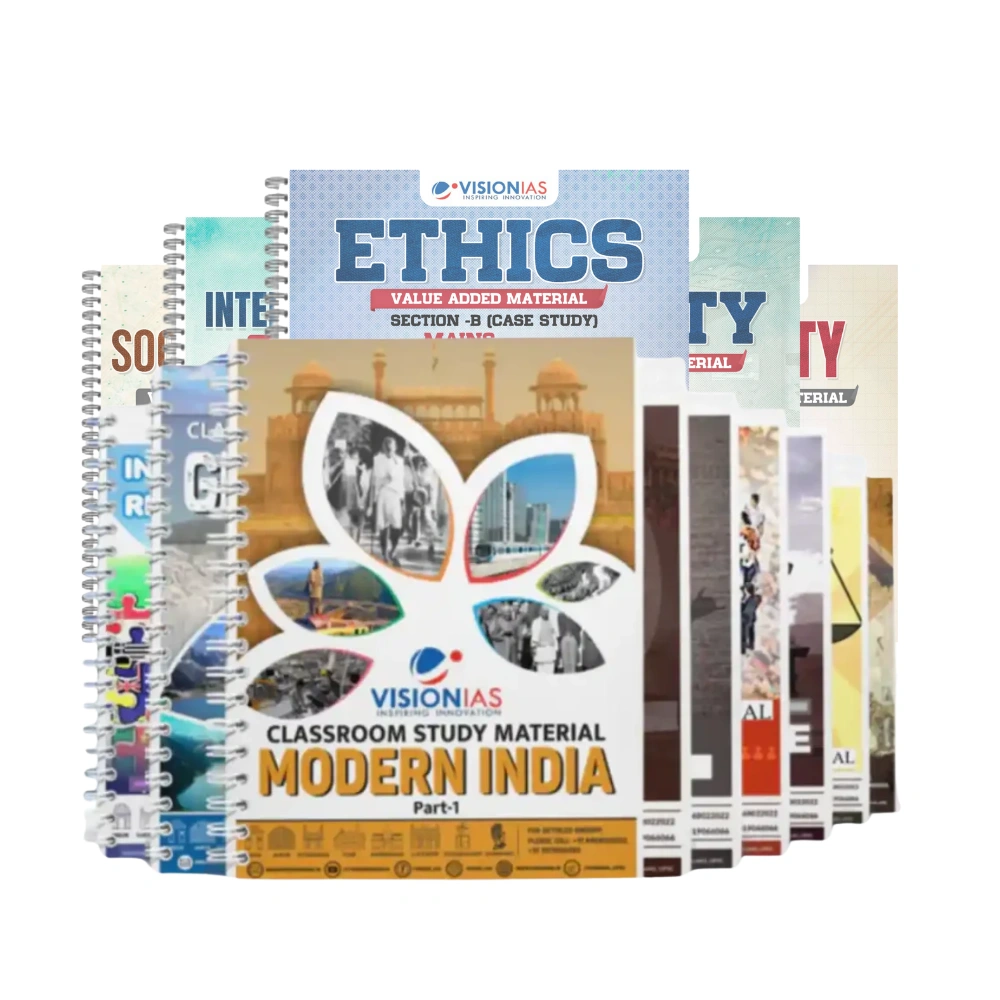
For end-to-end GS coverage across GS-I to GS-III, a consolidated set such as the Vision IAS GS 2026-27 Booklets (56 booklets with value-added material) maps neatly onto the HCS General Studies papers. For the essay component embedded in both language papers, the Vajiram Essay Notes give you ready structures and themes to write balanced, high-scoring essays. Keep a syllabus reference handy — a compact booklet like the GS Score Latest Syllabus Booklet 2026-27 is useful for tracking topics off before revision.
How to Download the Official HPSC HCS Syllabus PDF
Always verify topics against the official notification. To get the hpsc hcs syllabus pdf download directly from the source:
- Visit the official HPSC website at hpsc.gov.in.
- Open the “Advertisements” or “What’s New” / Notifications section.
- Find the latest HCS (Executive Branch) & Allied Services advertisement.
- Open the detailed notification PDF — the syllabus and exam scheme are annexed within it.
- Download and save the PDF; cross-check every topic with your notes.
Because HPSC publishes the syllabus inside the exam notification rather than as a standalone file, always rely on the most recent advertisement PDF for the definitive scheme and any mid-cycle revisions.
HPSC HCS Preparation Strategy & Common Mistakes
A structured approach beats scattered effort. Use this simple roadmap for the 2026 pattern:
- Build the NCERT + standard-book base for History, Polity, Geography and Economy before touching advanced notes.
- Treat CSAT seriously — a few weekly timed sets are enough to lock the 33% qualifying bar early.
- Start GS-IV Ethics early — it is scoring but needs practised answer structures and a case-study approach.
- Own Haryana GK — make a dedicated notebook for state history, geography, schemes, culture and sports.
- Write daily — with six descriptive papers, answer-writing and essay practice decide your merit rank.
- Stay current — integrate monthly national and Haryana current affairs into every subject.
Common mistakes: ignoring CSAT until the last month, clinging to an old optional plan, neglecting the language/essay papers that now count fully, and under-preparing Haryana-specific topics. Avoid these four and you are already ahead of most of the field.
One-Page HPSC HCS Syllabus Summary
Keep this printable snapshot on your wall:
| Element | Detail |
|---|---|
| Conducting body | Haryana Public Service Commission (HPSC) |
| Stages | Prelims → Mains → Interview |
| Prelims papers | GS (100, merit) + CSAT (qualifying 33%) |
| Negative marking | 0.25 per wrong answer (Prelims) |
| Mains papers | 6 papers × 100 = 600 marks, 3 hrs each |
| Mains structure | English, Hindi (both with essay), GS-I to GS-IV |
| Optional subject | Removed |
| Interview | 75 marks |
| Final merit | Mains (600) + Interview (75) = 675 |
| Official source | hpsc.gov.in (syllabus inside notification PDF) |
Frequently Asked Questions
What is the HPSC HCS syllabus for 2026?
The HPSC HCS syllabus for 2026 has three stages: a Prelims with a General Studies paper (merit) and a CSAT paper (qualifying at 33%), a Mains with six descriptive papers of 100 marks each — English and Hindi with essay plus GS-I to GS-IV — totalling 600 marks, and a 75-mark Personality Test. The optional subject has been removed.
How many papers are there in the HPSC HCS Mains exam?
The HPSC HCS Mains has six descriptive papers, each of 100 marks and 3 hours: English (with essay), Hindi in Devanagari (with essay), and General Studies I, II, III and IV. All six papers total 600 marks and count toward the final merit.
Has the optional subject been removed from HPSC HCS?
Yes. Under the 2026 pattern the optional subject has been removed from HPSC HCS. In its place, four General Studies papers (GS-I to GS-IV) have been introduced, standardising the syllabus for all candidates instead of letting them specialise in a single scoring optional.
Is there negative marking in the HPSC HCS Prelims exam?
Yes, there is negative marking in the HPSC HCS Prelims. For every wrong answer, 0.25 marks (one-fourth) are deducted in both the General Studies and CSAT papers. Unattempted questions carry no penalty, so avoid blind guessing.
What are the qualifying marks for CSAT in HPSC HCS Prelims?
CSAT (Prelims Paper II) is qualifying in nature and you must score at least 33%, which is about 33 marks out of 100. Your CSAT score is not added to the Prelims merit — but failing to reach 33% disqualifies you regardless of your General Studies score.
What is the new HPSC HCS exam pattern and total marks?
The new HPSC HCS exam pattern has three stages. Prelims has two objective papers (GS of 100 marks for merit and CSAT qualifying at 33%). Mains has six descriptive papers of 100 marks each, totalling 600 marks — English and Hindi (both with essay) and GS-I to GS-IV. The Interview is 75 marks. The final merit is out of 675 marks (Mains 600 + Interview 75); Prelims marks are not counted.
Which subjects and Haryana-specific topics are included in the HPSC syllabus?
The HPSC HCS syllabus covers History, Geography, Indian Polity & Governance, Economy & Social Development, General Science, Environment & Ecology, Current Affairs, English and Hindi language with essay, and Ethics (GS-IV). Haryana-specific topics span state history (Rakhigarhi, Kurukshetra, 1857 revolt), Haryana geography (Yamuna and Ghaggar rivers, Aravalli–Shivalik zones), the state economy and welfare schemes, Haryana’s formation in 1966 and administration, culture (folk dances, festivals, dialects) and its sporting legacy.
Where can I download the official HPSC HCS syllabus PDF?
Download the official HPSC HCS syllabus PDF from the HPSC website at hpsc.gov.in. Open the Advertisements or Notifications section, select the latest HCS (Executive Branch) & Allied Services advertisement, and open the detailed notification PDF — the syllabus and exam scheme are included within it.
Recommended Study Material
Continue Reading

UPSC Exam Pattern 2026: Prelims, Mains & Interview Marks
The UPSC exam pattern follows a three-stage structure: the Preliminary Examination (400 marks, objective screening), the Main Examination…
IBPS Clerk Syllabus 2026: Prelims, Mains, Exam Pattern + PDF
The ibps clerk syllabus for 2026 covers three subject areas in Prelims — English Language, Numerical Ability and…
WBCS Syllabus 2026: Prelims, Mains, Optional + PDF
The WBCS syllabus for 2026 is set by the West Bengal Public Service Commission (WBPSC) and runs across…