UPTET Syllabus 2026: Paper 1 & 2 Subject-Wise + PDF (Hindi)
UPTET syllabus 2026 for Paper 1 (Class 1-5) & Paper 2 (Class 6-8): subject-wise topics, exam pattern, weightage, passing marks, best books + PDF download in Hindi.

The UPTET syllabus is divided into two papers — Paper 1 for candidates who want to teach Classes 1–5 and Paper 2 for Classes 6–8 — and each paper carries 150 one-mark multiple-choice questions worth 150 marks, to be solved in 2.5 hours with no negative marking. Paper 1 tests Child Development & Pedagogy (CDP), Language I (Hindi), Language II (English/Sanskrit/Urdu), Mathematics and Environmental Studies — 30 marks each. Paper 2 tests CDP, Language I, Language II (30 each) plus either Mathematics & Science or Social Studies (60 marks). This guide gives you the full subject-wise topic list, past-paper weightage, a printable checklist, best books, and a Hindi PDF plan so you can prepare with zero confusion.
Important status note (read this first): The UP Teacher Eligibility Test has not been conducted since 2021. The Uttar Pradesh Basic Education Board has signalled a reform in which teacher eligibility is being aligned with — and largely replaced by — the national CTET, which UP already accepts for its 69,000 and future teacher recruitments. So while you should master the UPTET syllabus below, prepare in a way that also covers CTET, because the topic overlap is over 90%. We cover the UPTET vs CTET difference in detail later in this article.
UPTET Syllabus 2026 at a Glance
The UPTET syllabus 2026 is built on the NCERT/SCERT framework for Classes 1–8, but the difficulty of the questions is pitched roughly at Class 12 level even though the content is drawn from Class 1–8. In other words, the topics are simple but the way they are asked — application, pedagogy, tricky reasoning — is not. Understanding this gap is the single biggest reason candidates who “know the chapters” still fail the paper.
| Feature | UPTET Paper 1 | UPTET Paper 2 |
|---|---|---|
| For teaching | Classes 1 to 5 (Primary) | Classes 6 to 8 (Upper Primary) |
| Total questions | 150 MCQs | 150 MCQs |
| Total marks | 150 | 150 |
| Duration | 2 hours 30 minutes | 2 hours 30 minutes |
| Marks per question | 1 | 1 |
| Negative marking | None | None |
| Nature of exam | Offline, OMR-based | Offline, OMR-based |
UPTET Exam Pattern 2026
Before the syllabus, lock in the UPTET exam pattern, because it decides how you allocate study time. Every question is a single-correct-answer MCQ, every question is worth exactly 1 mark, and because there is no negative marking, you should attempt all 150 questions — never leave a blank.
Paper 1 Exam Pattern (Classes 1–5)
| Section | Questions | Marks |
|---|---|---|
| Child Development & Pedagogy (CDP) | 30 | 30 |
| Language I – Hindi | 30 | 30 |
| Language II – English / Sanskrit / Urdu | 30 | 30 |
| Mathematics | 30 | 30 |
| Environmental Studies (EVS) | 30 | 30 |
| Total | 150 | 150 |
Paper 2 Exam Pattern (Classes 6–8)
| Section | Questions | Marks |
|---|---|---|
| Child Development & Pedagogy (CDP) | 30 | 30 |
| Language I – Hindi | 30 | 30 |
| Language II – English / Sanskrit / Urdu | 30 | 30 |
| Mathematics & Science (for Maths/Science teachers) OR Social Studies (for Social Studies teachers) | 60 | 60 |
| Total | 150 | 150 |
In Paper 2 you choose one optional block based on your degree/teaching subject: Mathematics & Science (30+30) if you are a science-maths teacher, or Social Studies (60) if you are a humanities teacher. Candidates who intend to teach both levels simply sit for both papers.
UPTET Paper 1 Syllabus (Subject-Wise, Classes 1–5)
The UPTET Paper 1 syllabus covers five equally-weighted sections. Here is the detailed, topic-by-topic breakdown.
1. Child Development & Pedagogy (30 Marks) — Your Highest-Yield Section
CDP is the most scoring section because it is theory-driven, repeats heavily across years, and needs no calculation. Master it first.
- Concept of development and its relationship with learning; principles of child development
- Influence of heredity and environment
- Socialisation processes: society and child (teacher, parents, peers)
- Piaget, Kohlberg and Vygotsky — constructs and critical perspectives
- Concepts of child-centred and progressive education
- Multi-dimensional intelligence; language and thought
- Gender roles, gender bias and educational practice
- Individual differences among learners; assessment for and of learning
- Formulating appropriate questions; Continuous and Comprehensive Evaluation (CCE)
- Concept of Inclusive Education; addressing learners with special needs, disadvantaged and deprived groups
- Addressing children with learning difficulties and impairments
- Addressing the talented, creative and specially-abled learners
- Learning and pedagogy: how children think and learn; factors contributing to learning; motivation
Below is a quick theorist-wise revision table — one of the most under-covered but highest-return parts of UPTET pedagogy.
| Theorist | Core Idea | Typical UPTET Angle |
|---|---|---|
| Jean Piaget | 4 stages of cognitive development | Match age to stage (sensorimotor, pre-operational, concrete, formal) |
| Lev Vygotsky | Social constructivism, ZPD, scaffolding | Role of language, peers, MKO in learning |
| Lawrence Kohlberg | Stages of moral development | Pre-conventional to post-conventional reasoning |
| B.F. Skinner | Operant conditioning, reinforcement | Reward/punishment classroom examples |
| Howard Gardner | Multiple intelligences | Identifying 8 intelligence types in students |
2. Language I – Hindi (30 Marks)
Hindi is the first language section and is where Hindi-medium aspirants must not lose marks. It splits into language comprehension and language pedagogy.
- अपठित गद्यांश व पद्यांश (unseen prose and poetry passages) with comprehension, inference and grammar questions
- व्याकरण: संज्ञा, सर्वनाम, विशेषण, क्रिया, काल, वचन, लिंग, कारक, संधि, समास, उपसर्ग-प्रत्यय, तत्सम-तद्भव, पर्यायवाची, विलोम, मुहावरे व लोकोक्तियाँ, रस, छंद, अलंकार
- भाषा शिक्षण शास्त्र (Pedagogy of Language Development): learning and acquisition, principles of language teaching
- Role of listening and speaking; function of language; how children use language as a tool
- Critical perspective on the role of grammar in learning a language
- Challenges of teaching in a diverse classroom; language difficulties, errors and disorders
- Evaluating language comprehension and proficiency; teaching-learning materials, remedial teaching
3. Language II – English / Sanskrit / Urdu (30 Marks)
Language II must be different from your Language I and is chosen by you at the time of applying. Most candidates pick English, but you may choose Sanskrit or Urdu if you are more comfortable — the section is scored identically whichever language you take, so pick the one in which you can score highest, not the “popular” one.
- Two unseen prose passages (discursive, literary, scientific or narrative) with comprehension, grammar and verbal ability questions
- Grammar: tenses, articles, prepositions, modals, active-passive, narration, subject-verb agreement, synonyms/antonyms, one-word substitution, spelling and error detection
- Pedagogy of Language Development — same framework as Language I (acquisition, principles of teaching, remedial teaching, evaluation)
4. Mathematics (30 Marks)
Content is Class 1–5 level; questions test conceptual clarity and teaching approach.
- Number system, place value, operations (addition, subtraction, multiplication, division)
- Fractions, LCM & HCF, decimals, percentage
- Geometry: shapes, lines, angles, basic mensuration (area, perimeter, volume)
- Measurement: length, weight, capacity, time, money
- Data handling and patterns
- Pedagogical issues: nature of Mathematics/logical thinking, place of Mathematics in curriculum, language of Mathematics, community Mathematics, evaluation, remedial teaching, error analysis and problems of teaching
5. Environmental Studies (30 Marks)
- Family and friends; relationships, work and play, animals, plants
- Food, shelter, water, travel, and “things we make and do”
- Concept and scope of EVS; significance of integrated EVS
- Environmental studies and environmental education
- Learning principles; approaches to presenting concepts, activities, experimentation/practical work
- Discussion; CCE; teaching material/aids; problems of teaching
UPTET Paper 2 Syllabus (Subject-Wise, Classes 6–8)
The UPTET Paper 2 syllabus keeps CDP, Language I and Language II identical in structure to Paper 1 (30 marks each) but pitches the content slightly higher and replaces Maths/EVS with a single 60-mark subject block.
Common Sections (CDP + Language I + Language II)
The CDP, Hindi and English/Sanskrit/Urdu sections follow the same topic list as Paper 1 above, with pedagogy oriented to the upper-primary age group (11–14 years). Do not re-study them separately — the overlap is near-total.
Option A: Mathematics & Science (60 Marks)
| Mathematics (30 marks) | Science (30 marks) |
|---|---|
| Number system, integers, rational numbers | Food: sources, components, cleaning |
| Algebra: exponents, algebraic expressions, linear equations | Materials: materials of daily use, separation |
| Ratio & proportion, percentage, profit-loss, simple interest | The living world: plants, animals, human body |
| Geometry, symmetry, construction, mensuration | Moving things, people and ideas (motion, force) |
| Data handling, statistics | How things work: electricity, magnets, light |
| Pedagogical issues in Mathematics | Natural phenomena and resources; pedagogy of Science |
Option B: Social Studies / Social Science (60 Marks)
| Sub-subject | Key Topics |
|---|---|
| History | When, where and how; earliest societies; first farmers & herders; first cities; early states, empires (Mauryas, Guptas); contacts with distant lands; new kingdoms, culture, buildings; revolt of 1857; nationalism & freedom struggle |
| Geography | Geography as a subject; planet Earth in the solar system; globe; environment (air, water, human); resources and their types; agriculture |
| Civics / Social & Political Life | Diversity, government, local government, making a living, democracy, State government, media, unpacking gender, Constitution, Parliamentary government, Judiciary, social justice and marginalised groups |
| Pedagogy | Concept and nature of Social Science, class-room processes, developing critical thinking, enquiry, sources, projects, evaluation |
Subject-Wise Weightage: Where to Actually Focus
Most UPTET pages list topics but never tell you where the marks concentrate. Based on the pattern of the last held papers (2018, 2019, 2021), here is a realistic high-yield map so you don’t waste time.
| Section | High-Yield Focus Areas | Difficulty |
|---|---|---|
| CDP | Piaget/Vygotsky/Kohlberg, learning theories, inclusive education, assessment (CCE) | Easy–Moderate |
| Hindi | व्याकरण (grammar), अलंकार, रस, संधि-समास, अपठित गद्यांश | Moderate |
| English | Tenses, error spotting, comprehension, pedagogy | Easy–Moderate |
| Maths | Arithmetic word problems, geometry, pedagogy of maths | Moderate–Hard |
| EVS / Science | Human body, plants/animals, EVS pedagogy, environment | Easy–Moderate |
| Social Studies | History (ancient + freedom struggle), Civics (Constitution) | Moderate |
Key insight: Pedagogy sub-questions appear in every section (CDP, language, maths, EVS, science, SST). If you total pedagogy across all sections, it is easily 40–50 of the 150 marks. Making pedagogy your strongest area is the fastest route to clearing the cut-off.
UPTET Qualifying / Passing Marks by Category
UPTET is a qualifying eligibility test — you either clear it or you don’t, and the certificate is now valid for a lifetime. You must score at least the percentage shown below in your paper.
| Category | Minimum % | Marks Required (out of 150) |
|---|---|---|
| General / Unreserved | 60% | 90 |
| OBC | 55% | 83 |
| SC | 55% | 83 |
| ST | 55% | 83 |
Clearing UPTET only makes you eligible; final teacher selection depends on the separate recruitment (like the Basic Education recruitment) and its merit list. Aim well above the cut-off — a 100+ score gives you a real edge.
UPTET Syllabus PDF Download (Hindi & English)
You can get the official UPTET syllabus PDF download in Hindi and English from the UP Basic Education Board’s TET portal (updeled.gov.in) whenever a notification is active. Here is the simplest way to download and use it:
- Visit the official UPTET/UPBEB portal and open the latest information bulletin (सूचना पुस्तिका).
- The bulletin contains the complete Paper 1 and Paper 2 syllabus, usually in bilingual (Hindi + English) format — scroll to the परिशिष्ट/Appendix section.
- Save the PDF and print the syllabus pages so you can tick topics off as you finish them.
- Cross-check with the CTET syllabus PDF (from ctet.nic.in) since UP now accepts CTET — the two are almost identical and preparing to the CTET standard future-proofs your effort.
For a printable, trackable checklist, copy the subject-wise lists in this article into a single page and mark each topic Not-Started / Revising / Done. Hindi-medium aspirants should study the व्याकरण and pedagogy content in Hindi directly — do not translate mentally from English notes, as it slows recall in the exam.
UPTET vs CTET Syllabus: Which Should You Prepare?
This is now the most important strategic question for any UP teaching aspirant, because UPTET has been dormant since 2021 while CTET runs twice a year and is accepted in UP.
| Aspect | UPTET | CTET |
|---|---|---|
| Conducting body | UP Basic Education Board (UPBEB) | CBSE (national) |
| Validity | Lifetime (UP only) | Lifetime (all India) |
| Papers | Paper 1 (1-5), Paper 2 (6-8) | Paper 1 (1-5), Paper 2 (6-8) |
| Sections & marks | Same 5-section, 150-mark pattern | Same 5-section, 150-mark pattern |
| Language II options | English / Sanskrit / Urdu | Wide list incl. Hindi, English, Urdu, Sanskrit, regional |
| Current status (2026) | Not held since 2021; reform pending | Actively conducted, accepted in UP |
Verdict: Prepare from the UPTET syllabus in this article, but sit for CTET-aligned practice too — the >90% overlap means one preparation covers both, and CTET is the exam you can actually appear for right now. If you want to see the detailed national version side-by-side, our CTET Syllabus 2026 guide breaks down every section.
UPTET Preparation Strategy & Study Plan
The syllabus is Class 1–8 but the questions are exam-smart, so your plan must combine NCERT basics with heavy pedagogy and mock practice.
Core Preparation Principles
- Anchor on NCERT Class 1–8 for Maths, EVS, Science and Social Studies — read them cover to cover; most factual questions come straight from here.
- Give pedagogy top priority — CDP plus the pedagogy sub-parts of every subject are the highest-return marks and are theory-based.
- Solve previous year papers (PYQs) of UPTET and CTET — pattern and even repeated questions appear year after year.
- Take weekly full-length mock tests in OMR mode to build the 2.5-hour stamina and time management (roughly 1 minute per question).
- Attempt every question — with no negative marking, an educated guess only helps.
A Realistic 90-Day Study Plan
| Phase | Days | Focus |
|---|---|---|
| Foundation | 1–30 | Finish CDP theory + NCERT Class 1–8 for your subject; daily 1 hr Hindi/English grammar |
| Consolidation | 31–60 | Pedagogy of each subject; topic-wise tests; start PYQs; make revision notes |
| Test & Revise | 61–90 | 2 full mocks/week, analyse errors, revise weak topics, memorise theorists & formulae |
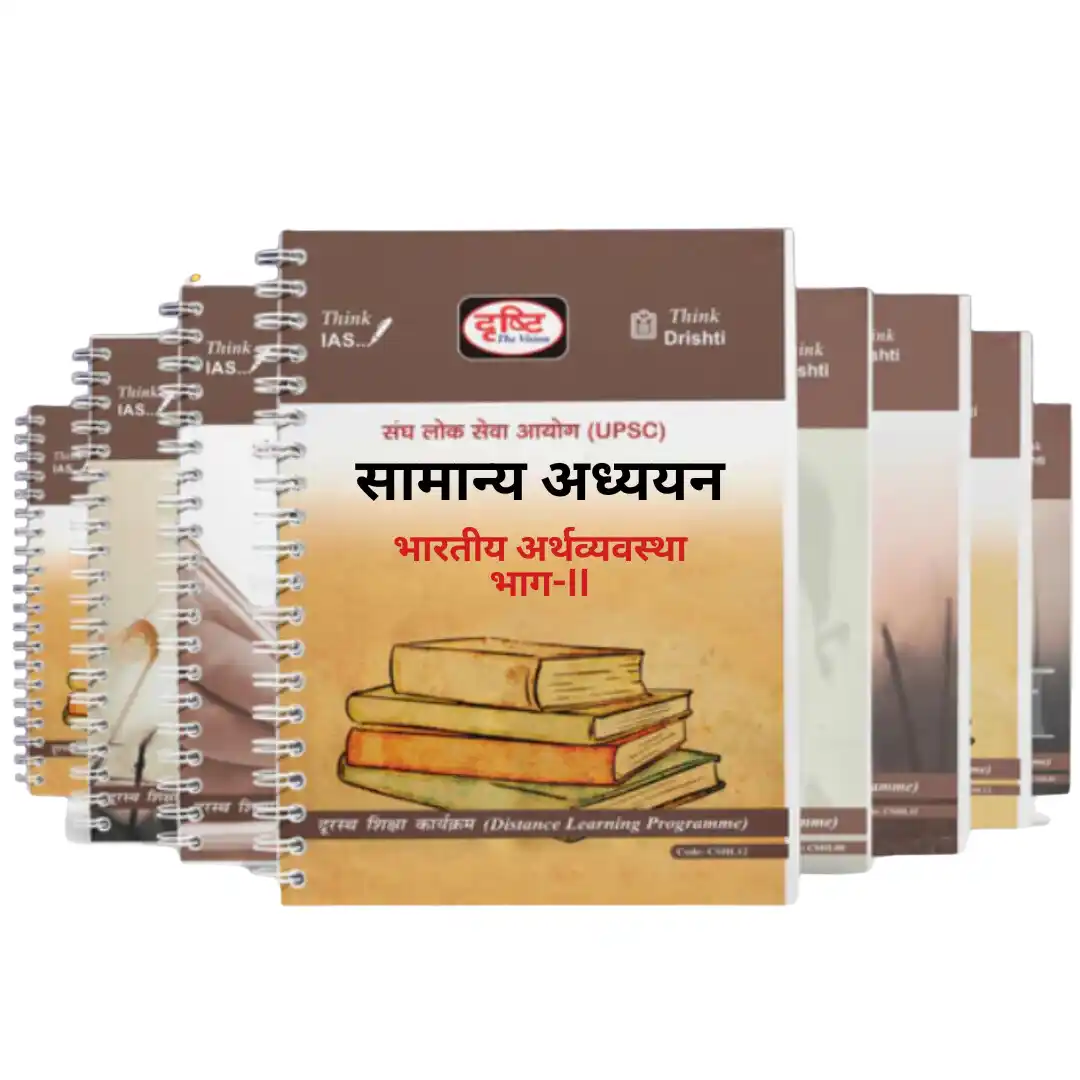
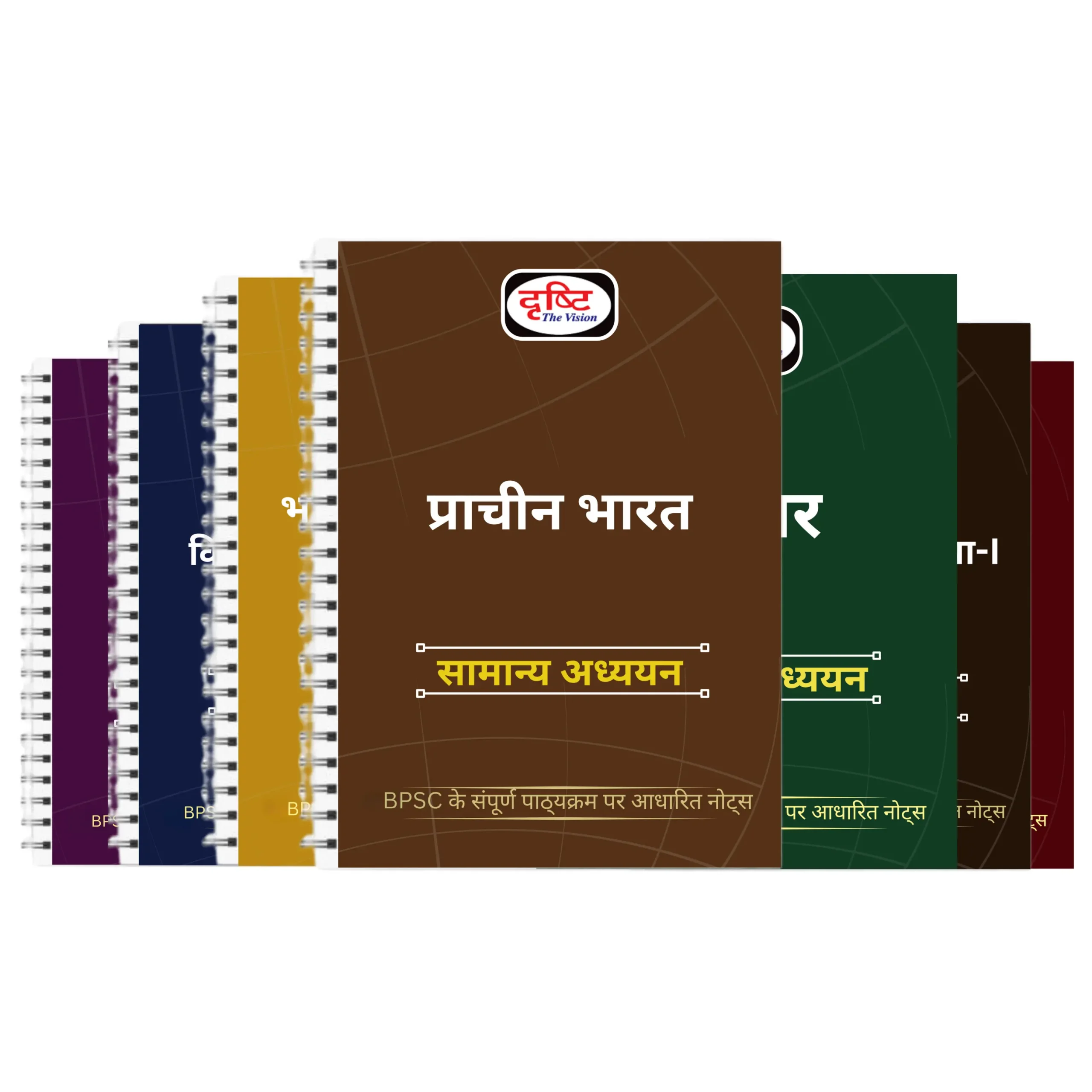
Aspirants who are simultaneously preparing for UP state exams like UPPCS or BPSC can reuse a lot of their History, Polity and Geography base; structured Hindi-medium material such as Drishti IAS Hindi Study Material builds exactly the conceptual depth that Paper 2 Social Studies rewards. If your bigger goal is a state PCS, the Drishti BPSC Hindi book set overlaps strongly with the Social Studies portion.
Best Books for UPTET Paper 1 and Paper 2
Pair one comprehensive guidebook with dedicated pedagogy and practice-paper books.
| Purpose | Recommended Resource | For |
|---|---|---|
| Complete guide | Arihant / Kiran UPTET Paper 1 & Paper 2 guides | Full syllabus coverage |
| Child Development & Pedagogy | NCERT-based CDP + a dedicated pedagogy book | All candidates |
| Hindi & English language | Lucent Samanya Hindi; Wren & Martin (English) | Language I & II |
| Maths & EVS/Science | NCERT Class 1–8 + R.S. Aggarwal for practice | Paper 1 & Paper 2 (Maths-Science) |
| Social Studies | NCERT Class 6–8 History/Geography/Civics | Paper 2 (SST) |
| Practice | UPTET/CTET previous year solved papers + mock sets | Final phase |
Add a current-affairs habit — even the teaching exams sneak in general-awareness and NEP-2020-related questions. A concise monthly like the Vision IAS Current Affairs (Hindi) keeps you updated without eating into core syllabus time.
Common Mistakes UPTET Aspirants Make
- Underrating pedagogy — treating CDP as an afterthought when it is the biggest scoring block.
- Skipping NCERT and jumping straight to guidebooks, missing the exact source of factual questions.
- Ignoring Hindi grammar depth — अलंकार, रस, संधि and समास quietly decide 8–10 marks.
- Not simulating the OMR mock — running out of time in the real 2.5-hour exam.
- Preparing only for UPTET and ignoring CTET, when CTET is the exam currently being conducted and accepted in UP.
Sample Questions to Gauge Difficulty
These illustrate the “simple topic, exam-smart question” nature of UPTET:
- CDP: According to Piaget, a child who can perform logical operations on concrete objects but not abstract ideas is in which stage? (Ans: Concrete Operational)
- Maths: The LCM of two co-prime numbers is equal to their — (Ans: Product)
- Hindi: ‘नीरज’ शब्द में कौन-सी संधि है? (उत्तर: दीर्घ संधि)
- EVS: Which vitamin is produced in the human body on exposure to sunlight? (Ans: Vitamin D)
None of these need advanced study — but they need clarity and speed, which only mocks and PYQs build.
Frequently Asked Questions
What is the syllabus of UPTET?
The UPTET syllabus has two papers. Paper 1 (Classes 1–5) covers Child Development & Pedagogy, Language I (Hindi), Language II (English/Sanskrit/Urdu), Mathematics and Environmental Studies — 30 marks each, totalling 150. Paper 2 (Classes 6–8) covers CDP, Language I, Language II (30 each) plus Mathematics & Science or Social Studies (60 marks). Both papers are 150 one-mark MCQs in 2.5 hours.
What is the difference between UPTET Paper 1 and Paper 2 syllabus?
Paper 1 is for teaching Classes 1–5 and includes Mathematics and Environmental Studies. Paper 2 is for Classes 6–8 and replaces those with a 60-mark subject block — either Mathematics & Science or Social Studies — chosen according to your teaching subject. The CDP and language sections are common to both, with Paper 2 pitched at a slightly higher, upper-primary level.
How many questions are there in UPTET and is there negative marking?
Each UPTET paper has 150 multiple-choice questions worth 150 marks, with 1 mark per question and a duration of 2 hours 30 minutes. There is no negative marking, so you should attempt all 150 questions even if you are unsure of some answers.
What are the qualifying/passing marks for UPTET?
General category candidates must score at least 60% (90 out of 150), while OBC, SC and ST candidates need 55% (83 out of 150). UPTET is a qualifying eligibility test; passing it makes you eligible for teacher recruitment but does not guarantee a job, and the certificate is now valid for a lifetime.
Which books are best for UPTET Paper 1 and Paper 2 preparation?
Start with NCERT Class 1–8 as your base for Maths, EVS, Science and Social Studies, then add a complete UPTET guide (Arihant or Kiran) and a dedicated Child Development & Pedagogy book. For languages use Lucent Samanya Hindi and Wren & Martin for English, and finish with UPTET/CTET previous-year solved papers and mock sets. One comprehensive guide plus focused pedagogy and practice books is enough — avoid stacking too many titles.
Is the UPTET syllabus based on NCERT and what is the difficulty level?
Yes, the content is drawn from the NCERT/SCERT curriculum for Classes 1–8. However, the difficulty of the questions is closer to Class 12 level because they test application, pedagogy and reasoning rather than plain recall. So the topics are basic, but the questioning is not — practising PYQs and mocks is essential.
Can I choose the language in UPTET Language II section?
Yes. In both papers you select Language II from English, Sanskrit or Urdu, and it must be different from your Language I (Hindi). The section carries 30 marks and is scored the same whichever language you pick, so choose the one you can score highest in. Most candidates take English, but Sanskrit or Urdu are equally valid if you are stronger in them.
How can I download the UPTET syllabus PDF in Hindi?
Download the official bilingual (Hindi + English) syllabus from the UP Basic Education Board’s TET portal (updeled.gov.in) via the latest information bulletin, and open its Appendix/परिशिष्ट section for the full Paper 1 and Paper 2 syllabus. Since UP now accepts CTET, also keep the CTET syllabus PDF from ctet.nic.in, as the two are over 90% identical.
Recommended Study Material
Continue Reading
RRB Technician Syllabus 2026: Grade 1 & 3, Pattern + PDF
The rrb technician syllabus for 2026 is tested in a single 90-minute Computer Based Test (CBT) of 100…
UPSC Mains Syllabus 2026: GS 1-4, Optional + PDF
The UPSC Mains syllabus covers nine descriptive papers - two qualifying language papers (Paper A and Paper B),…
Sociology Optional Syllabus 2026: Paper 1 & 2 + PDF
The sociology optional syllabus for UPSC is a two-paper syllabus of 250 marks each (500 total): Paper 1,…