Anthropology Optional Syllabus 2026: UPSC Paper 1 & 2 + PDF
Complete anthropology optional syllabus for UPSC 2026 — full Paper 1 & Paper 2 topics, free PDF download, booklist, PYQ weightage, GS overlap, toppers & strategy.

The anthropology optional syllabus for UPSC is divided into two papers — Paper 1 (fundamentals of physical and social-cultural anthropology) and Paper 2 (Indian anthropology, tribes and development) — each worth 250 marks, for a combined total of 500 marks in the Mains examination. It is one of the shortest, most static optionals with a science-plus-society mix, which is why aspirants from engineering, medical, arts and commerce backgrounds alike pick it, and well-prepared candidates have scored in the 280–330 range. This guide gives you the complete topic-wise Paper 1 and Paper 2 syllabus, a free PDF download, a PYQ-based high-weightage table, an author-wise booklist, a month-by-month study plan and clear answer-writing tips.
Quick facts at a glance:
- Papers: 2 (Paper 1 + Paper 2), descriptive, 3 hours each.
- Marks: 250 + 250 = 500 total in Mains.
- Nature: Short, static syllabus; low current-affairs load.
- Time to finish: 3–4 months with first revision for a focused aspirant.
- Background needed: None — open to science and non-science students alike.
- GS synergy: Overlaps GS1 (society, culture), GS2 (vulnerable sections) and Essay.
Anthropology Optional Syllabus UPSC: Overview & Exam Pattern
Anthropology is a two-paper optional in the UPSC Civil Services Mains. Both papers are descriptive, three hours each, and together carry 500 of the 1750 marks that decide your Mains rank. Unlike dynamic optionals, the anthropology optional syllabus UPSC prescribes is compact and rarely changes year to year, so a well-made note set stays valid across attempts.
| Component | Paper 1 | Paper 2 |
|---|---|---|
| Focus | Physical/Biological + Social-Cultural Anthropology (theory) | Indian Anthropology, Tribes & Development |
| Marks | 250 | 250 |
| Duration | 3 hours | 3 hours |
| Total questions | 8 (answer 5) | 8 (answer 5) |
| Sections | Section A & Section B (4 each) | Section A & Section B (4 each) |
| Q1 & Q5 | Compulsory short-note questions | Compulsory short-note questions |
| Combined total | 500 marks | |
In each paper you attempt five of eight questions. Questions 1 and 5 are compulsory and usually carry 10-mark short notes; from the remaining six you choose any three (at least one from the other section as per the paper’s instructions). Understanding this structure is the first step of any serious anthropology optional strategy for UPSC.
What Is the Syllabus of Anthropology Optional for UPSC? Paper 1
Paper 1 covers the scientific and theoretical core of the discipline. Broadly it has around twelve thematic clusters spanning physical/biological anthropology and social-cultural anthropology. Here is the complete anthropology syllabus Paper 1 and Paper 2 split, starting with Paper 1.
1. Meaning, Scope & Development of Anthropology
Definition, history and development of anthropology; its main branches (physical/biological, social-cultural, archaeological, linguistic) and their scope and relevance; relationship with other disciplines like life sciences, behavioural sciences, earth sciences, medical sciences and humanities.
2. Human Evolution & Emergence of Man
Biological and cultural factors in human evolution; theories of organic evolution — pre-Darwinian (Lamarckism), Darwinian and synthetic theory; principles — Doctrine of Natural Selection, synthetic theory of evolution; the “Emergence of Man” and brief outline of terms Isolation, Variation, Selection, Adaptation.
3. Characteristics & Taxonomy of Primates (Primatology)
Characteristics of Primates; evolutionary trend and primate taxonomy; primate adaptations (arboreal and terrestrial); primate behaviour; comparative anatomy of man and apes; skeletal changes due to erect posture and its implications.
4. Fossil Evidence & Human Phylogeny
Phylogenetic status, characteristics and geographical distribution of Plio-Pleistocene hominids in South and East Africa (Australopithecines); Homo erectus (Africa, Europe, Asia); Neanderthal man, Rhodesian man and Homo sapiens (Cromagnon, Grimaldi and Chancelede).
5. Human Genetics — Mendelian Genetics & Hardy-Weinberg Law
Methods and application of study of human genetics (family study, twin study, cytogenetic, chromosomal and karyotype methods); Mendelian genetics; concept of genetic polymorphism and selection; Mendelian population; Hardy-Weinberg law; causes and changes that bring down frequency — mutation, isolation, migration, selection, inbreeding and genetic drift. Chromosomes, DNA structure, cell division, and the ABO, Rh blood group and other genetic markers are all part of this high-scoring static block.
6. Human Growth, Physiology, Ecology & Race
Concept of human growth and development; stages of growth; factors affecting growth and development; biological basis of life (cell, DNA, protein synthesis); physiological adaptations (heat, cold, high altitude); concept of human ecology; the biological concept of race, racial criteria, racial classification and racism; concept of human variation.
7. Nature, Scope & Subject Matter of Social-Cultural Anthropology
Concepts of society and culture; ethnocentrism vis-à-vis cultural relativism; cultural evolution; concept of culture area, culture trait, culture complex, culture pattern; enculturation and acculturation; diffusion.
8. Marriage, Family & Kinship
Definition and universality of marriage; laws of marriage (endogamy, exogamy, hypergamy, hypogamy); types and forms of marriage; functions of marriage; marriage payments (bride wealth and dowry). Family — definition, types, functions, universality, changing nature. Kinship — descent, lineage, clan, phratry, moiety and kindred; rules of descent and descent groups; kinship terminology; kinship behaviour (avoidance, joking relationship, teknonymy, avunculate, amitate, couvade).
9. Economic & Political Organization and Social Control
Economic organization — meaning, scope and relevance of economic anthropology; formalist and substantivist debate; principles of production, distribution and exchange (reciprocity, redistribution and market) in communities subsisting on hunting-gathering, fishing, horticulture, pastoralism and peasant agriculture. Political organization and social control — band, tribe, chiefdom, kingdom and state; concepts of power, authority and legitimacy; law and justice in simple societies.
10. Religion & Anthropological Theories
Religion — anthropological approaches (evolutionary, psychological, functional); monotheism and polytheism; sacred and profane; myths and rituals; forms (animism, animatism, fetishism, naturism and totemism); magic, religion and science; magico-religious functionaries (priest, shaman, medicine man, sorcerer and witch). Anthropological theories — classical evolutionism, historical particularism, diffusionism, functionalism, structural-functionalism, structuralism, culture and personality, neo-evolutionism, cultural materialism, symbolic, interpretive and cognitive theories, post-modernism in anthropology.
11. Culture, Language & Communication + Research Methods
Nature, origin and characteristics of language; verbal and non-verbal communication; social context of language use. Research methods in anthropology — fieldwork tradition; distinction between technique, method and methodology; tools of data collection (observation, interview, schedules, questionnaire, case study, genealogy, life-history, comparative method); analysis, interpretation and writing-up.
12. Applied, Ecological & Epidemiological Anthropology
Relevance of menarche, menopause and other bio-events to fertility; adaptive significance of fertility and growth; demographic theories (biological, social and cultural); concepts and methods of ecological anthropology; bio-cultural adaptations; epidemiological anthropology (health and disease, nutritional deficiency and genetic disorders).
Anthropology Syllabus Paper 2: Indian Anthropology (Topic-Wise)
Paper 2 applies the Paper 1 framework to India — its civilisation, caste, villages, tribes and development. It is more static, more GS-friendly and highly scoring if your examples are current.
1. Evolution of Indian Culture & Civilization (incl. Indus Valley)
Evolution of Indian culture and civilisation — Prehistoric (Palaeolithic, Mesolithic, Neolithic and Neolithic-Chalcolithic), Protohistoric (Indus Civilization — Pre-Harappan, Harappan and Post-Harappan cultures). Contributions of tribal cultures to Indian civilisation. Palaeo-anthropological evidences from India with special reference to Siwaliks and Narmada basin (Ramapithecus, Sivapithecus and Narmada Man).
2. Demographic Profile & Structure of Indian Society
Demographic profile of India — ethnic and linguistic elements and their distribution; structure and nature of traditional Indian social system — Varnashrama, Purushartha, Karma, Rina and Rebirth.
3. Caste System in India (Varna, Ghurye, Srinivas)
Caste system in India — structure and characteristics; Varna and caste; theories of origin of caste system; dominant caste; caste mobility; features of caste system; Jajmani system; tribe-caste continuum. This is where thinkers like G.S. Ghurye (caste features) and M.N. Srinivas (dominant caste, Sanskritisation, Westernisation) are directly asked.
4. Sacred Complex, Religion & Indian Village
Sacred Complex and Nature-Man-Spirit Complex; impact of Buddhism, Jainism, Islam and Christianity on Indian society. Indian Village — significance of village study in India; Indian village as a social system; traditional and changing patterns of settlement and inter-caste relations; agrarian relations in Indian villages; impact of globalisation on Indian villages.
5. Tribe-Caste Continuum & Linguistic/Religious Minorities
Linguistic and religious minorities and their social, political and economic status; indigenous and exogenous processes of socio-cultural change in Indian society — Sanskritisation, Westernisation, modernisation; inter-play of little and great traditions; panchayati raj and social change; media and social change.
6. Tribal Communities in India
Tribal situation in India — bio-genetic variability, linguistic and socio-economic characteristics of tribal populations and their distribution; classification of tribes (geographical, linguistic, racial, economic, religious). Problems of tribal communities — land alienation, poverty, indebtedness, low literacy, poor educational facilities, unemployment, underemployment, health and nutrition.
7. Tribal Problems, Development & Social Change
Impact of Hinduism, Buddhism, Christianity, Islam and other religions on tribal societies; problems of exploitation and deprivation of SC, ST and OBCs; social change and contemporary tribal societies; cultural change, social change and development among the tribes; impact of modern democratic institutions, development programmes and welfare measures on tribes and weaker sections.
8. Constitutional Safeguards (Schedules 5 & 6, PESA, Xaxa Committee)
Constitutional safeguards for Scheduled Tribes and Scheduled Castes — Fifth and Sixth Schedules of the Constitution, PESA Act 1996, Forest Rights Act 2006; social change among the tribes during colonial and post-independent India; tribe and nation-state; contributions of anthropology to tribal and rural development; the Xaxa Committee (2014) recommendations, Dhebar Commission, Lokur Committee, and administrative/other agencies working for tribal welfare.
9. Contemporary Issues — Ethnicity, Regionalism & PVTGs
Ethnicity and ethnic movements; concepts of ethnic boundaries; tribe and nation-state; regionalism and demand for autonomy; pseudo-tribalism; social change among the tribes; impact of development on displacement and rehabilitation; Particularly Vulnerable Tribal Groups (PVTGs); role of NGOs in tribal development; contemporary debates on reservation, forest rights and tribal identity.
Anthropology Optional Syllabus PDF Download
You can download a clean, print-ready anthropology optional syllabus PDF download — no login, no sign-up — covering both papers topic-wise as notified by UPSC. Save it, highlight the sections you have finished and track revision cycles against it. If you prefer a printed, exam-aligned syllabus booklet for all GS and optional subjects to plan your table-of-contents revision, the GS Score Latest Syllabus Booklet 2026-27 is a handy desk companion. Always cross-check against the official UPSC Civil Services notification each cycle to confirm there are no micro-changes for the anthropology optional syllabus 2026.
High-Weightage Topics: Anthropology PYQ Frequency Analysis
Most syllabus pages stop at listing topics. The real edge comes from knowing which sub-topics are asked almost every year. Based on a reading of UPSC question papers from 2013–2024, the table below maps the highest-return areas so you can prioritise revision. (Treat frequencies as broad guidance from past-paper analysis, not an exact count.)
| Paper | High-weightage topic | Typical ask frequency | Priority |
|---|---|---|---|
| Paper 1 | Anthropological theories (functionalism, structuralism, evolutionism) | Every year, 2–3 questions | Very High |
| Paper 1 | Kinship, marriage, family (descent, terminology) | Every year | Very High |
| Paper 1 | Human genetics & Hardy-Weinberg law | Most years (numerical-friendly) | High |
| Paper 1 | Fossil hominids & primate taxonomy | Every year | High |
| Paper 1 | Research methods & fieldwork | Most years | Medium-High |
| Paper 2 | Caste system (Ghurye, Srinivas, dominant caste) | Every year | Very High |
| Paper 2 | Tribal problems & development programmes | Every year, 2+ questions | Very High |
| Paper 2 | Constitutional safeguards, PESA, Xaxa Committee | Most years | High |
| Paper 2 | Indian village studies & sacred complex | Most years | Medium-High |
Takeaway: a large share of marks concentrates in theories, kinship, genetics and fossils (Paper 1) and caste, tribal development and safeguards (Paper 2). Master these first before chasing peripheral topics.
Syllabus-to-GS Mapping: How Much Anthropology Overlaps With GS
Anthropology is one of the better optionals for GS and Essay synergy. Instead of a vague claim, here is a direct mapping showing exactly where the anthropology optional syllabus saves you GS preparation time.
| Anthropology topic | Directly helps | How |
|---|---|---|
| Tribal problems, PESA, FRA, Xaxa Committee | GS1 (society), GS2 (governance, vulnerable sections) | Ready-made answers on tribal welfare & schemes |
| Caste, Sanskritisation, village studies | GS1 (Indian society, social empowerment) | Thinkers & case studies for society questions |
| Indus Valley, prehistory, culture | GS1 (art & culture, ancient India) | Civilisational depth & archaeology |
| Human evolution, genetics, race | GS1 / Essay (science & society) | Science-backed, high-value content |
| Ethnicity, regionalism, displacement | GS1 (communalism, regionalism), GS3 (development) | Analytical frameworks |
| Development vs displacement, PVTGs | Essay, GS2, GS3 | Nuanced, humane essay examples |
Realistically, a meaningful share of GS1 society content and significant chunks of GS2 vulnerable-sections material overlap with Paper 2 — a major reason anthropology is rated a smart, efficient optional.
UPSC Anthropology Optional Booklist (Topic-Wise & Author-Wise)
A focused booklist beats a long one. Below is a proven UPSC anthropology optional booklist, mapped to the topic it best serves, with free/NCERT alternatives where they exist.
| Book / Author | Best for | Paper | Free alternative |
|---|---|---|---|
| Physical Anthropology — P. Nath / B.M. Das | Evolution, genetics, fossils | Paper 1 | NCERT Biology class 11-12 (evolution, genetics) |
| An Introduction to Social Anthropology — D.N. Majumdar & T.N. Madan | Social-cultural concepts | Paper 1 | IGNOU BA anthropology eGyankosh notes |
| Social & Cultural Anthropology Made Simple — Nadeem Hasnain | Kinship, marriage, religion, theories | Paper 1 | IGNOU MA anthropology units |
| Indian Anthropology — Nadeem Hasnain | Caste, village, tribes | Paper 2 | NCERT Sociology class 12 |
| Tribal India — Nadeem Hasnain | Tribal situation & problems | Paper 2 | Ministry of Tribal Affairs reports |
| Anthropological Theories — Makhan Jha / Upadhyay & Pandey | Theory block | Paper 1 | IGNOU theory units |
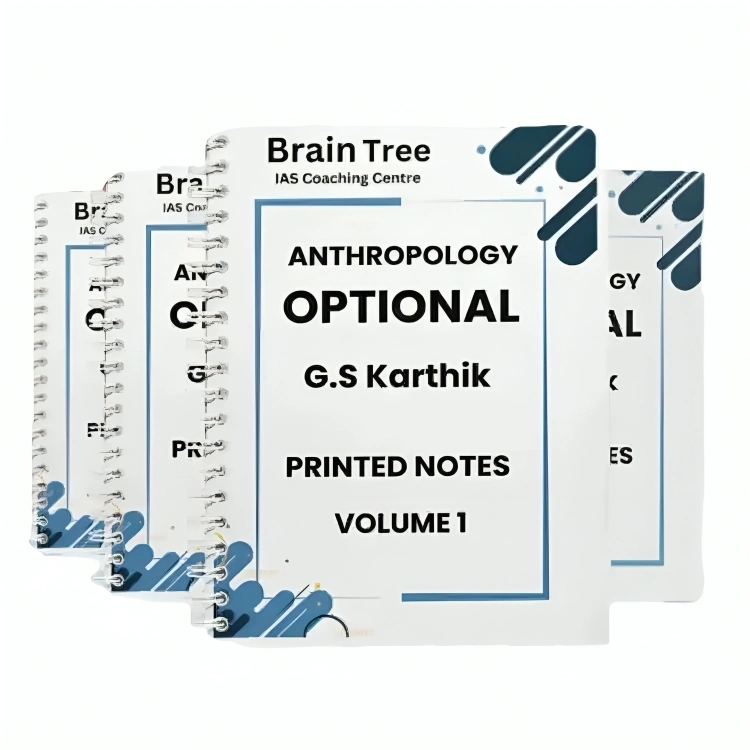
| Consolidated coaching notes (Brain Tree) | Both papers, exam-oriented | Paper 1 & 2 | — |
For a single, Mains-aligned set that stitches these authors into exam-ready answers, many aspirants use Brain Tree Anthropology Optional Notes for 2025-26. Supplement with the Forum IAS Topic-Wise PYQ Toolkit (1992-2025) to internalise question patterns, and keep a monthly current-affairs source like the Vision IAS Current Affairs Magazine January 2026 to add fresh tribal-development and policy examples that examiners reward.
Is Anthropology a Good Optional for UPSC? Scoring & Toppers
Anthropology is widely regarded as a high-scoring, relatively low-risk optional because the syllabus is short and static, answers can be diagram-driven and point-based, and the science-plus-society mix rewards well-structured answers. It has produced top rankers across backgrounds.
| Topper | Rank (CSE) | Optional | Indicative optional marks |
|---|---|---|---|
| Shubham Kumar | AIR 1 (2020) | Anthropology | ~328/500 |
| Anudeep Durishetty | AIR 1 (2017) | Anthropology | ~309/500 |
| Mittali Sethi | AIR 56 (2016) | Anthropology | ~300/500 |
| Pradeep Singh | AIR 26 (2019) | Anthropology | ~300/500 |
Optional marks are approximate figures commonly cited from mark-sheets circulated online; always verify against the candidate’s official UPSC mark-sheet before quoting them. The broader pattern is clear: a 300+ optional score is achievable, and that cushion often decides the final rank. If you can draw clean diagrams (evolution of man, kinship charts, settlement patterns) and quote thinkers precisely, anthropology rewards you.
Anthropology vs Sociology vs PSIR: Which Optional to Pick?
This is the top decision-stage query. All three are popular, GS-friendly humanities optionals, but they suit different aptitudes.
| Parameter | Anthropology | Sociology | PSIR |
|---|---|---|---|
| Syllabus length | Short, static | Short-medium | Long, dynamic |
| Nature | Science + society | Pure society/theory | Theory + current affairs |
| Diagrams/figures | High (big advantage) | Low | Low |
| Current affairs load | Low-moderate | Moderate | Very high |
| GS overlap | GS1, GS2, Essay | GS1, Essay | GS2, GS3 (IR), Essay |
| Best for | Science & non-science; those who like concrete, factual content | Those who enjoy social theory & abstraction | Those strong in polity & international relations |
Choose anthropology if you want the shortest static syllabus, enjoy diagrams and factual precision, or come from a science background. Choose sociology if you prefer social theory and abstraction — compare with our SS Pandey Sociology Notes before deciding. Choose PSIR if polity and international relations excite you. For many aspirants seeking a strong score per hour of study, anthropology is a favoured choice.
Anthropology Optional Strategy for UPSC: 3–4 Month Study Plan
A disciplined aspirant can complete the entire anthropology optional syllabus 2026 in 3–4 months with first revision. The key to a strong anthropology optional strategy for UPSC is finishing Paper 1 theory first (it underpins Paper 2) and building a personal “value-addition” register of diagrams, thinkers and tribal case studies from day one.
| Month | Focus | Syllabus sections | Deliverable |
|---|---|---|---|
| Month 1 | Paper 1 — Physical anthropology | Evolution, genetics, Hardy-Weinberg, fossils, primates, race | Diagram bank + genetics numericals |
| Month 2 | Paper 1 — Social-cultural | Kinship, marriage, religion, economy, polity, theories, methods | Thinker & theory notes |
| Month 3 | Paper 2 — Indian anthropology | Indus, caste, village, tribe-caste continuum, minorities | Case-study register |
| Month 4 | Paper 2 — Tribes & revision | Tribal problems, safeguards, PESA, Xaxa, contemporary issues | Answer-writing + PYQ practice |
From week one, practise answer-writing in parallel — do not wait to “finish” the syllabus. Attempt previous-year questions after every section and self-evaluate against the demand of the question.
How to Answer-Write in Anthropology (Value-Addition That Fetches Marks)
Content alone rarely crosses 300; presentation does. For every answer: (1) open with a precise definition and a relevant thinker, (2) insert at least one labelled diagram or flowchart (evolution of man, kinship symbols, settlement layout, Jajmani web), (3) anchor abstract points with a concrete tribe example — Jarawa, Dongria Kondh, Baiga, Santhal, Gond, Toda — and a scheme/report (PESA, FRA, Xaxa Committee, Eklavya schools, PVTG mission), and (4) close with a contemporary or policy linkage. This case-study + diagram + thinker triad is exactly the value-addition most syllabus pages ignore and a reliable way to convert knowledge into marks.
Previous Year Question Papers (PYQ 2018–2025)
Solving PYQs is non-negotiable because anthropology repeats themes with slight reframing. Collect the official UPSC Paper 1 and Paper 2 question papers for 2018, 2019, 2020, 2021, 2022, 2023, 2024 and 2025 from the UPSC website and compile them topic-wise against your syllabus copy. Map each question to its section, note repeated sub-topics, and build model answers for the recurring ones (caste theories, functionalism, tribal development, Hardy-Weinberg, kinship terminology). A structured PYQ bank such as the Forum IAS Topic-Wise PYQ Toolkit helps you see the pattern across years at a glance, even though it is prelims-focused — the habit of pattern-mapping transfers directly to the optional.
Common Mistakes to Avoid
Aspirants lose marks not from lack of content but from avoidable errors:
- Writing essay-style paragraphs instead of point-and-diagram answers.
- Ignoring Paper 1 numericals in genetics and Hardy-Weinberg.
- Memorising theories without being able to apply them to Indian data.
- Using outdated tribal statistics and generic, undated examples.
- Skipping answer-writing until the syllabus is “complete”.
Fix these early. Treat diagrams and tribe examples as compulsory, revise the high-weightage table above repeatedly, and keep updating your current-affairs register so your Paper 2 answers never read stale.
Frequently Asked Questions
What is the syllabus of anthropology optional for UPSC?
The anthropology optional syllabus has two papers of 250 marks each (500 total). Paper 1 covers physical/biological anthropology (evolution, genetics, Hardy-Weinberg, fossils, primates) and social-cultural anthropology (kinship, marriage, religion, economy, polity, theories, methods). Paper 2 covers Indian anthropology — Indus Valley, caste, village studies, tribes, tribal problems, constitutional safeguards (Schedules 5 & 6, PESA), the Xaxa Committee and contemporary issues.
Is anthropology a good and scoring optional for UPSC?
Yes. Anthropology is considered one of the more scoring optionals because the syllabus is short and static, answers can be diagram- and point-based, and it has produced AIR 1 rankers like Shubham Kumar and Anudeep Durishetty. Well-structured answers with diagrams, thinkers and tribe examples can fetch strong scores, with 300+ out of 500 being an achievable target.
Can a non-science student take anthropology as an optional?
Absolutely. Anthropology requires no prior science background. Topics like genetics, evolution and Hardy-Weinberg are explained from scratch in standard books and are simpler than full science optionals. Many arts, commerce and humanities students perform well in anthropology, so the “science vs non-science” worry is unfounded.
How many months does it take to complete the anthropology optional syllabus?
A focused aspirant can complete the full anthropology optional syllabus in 3–4 months, including first revision, when studying 4–5 hours daily. Finish Paper 1 theory first (around two months), then Paper 2 Indian anthropology and tribes in the next one to two months, with answer-writing running in parallel throughout.
Which is better, anthropology or sociology optional?
Both are short and GS-friendly. Choose anthropology if you prefer concrete, factual, diagram-driven content and a more static syllabus — it also suits science backgrounds. Choose sociology if you enjoy social theory and abstraction with slightly more current-affairs flavour. On score-per-hour efficiency, anthropology is often rated marginally higher due to its diagrams and compact syllabus, though both have produced top ranks.
What are the best books for anthropology optional?
Key books include Physical Anthropology by P. Nath/B.M. Das, Social & Cultural Anthropology Made Simple and Indian Anthropology/Tribal India by Nadeem Hasnain, D.N. Majumdar & T.N. Madan’s An Introduction to Social Anthropology, and a theory book like Makhan Jha. Pair these with consolidated coaching notes such as Brain Tree and solve UPSC PYQs for maximum mileage.
How much of the anthropology syllabus overlaps with the GS papers?
A meaningful part of Paper 2 overlaps with GS, mainly GS1 (Indian society, caste, culture, Indus Valley, regionalism) and GS2 (vulnerable sections, tribal welfare, PESA, Forest Rights Act). Human evolution, genetics and development-vs-displacement themes also feed directly into Essay and GS3. This overlap is a key reason aspirants rate anthropology an efficient optional for the overall Mains score.
Where can I download the anthropology optional syllabus PDF?
You can use the free, print-ready anthropology optional syllabus PDF linked in the PDF-download section above, which lists both papers topic-wise. For planning across all subjects, a consolidated printed syllabus booklet is a useful companion, but always confirm the exact wording against the current UPSC Civil Services notification before finalising your prep.
Recommended Study Material

Continue Reading
UKPSC Syllabus 2025: Prelims, Mains, Pattern + PDF (Hindi & English)
The UKPSC syllabus for the Combined State Civil / Upper Subordinate Services (Uttarakhand PCS) is spread across three…
History Optional Syllabus 2026: UPSC Paper 1 & 2 + PDF
The history optional syllabus for UPSC Civil Services Mains carries 500 marks across two papers of 250 marks…
NEET Syllabus 2026: Subject-Wise Topics, Weightage + PDF
The NEET syllabus for 2026 is the official National Testing Agency (NTA) list of examinable topics — finalised…