Best Books for JEE Advanced 2026: Subject-Wise List + Order
Best books for JEE Advanced 2026: subject-wise Physics, Chemistry & Maths shortlist with difficulty tags, reading order, budget picks and IIT-topper favourites.

The best books for JEE Advanced are NCERT as your non-negotiable foundation plus exactly one theory book and one problem book per subject: H.C. Verma with D.C. Pandey/Irodov for Physics; NCERT with Narendra Avasthi, M.S. Chauhan and V.K. Jaiswal for Chemistry; and Cengage (Tewani) with Vikas Gupta’s “Black Book” for Mathematics. You do not need ten books per subject — you need 4–5 books truly mastered, solved twice, and backed by previous-year papers and a good test series. This 2026 guide gives you the full subject-wise shortlist, difficulty tags, a Class 11 vs Class 12 reading order, budget tiers, and a minimum-viable book set so you buy smart and study smarter.
How this list was compiled: the recommendations below are drawn from the JEE Advanced syllabus published by the IITs and from booklists repeatedly named in publicly shared AIR-under-100 topper interviews and long-standing coaching recommendations. We deliberately favour titles with a multi-year track record against the actual exam over newly launched books, and we flag difficulty honestly so you sequence them correctly rather than owning them all at once.
Best Books for JEE Advanced 2026: The Quick Answer
JEE Advanced rewards depth over volume. Toppers repeat the same principle every year: pick a small, standard set, finish it end-to-end, and revise it three times rather than owning a shelf you never open. The winning formula is NCERT + one theory book + one problem book per subject. Below is the minimum-viable set most AIR-under-1000 rankers actually used.
| Subject | Foundation | Theory Book | Problem/Advanced Book |
|---|---|---|---|
| Physics | NCERT (11 & 12) | H.C. Verma (Vol 1 & 2) | D.C. Pandey / Irodov |
| Physical Chemistry | NCERT | NCERT + P. Bahadur | Narendra Avasthi (Balaji) |
| Organic Chemistry | NCERT | Morrison & Boyd / L.G. Wade | M.S. Chauhan (Balaji) |
| Inorganic Chemistry | NCERT (primary source) | J.D. Lee (adapted) | V.K. Jaiswal (Balaji) |
| Mathematics | NCERT | Cengage (G. Tewani) | Vikas Gupta “Black Book” / I.A. Maron |
That is roughly 10–12 books across three subjects — and honestly, most students finish only 60–70% of them. If you master this set and pair it with 10+ years of previous-year questions (PYQs) and weekly mock tests, you have everything required to clear the cut-off. A structured module set such as the eSaral IIT JEE Modules 2026 can bundle concise theory, solved examples and practice into one place if you prefer a single coordinated resource over assembling individual books.
Which Subjects and Books to Prioritise First
Not every book deserves equal time. Both papers carry all three subjects in near-equal weight, so your edge comes from where you invest hours, not from how many titles you own. Use this quick priority map before you spend a rupee.
| Priority | Where it decides your rank | Do this first |
|---|---|---|
| Mathematics | Most time-intensive and differentiating; long problems | Lock Cengage early; build daily solving volume |
| Physics | Punishes rote learning; multi-concept reasoning | Finish H.C. Verma before any advanced problem book |
| Chemistry | Highest-ROI marks, especially Inorganic from NCERT | Revise NCERT line-by-line; it is the fastest scoring |
Read that table as a sequencing rule: secure Chemistry marks with NCERT discipline, build Physics intuition with H.C. Verma, and reserve your longest daily study block for Maths practice. Everything below fills in the specific titles.
Why Book Choice for JEE Advanced Differs from JEE Main
Before buying anything, understand what you are preparing for. JEE Main and JEE Advanced share most of the syllabus, but the nature of questions is completely different — and that is exactly why your book list changes.
| Parameter | JEE Main | JEE Advanced |
|---|---|---|
| Question style | Direct, formula-based, single-concept | Multi-concept, analytical, application-heavy |
| Difficulty | Moderate | High to very high |
| Question types | Mostly single-correct MCQ + numericals | Multiple-correct, matrix-match, paragraph, integer |
| Ideal books | NCERT, D.C. Pandey, MTG, Cengage basics | H.C. Verma, Irodov, Cengage, Avasthi, Jaiswal |
| Negative marking | Fixed | Varies by section, partial marking possible |
| What it tests | Speed + accuracy | Conceptual depth + reasoning |
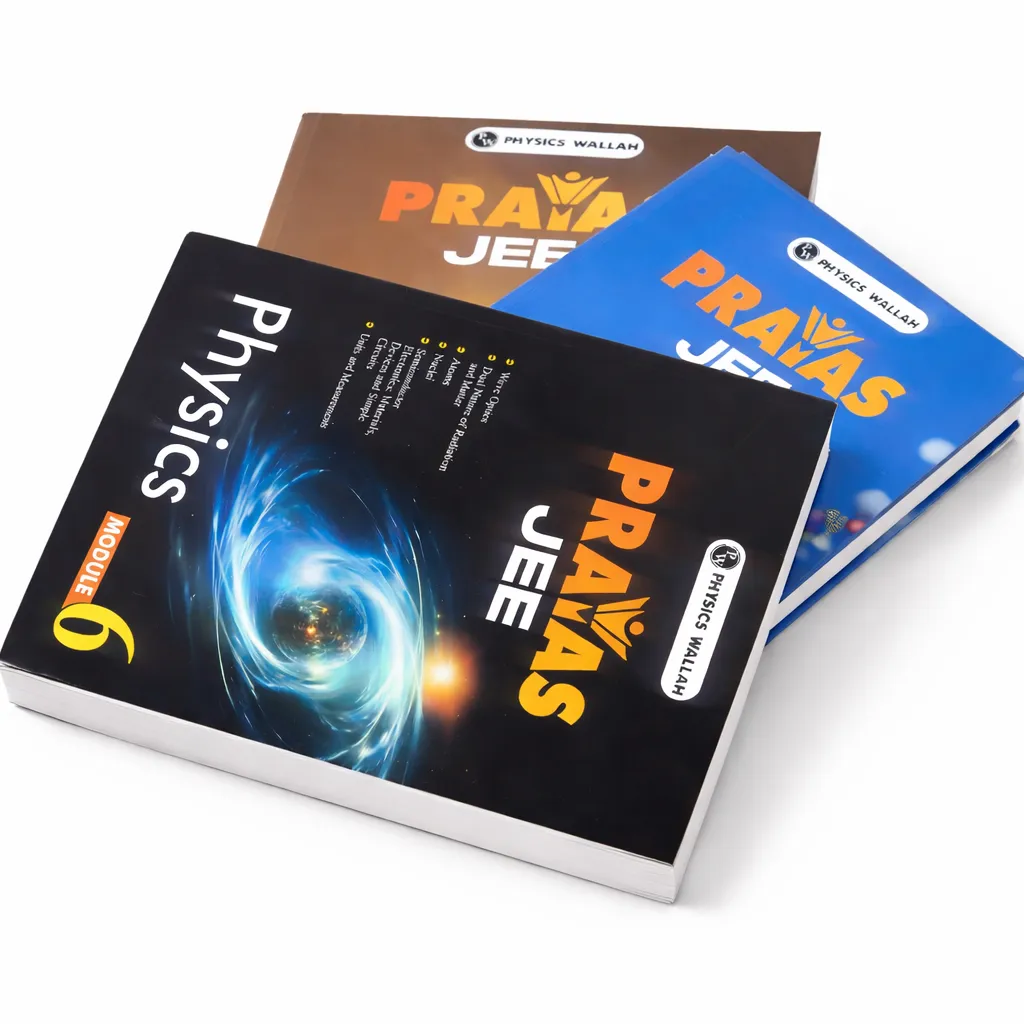
In short: JEE Main can be cleared largely with NCERT plus one problem book per subject, while JEE Advanced demands books that push conceptual reasoning — the multi-step, “why-does-this-happen” style. If you have not yet built your Main-level foundation, start with the PW Prayas JEE Modules for 2026, which cover the Class 11 + 12 base you must lock down before touching Advanced-level books.
Best Books for JEE Advanced Physics
Physics is where JEE Advanced separates rankers from the rest, because it punishes rote learning. Your theory book must build intuition; your problem book must stretch it.
Which is the best physics book for JEE Advanced?
H.C. Verma’s “Concepts of Physics” (Vol 1 & 2) is the single most recommended physics book for JEE Advanced and the best starting point after NCERT. Its short, conceptual questions build exactly the reasoning JEE Advanced tests. Pair it with D.C. Pandey (Arihant) for topic-wise drilling, and only then move to Irodov for the hardest chapters.
| Book | Author / Publisher | Best For | Difficulty |
|---|---|---|---|
| NCERT Physics 11 & 12 | NCERT | Baseline concepts, Modern Physics | Foundation |
| Concepts of Physics Vol 1 & 2 | H.C. Verma | Concept building, short problems | Foundation → Intermediate |
| Understanding Physics (5 books) | D.C. Pandey (Arihant) | Topic-wise practice, JEE Main + Advanced | Intermediate |
| Problems in General Physics | I.E. Irodov | Advanced-level problem solving | Advanced |
| Fundamentals of Physics | Halliday, Resnick & Walker | Deep theory, optional reference | Intermediate → Advanced |
| Problems in Physics | S.S. Krotov | Mechanics & tricky problems | Advanced |
Is HC Verma enough for JEE Advanced?
H.C. Verma is necessary but not sufficient. It builds unbeatable concepts and covers the syllabus, but its problems sit at the foundation-to-intermediate level. For Advanced, you must add higher-difficulty practice — D.C. Pandey for most students, and Irodov/Krotov for those targeting a top-500 rank. Finish H.C. Verma first, then escalate.
Is Irodov necessary for JEE Advanced?
No — Irodov is optional, not mandatory. It is superb for Mechanics, Electrodynamics and Thermodynamics, but a common mistake is opening Irodov in Class 11 before concepts are solid, which wastes months. Use it in the last 6–8 months of preparation, and only for selected chapters. If you are short on time, D.C. Pandey plus PYQs is enough to clear the paper.
Best Books for JEE Advanced Chemistry (Physical, Organic, Inorganic)
Chemistry is the highest-scoring subject if you split it correctly. Each branch needs a different book strategy, and NCERT plays a bigger role here than in any other subject.
Physical Chemistry
Physical Chemistry is numerical and formula-driven. Build theory from NCERT and P. Bahadur, then master Narendra Avasthi’s “Problems in Physical Chemistry” (Balaji) — the gold-standard problem book that mirrors JEE Advanced difficulty. Add R.C. Mukherjee specifically for mole-concept and stoichiometry.
Which is the best organic chemistry book for JEE Advanced?
M.S. Chauhan (Balaji) is the best problem book for JEE Advanced Organic Chemistry, and Morrison & Boyd (or L.G. Wade) is the go-to theory reference for mechanism-based understanding. Start with NCERT and Himanshu Pandey/Solomons for basics, then move to Chauhan for advanced reaction problems. Do not read Morrison & Boyd cover to cover — use it selectively for named reactions and mechanisms.
Inorganic Chemistry
Here is the single most important rule of JEE Advanced Chemistry: NCERT is the primary source for Inorganic Chemistry. A large share of Inorganic questions come straight from NCERT lines, especially in the p-block and coordination chemistry. Supplement with J.D. Lee (adapted Indian edition) for depth and V.K. Jaiswal (Balaji) for practice.
| Branch | Theory Book | Problem Book | Difficulty |
|---|---|---|---|
| Physical | NCERT + P. Bahadur | Narendra Avasthi, R.C. Mukherjee | Intermediate → Advanced |
| Organic | NCERT + Morrison & Boyd / L.G. Wade | M.S. Chauhan, Himanshu Pandey | Foundation → Advanced |
| Inorganic | NCERT (primary) + J.D. Lee | V.K. Jaiswal, O.P. Tandon | Foundation → Intermediate |
O.P. Tandon (GRB) works as an all-in-one theory alternative across all three branches for students who want a single Indian-authored reference. But whatever you choose, revise NCERT Chemistry line-by-line — it is the highest ROI reading in the entire syllabus.
Best Books for JEE Advanced Maths
Mathematics decides your rank because it is the most time-intensive and the most differentiating section. The strategy: one comprehensive series for theory + practice, one advanced problem book, and specialist books for graphs and calculus.
| Book | Author / Publisher | Best For | Difficulty |
|---|---|---|---|
| NCERT Maths 11 & 12 | NCERT | Baseline, basic problems | Foundation |
| Mathematics (topic-wise series) | Cengage — G. Tewani | Complete theory + JEE-level practice | Intermediate → Advanced |
| Advanced Problems in Mathematics (Black Book) | Vikas Gupta & Pankaj Joshi | Advanced problem solving, revision | Advanced |
| Problems in Calculus of One Variable | I.A. Maron | Calculus mastery | Advanced |
| Higher Algebra | Hall & Knight | Algebra, P&C, sequences | Intermediate → Advanced |
| Plane Trigonometry / Coordinate Geometry | S.L. Loney | Trigonometry & coordinate geometry | Intermediate |
| Play with Graphs | Amit Agarwal (Arihant) | Functions & graph-based questions | Intermediate → Advanced |
For most students, Cengage (Tewani) as the main series + Vikas Gupta’s Black Book for advanced practice is the complete Maths combination. Add Maron for calculus and S.L. Loney for trigonometry/coordinate geometry only if those are weak areas — do not buy all seven. Maths rewards volume of quality practice, so budget the most daily time here.
Is NCERT Enough for JEE Advanced?
No, NCERT alone is not enough to crack JEE Advanced — but it is mandatory and non-negotiable. NCERT is essential for building concepts and is the primary source for Inorganic Chemistry and Organic basics, where questions are often lifted directly. However, NCERT problems are far below Advanced difficulty in Physics and Maths, so you must layer standard reference and problem books on top.
The correct way to read it: treat NCERT as the skeleton and the standard books as the muscle. Skip NCERT and you will lose easy Chemistry marks; rely only on NCERT and you will be crushed by Physics and Maths. Both extremes cost ranks.
Reading Order & Study Timeline (Class 11 vs Class 12)
The biggest gap in most “best books” lists is sequencing. Owning the right books means nothing if you open Irodov in Class 11 or start the Black Book before finishing Cengage. Follow this order.
| Stage | Physics | Chemistry | Maths |
|---|---|---|---|
| Class 11 (Foundation) | NCERT + H.C. Verma Vol 1 | NCERT + O.P. Tandon / P. Bahadur | NCERT + Cengage (Algebra, Trig) |
| Class 12 (Build-up) | H.C. Verma Vol 2 + D.C. Pandey | NCERT + Morrison & Boyd + Avasthi | Cengage (Calculus, Coordinate) |
| Final 6–8 months (Advanced) | Irodov / Krotov (selected) | M.S. Chauhan + V.K. Jaiswal | Vikas Gupta Black Book + Maron |
| Last 3 months (Revision) | PYQs + mock tests | NCERT re-read + PYQs | Mixed problem sets + PYQs |
Rule of thumb for moving from theory to advanced: only pick up Irodov, the Black Book, or Maron once you can solve 80%+ of your theory book’s exercises unaided. Jumping too early destroys confidence and wastes months. Reserve the final quarter almost entirely for previous-year papers and full-length mocks under timed conditions.
How Many Books Are Enough to Crack JEE Advanced?
Around 4–5 books per subject — roughly 12–15 total — are more than enough to crack JEE Advanced. Rankers consistently say the same thing: fewer books, revised multiple times, beats a large collection read once. “Book overload” is one of the top reasons prepared students still underperform.
The logic is simple. A single problem book solved twice with error analysis teaches more than three problem books skimmed once. Every extra book adds hours of reading, not extra marks. Lock your list early — one foundation, one theory, one problem book per subject — and spend the saved time on revision and mocks. A coordinated module set like the eSaral IIT JEE Modules 2026 helps here because it consolidates theory, examples and practice, reducing the temptation to over-buy.
Which Books Do IIT Toppers Recommend for JEE Advanced?
IIT-topper recommended books for JEE Advanced are remarkably consistent year after year — the “standard set” below appears in almost every AIR-under-100 interview. Toppers emphasise mastery and revision over the specific title, but these are the recurring names.
| Subject | Topper-Recommended Core Books |
|---|---|
| Physics | H.C. Verma, D.C. Pandey, Irodov (selected chapters) |
| Physical Chemistry | NCERT, Narendra Avasthi, P. Bahadur |
| Organic Chemistry | NCERT, M.S. Chauhan, Morrison & Boyd |
| Inorganic Chemistry | NCERT (primary), J.D. Lee, V.K. Jaiswal |
| Mathematics | Cengage (Tewani), Vikas Gupta Black Book, Maron |
Notice what is not on the list: five different physics problem books, or three coaching module sets stacked together. Toppers pick one, finish it, and move to PYQs. The book is a tool; the revision discipline is the real edge. Treat any “secret booklist” that adds five more titles with suspicion — the winners consistently subtract, not add.
Budget Guide & Minimum Viable Book Set
For cost-conscious buyers, you do not need to spend a fortune. Here is a realistic budget breakdown for the complete standard set, plus a stripped-down “minimum viable” list for tight budgets.
| Tier | What It Includes | Approx. Cost (₹) |
|---|---|---|
| Minimum Viable Set | NCERT + H.C. Verma + Avasthi + Chauhan + Jaiswal + Cengage (core) | ₹3,000 – ₹4,500 |
| Standard Set | Above + D.C. Pandey + Black Book + Morrison & Boyd | ₹5,000 – ₹7,500 |
| Advanced/Topper Set | Standard + Irodov + Maron + J.D. Lee + coaching modules | ₹8,000 – ₹12,000 |
Smart money tips: buy the latest edition (publishers update solved examples and align with the current pattern — an outdated edition can miss recent question types), avoid duplicate problem books, and prioritise NCERT + one problem book per subject if funds are tight. A single bundled module set is often cheaper and more coordinated than buying eight separate titles — compare the PW Prayas JEE Modules for 2026 (18-book set covering Class 11 + 12) against assembling individual books before deciding.
Common Book-Buying Mistakes to Avoid
Most aspirants lose marks not from bad books but from bad book decisions. Avoid these traps.
| Mistake | Why It Hurts | Fix |
|---|---|---|
| Over-buying books | Time lost, none finished, no revision | One theory + one problem book per subject |
| Starting Irodov too early | Confidence crash before concepts are ready | Use only in final 6–8 months |
| Skipping NCERT Inorganic | Direct, easy marks lost | Read NCERT Chemistry line-by-line |
| Buying old editions | Misaligned with current pattern | Always buy the latest edition |
| No PYQs / mocks | Never test exam temperament | Solve 10+ years PYQs + weekly mocks |
| Reading theory books cover-to-cover | Wastes weeks on low-yield content | Use references selectively by topic |
First-Attempt vs Dropper/Repeater Book Strategy
Your book plan should change based on how much time you have.
First-attempt students (with Class 11/12): Follow the two-year timeline above. Build slowly, prioritise NCERT and one theory book, and only add advanced problem books in the final year. Do not rush into Irodov or the Black Book — depth of foundation matters more than difficulty of practice at this stage.
Droppers/repeaters (one focused year): Skip re-reading theory you already know. Go straight to problem books and PYQs — Avasthi, Chauhan, Jaiswal, D.C. Pandey and the Black Book — using theory references only to patch weak topics. Droppers have the advantage of a completed syllabus, so their year should be 70% practice and revision, 30% theory repair. A quick revision-focused module set works better than fresh textbooks for this group.
PYQs, Mock Tests & Test-Series Supplements
Books build knowledge; PYQs and mocks convert it into marks. No book list is complete without them.
- Previous-year questions (2007–2025): Solve at least 10 years of JEE Advanced PYQs, topic-wise first, then full-paper. They reveal recurring patterns and the exact depth expected.
- Full-length mock tests: Take one full mock weekly in the final 3 months under real timing, then analyse every error.
- Test series & modules: A structured series keeps you disciplined and benchmarks you against peers. Coordinated JEE module sets such as the eSaral IIT JEE Modules 2026 and PW Prayas JEE Modules for 2026 bundle theory, solved examples and practice for a ready-made study spine.
Preparing for NEET alongside or switching tracks? The same discipline applies to medical prep — see the Careerwill NEET Study Module Set for a parallel example of a complete, pattern-aligned module system.
Can You Clear JEE Advanced With Self-Study Using Books Only?
Yes, you can clear JEE Advanced through self-study using books only — many rankers do — provided you have discipline, a fixed booklist, and a reliable test series for feedback. Books cover 100% of the syllabus; what self-study lacks is doubt-solving and benchmarking. Compensate with online doubt forums, PYQ solutions, and regular mock tests so you know where you stand.
The self-study formula: fixed timetable, one theory + one problem book per subject, daily PYQ practice, weekly full mocks, and honest error analysis. Consistency beats coaching for a motivated aspirant with the right books.
Frequently Asked Questions
Is NCERT enough for JEE Advanced?
No, NCERT alone is not enough for JEE Advanced, but it is mandatory. NCERT is the primary source for Inorganic and Organic Chemistry and builds core concepts, yet its problems are below Advanced difficulty in Physics and Maths. Layer standard reference and problem books like H.C. Verma, Avasthi and Cengage on top of NCERT.
Which is the best physics book for JEE Advanced?
H.C. Verma’s “Concepts of Physics” (Vol 1 & 2) is the most recommended physics book for JEE Advanced and the best base after NCERT. Add D.C. Pandey for topic-wise practice, and Irodov or Krotov for the hardest chapters in the final months if you are chasing a top rank.
Is HC Verma enough for JEE Advanced?
H.C. Verma is necessary but not sufficient. It builds excellent concepts and covers the syllabus, but its problems are foundation-to-intermediate level. For JEE Advanced, add higher-difficulty practice through D.C. Pandey, and Irodov or Krotov for selected chapters if you are targeting a top rank.
Is Irodov necessary for JEE Advanced?
No, Irodov is optional, not mandatory. It is excellent for Mechanics, Electrodynamics and Thermodynamics, but should be used only in the final 6–8 months for selected chapters. Starting Irodov too early is a common mistake. D.C. Pandey plus PYQs is enough to clear the paper for most students.
How many books are enough to crack JEE Advanced?
About 4–5 books per subject — roughly 12–15 total — are enough to crack JEE Advanced. Fewer books revised multiple times outperform a large collection read once. Stick to one foundation, one theory book and one problem book per subject, then spend the rest of your time on PYQs and mock tests.
Which is the best organic chemistry book for JEE Advanced?
M.S. Chauhan (Balaji) is the best problem book for JEE Advanced Organic Chemistry, paired with Morrison & Boyd or L.G. Wade for mechanism-based theory. Begin with NCERT and Himanshu Pandey for basics, then move to Chauhan for advanced reaction and mechanism problems.
Which books do IIT toppers recommend for JEE Advanced?
IIT toppers consistently recommend H.C. Verma and D.C. Pandey for Physics; NCERT, Narendra Avasthi, M.S. Chauhan and V.K. Jaiswal for Chemistry; and Cengage (Tewani) with Vikas Gupta’s Black Book for Maths. The recurring theme is mastering a small standard set and revising it, not collecting more titles.
Can I clear JEE Advanced with self-study using books only?
Yes, you can clear JEE Advanced through self-study using books only, provided you have discipline, a fixed booklist and a test series for feedback. Use one theory and one problem book per subject, solve 10+ years of PYQs, take weekly mocks, and rely on doubt forums to replace classroom support.
Recommended Study Material

Continue Reading
PSIR Optional Syllabus 2026: Paper 1 & 2 + PDF
The psir optional syllabus for UPSC has two papers of 250 marks each (500 total out of the…
SBI PO Syllabus 2026: Prelims, Mains, Pattern + PDF Download
The SBI PO syllabus for 2026 is built around three subjects in Prelims — English Language, Quantitative Aptitude…
CAPF Syllabus 2026: Paper 1 & 2 Topics, Pattern + PDF
The capf syllabus for the UPSC CAPF Assistant Commandant (AC) 2026 exam is divided into two papers: Paper…