JEE Main Exam Pattern 2026: Marks, Sections & Marking Scheme
JEE Main exam pattern 2026: CBT mode, 3-hour duration, 75 questions, 300 marks, section-wise split, +4/-1 marking and negative marking rules explained.

The JEE Main exam pattern for 2026 is a computer-based test (CBT) of 3 hours in which Paper 1 (B.E./B.Tech) carries 75 questions for a total of 300 marks, split equally across Physics, Chemistry and Mathematics. Each subject has two sections: Section A with 20 multiple-choice questions (MCQs) and Section B with 5 Numerical Value questions — and from 2025 onwards all 5 Section B questions are compulsory and carry negative marking. Correct answers earn +4, wrong answers lose -1, and unattempted questions score 0.
This guide breaks down the complete JEE Main 2026 exam pattern — mode, duration, subject-wise split, total marks, negative marking rules, Paper 2A (B.Arch) and Paper 2B (B.Plan) structures, a dated changelog of what changed across 2024 → 2025 → 2026, a topic-wise weightage table, an attempt-strategy plan, and how NTA percentile normalization actually works. Everything below reflects the pattern as notified by the NTA for the current cycle; always cross-check final specifics against the official information bulletin on jeemain.nta.nic.in before you finalise your plan.
JEE Main Exam Pattern 2026: Quick Overview
Before we go section by section, here is the at-a-glance snapshot of the JEE Main exam pattern 2026 for Paper 1 (B.E./B.Tech), which is the paper the overwhelming majority of aspirants sit for. Conducted by the National Testing Agency (NTA), the exam is held in two sessions (typically January and April), and your best of the two scores is considered.
| Particular | JEE Main 2026 Paper 1 Detail |
|---|---|
| Conducting body | National Testing Agency (NTA) |
| Mode of exam | Computer-Based Test (CBT) — online |
| Duration | 3 hours (180 minutes); 4 hours for PwD candidates |
| Number of sessions | 2 (January and April); best score counts |
| Subjects | Physics, Chemistry, Mathematics |
| Sections per subject | 2 (Section A — MCQ; Section B — Numerical Value) |
| Total questions | 75 (25 per subject) |
| Questions to attempt | All 75 (Section B is now fully compulsory) |
| Question types | MCQs (Section A) + Numerical Value questions (Section B) |
| Total marks | 300 |
| Marking scheme | +4 correct, -1 wrong, 0 unattempted |
| Negative marking | Yes — in both Section A and Section B |
| Medium | 13 languages |
Two things trip up new aspirants here. First, “75 questions” is the actual count you answer — earlier years had 90 questions on screen where you attempted 75. Second, “300 marks” is the raw ceiling; your final rank is decided by a normalized percentile, not this raw score, which we explain in detail further down.
JEE Main Paper 1 Exam Pattern (B.E./B.Tech)
Paper 1 is for admission to B.E./B.Tech programmes at NITs, IIITs, GFTIs and other participating institutions, and it is the qualifying gateway to JEE Advanced for IIT admissions. The paper has three subjects — Physics, Chemistry and Mathematics — and each subject is divided into two sections.
Section A and Section B: how each subject is split
Every one of the three subjects follows an identical structure, which makes the paper predictable to plan for:
- Section A — 20 MCQs: Standard multiple-choice questions with four options and exactly one correct answer. All 20 are compulsory.
- Section B — 5 Numerical Value questions (NVTs): No options; you compute a numerical answer and type it in. From 2025 onwards, all 5 are compulsory (earlier you got 10 and chose any 5).
So each subject has two sections and gives you 25 questions worth 100 marks, and three subjects together make 75 questions worth 300 marks.
| Subject | Section A (MCQ) | Section B (NVT) | Total Questions | Marks |
|---|---|---|---|---|
| Physics | 20 | 5 | 25 | 100 |
| Chemistry | 20 | 5 | 25 | 100 |
| Mathematics | 20 | 5 | 25 | 100 |
| Total | 60 | 15 | 75 | 300 |
Types of questions: MCQ vs Numerical Value
The two question types demand different skills. MCQs reward pattern recognition and elimination — you can often back-solve from the options. Numerical Value questions (NVTs) reward clean, error-free calculation because there is no option to sanity-check against; you round the answer to the nearest integer (or to two decimal places where specified) and enter it on the virtual keypad. Because NVTs now carry negative marking, wild guessing on them is penalised exactly as on MCQs.
JEE Main Marking Scheme 2026
The JEE Main marking scheme is uniform across Physics, Chemistry and Mathematics, and — this is the key 2025-onward change — it now applies identically to Section A and Section B.
| Response | Section A (MCQ) | Section B (NVT) |
|---|---|---|
| Correct answer | +4 marks | +4 marks |
| Incorrect answer | -1 mark | -1 mark |
| Unattempted / not answered | 0 marks | 0 marks |
| Marked for review but not answered | 0 marks | 0 marks |
The total-marks formula
Your raw score for Paper 1 is calculated as:
Total marks = (Number of correct answers × 4) − (Number of incorrect answers × 1)
For example, if you answer 60 questions correctly, get 8 wrong, and leave 7 unattempted, your raw score is (60 × 4) − (8 × 1) = 240 − 8 = 232 out of 300. Notice how just 8 careless errors cost you 8 marks directly and, more painfully, denied you the 32 marks those questions could have carried. This asymmetry is exactly why accuracy beats attempt-count in JEE Main.
Negative Marking Rules in JEE Main 2026
Negative marking is where most rank is silently lost, so understand it precisely:
- Every wrong answer — MCQ or NVT — deducts 1 mark.
- Unattempted questions are never penalised (0 marks).
- There is no partial marking and no bonus for attempting more questions.
Is there negative marking in JEE Main numerical value questions?
Yes. This is the single most misreported fact online. Some older articles and coaching pages still claim NVTs have “no negative marking” — that was true only until 2023, when you attempted any 5 of 10 optional numerical questions with no penalty. As per the current NTA notification, from the 2025 session onward the optional choice was removed: all 5 Numerical Value questions per subject are compulsory and carry the standard -1 negative marking. So for JEE Main 2026, treat every NVT with the same caution as an MCQ. If a source tells you otherwise, it is out of date.
What Changed in the JEE Main Exam Pattern: 2024 → 2025 → 2026
Most competing pages bury this. Here is a clean, dated changelog so you know exactly what is different this year and don’t prepare against stale rules.
| Feature | 2024 Pattern | 2025 Pattern | 2026 Pattern |
|---|---|---|---|
| Section B questions per subject | 10 shown, attempt any 5 | 5, all compulsory | 5, all compulsory |
| Optional choice in Section B | Yes | Removed | Removed |
| Negative marking in Section B | No (on the 5 attempted) | Yes (-1) | Yes (-1) |
| Total questions on screen | 90 (attempt 75) | 75 (attempt 75) | 75 (attempt 75) |
| Total marks | 300 | 300 | 300 |
| Duration | 3 hours | 3 hours | 3 hours |
Are all 5 numerical value questions compulsory in JEE Main 2026?
Yes. The biggest headline change carried into 2026 is that the optional-question relief in Section B is gone. You now attempt all 15 numerical value questions across the three subjects (5 each), and each carries negative marking. Practically, this means you can no longer “skip the hard numericals for free” — you must decide question by question whether the risk of -1 is worth the shot at +4.
JEE Main Paper 2 Exam Pattern (B.Arch & B.Plan)
Paper 2 is for candidates seeking admission to architecture and planning programmes, and it is split into two separate papers you can take independently or together:
- Paper 2A — B.Arch: 77 questions, 400 marks.
- Paper 2B — B.Plan: 100 questions, 400 marks.
Both run for 3 hours 30 minutes (210 minutes) — longer than Paper 1 because they include an aptitude component (and, for B.Arch, a pen-and-paper drawing test).
Paper 2A (B.Arch) structure
| Part | Type | Questions | Marks |
|---|---|---|---|
| Mathematics (Part I) | 20 MCQ + 10 NVT (answer 5) | 25 | 100 |
| Aptitude Test (Part II) | MCQ | 50 | 200 |
| Drawing Test (Part III) | Drawing (pen & paper) | 2 | 100 |
| Total | — | 77 | 400 |
Paper 2B (B.Plan) structure
| Part | Type | Questions | Marks |
|---|---|---|---|
| Mathematics (Part I) | 20 MCQ + 10 NVT (answer 5) | 25 | 100 |
| Aptitude Test (Part II) | MCQ | 50 | 200 |
| Planning-Based Questions (Part III) | MCQ | 25 | 100 |
| Total | — | 100 | 400 |
What is the difference between JEE Main Paper 1 and Paper 2 pattern?
Paper 1 (B.E./B.Tech) tests Physics, Chemistry and Mathematics in a 3-hour, 75-question, 300-mark CBT. Paper 2 replaces Physics and Chemistry with an Aptitude Test, keeps Mathematics, and adds either a Drawing test (2A/B.Arch) or Planning questions (2B/B.Plan). Paper 2 is 400 marks and 3.5 hours long, and the B.Arch drawing section is the only part of the entire JEE Main that is attempted on paper rather than on screen. If your goal is engineering, you only need Paper 1.
JEE Main Total Questions and Marks (Paper-Wise)
Here is the consolidated paper-wise summary of JEE Main total marks and number of questions, so you can see all three papers side by side:
| Paper | For Admission To | Total Questions | Total Marks | Duration |
|---|---|---|---|---|
| Paper 1 | B.E./B.Tech | 75 | 300 | 3 hours |
| Paper 2A | B.Arch | 77 | 400 | 3 hours 30 min |
| Paper 2B | B.Plan | 100 | 400 | 3 hours 30 min |
Subject-Wise Distribution of Marks (Paper 1)
Because all three subjects carry equal weight (100 marks each), no subject can be treated as “secondary.” A student strong only in Physics and Maths but weak in Chemistry effectively caps their score at ~200. Balanced preparation across the three is non-negotiable for a competitive percentile.
| Subject | Marks | Share of Paper | Questions Attempted |
|---|---|---|---|
| Physics | 100 | 33.3% | 25 |
| Chemistry | 100 | 33.3% | 25 |
| Mathematics | 100 | 33.3% | 25 |
Topic-Wise Weightage: High-Yield Chapters
The pattern is uniform, but marks are not evenly spread across chapters. Based on trends from recent JEE Main sessions, a handful of high-yield topics reliably carry the most marks. Use this as a prioritisation guide — not as permission to skip anything, since the exam is designed to reward full-syllabus preparation.
| Subject | High-Weightage Topics | Approx. Weightage |
|---|---|---|
| Physics | Modern Physics, Electrodynamics (Current, Magnetism), Optics, Heat & Thermodynamics | ~45-55% |
| Physics | Mechanics (Kinematics, Laws of Motion, Rotation) | ~25-30% |
| Chemistry | Physical Chemistry (Mole Concept, Thermodynamics, Equilibrium, Electrochemistry) | ~35-40% |
| Chemistry | Organic Chemistry (GOC, Hydrocarbons, Oxygen-containing compounds) | ~30-35% |
| Chemistry | Inorganic Chemistry (Periodic Table, Chemical Bonding, Coordination) | ~30% |
| Mathematics | Calculus (Limits, Continuity, Integration, Differential Equations) | ~30-35% |
| Mathematics | Coordinate Geometry (Straight Lines, Conics) | ~15-20% |
| Mathematics | Algebra (Matrices, Determinants, Complex Numbers, Sequences) | ~20-25% |
Note that percentages are indicative and shift session-to-session because NTA randomises question sets across shifts. The safe read: master Calculus, Physical Chemistry and Modern Physics first, because they combine high weightage with high scoring reliability. A well-structured module set that maps to these weightages — like the eSaral IIT JEE Modules 2026 — helps you spend revision time where marks actually sit rather than reading cover to cover blindly.
How to Turn the Pattern Into an Attempt Strategy
Knowing the pattern is worthless unless it changes how you sit the paper. Here is a concrete, minute-by-minute plan for the 180-minute Paper 1, and the guessing logic that negative marking should force on you.
Time allocation: roughly 60 minutes per subject
| Phase | Task | Time |
|---|---|---|
| Round 1 — Subject 1 (your strongest) | Attempt all sure-shot questions, flag doubtful ones | ~50 min |
| Round 1 — Subject 2 | Same approach | ~50 min |
| Round 1 — Subject 3 | Same approach | ~50 min |
| Round 2 — Revisit flagged | Return to marked-for-review questions across all subjects | ~25 min |
| Buffer | Recheck NVT entries, keypad typos, un-submitted answers | ~5 min |
Order of attempt
Start with the subject you are most confident in to bank easy marks and build momentum, then move to your second-strongest, and tackle your weakest last when the pressure is highest but the stakes are clearest. Within each subject, do Section A (MCQs) before Section B (NVTs), because MCQs are faster and NVTs need clean, unhurried calculation.
How negative marking should shape guessing
- Two options eliminated on an MCQ? Guessing is mathematically favourable — the expected value of a 50/50 guess is (0.5 × 4) + (0.5 × −1) = +1.5. Attempt it.
- No options eliminated (pure blind guess)? Expected value is (0.25 × 4) + (0.75 × −1) = +0.25 — barely positive on MCQs, and it costs you time you could spend elsewhere. Usually skip.
- NVT you can’t fully solve? There is no elimination advantage, so a random entry is a pure -1 risk with a tiny upside. Skip unless you have a strong estimate.
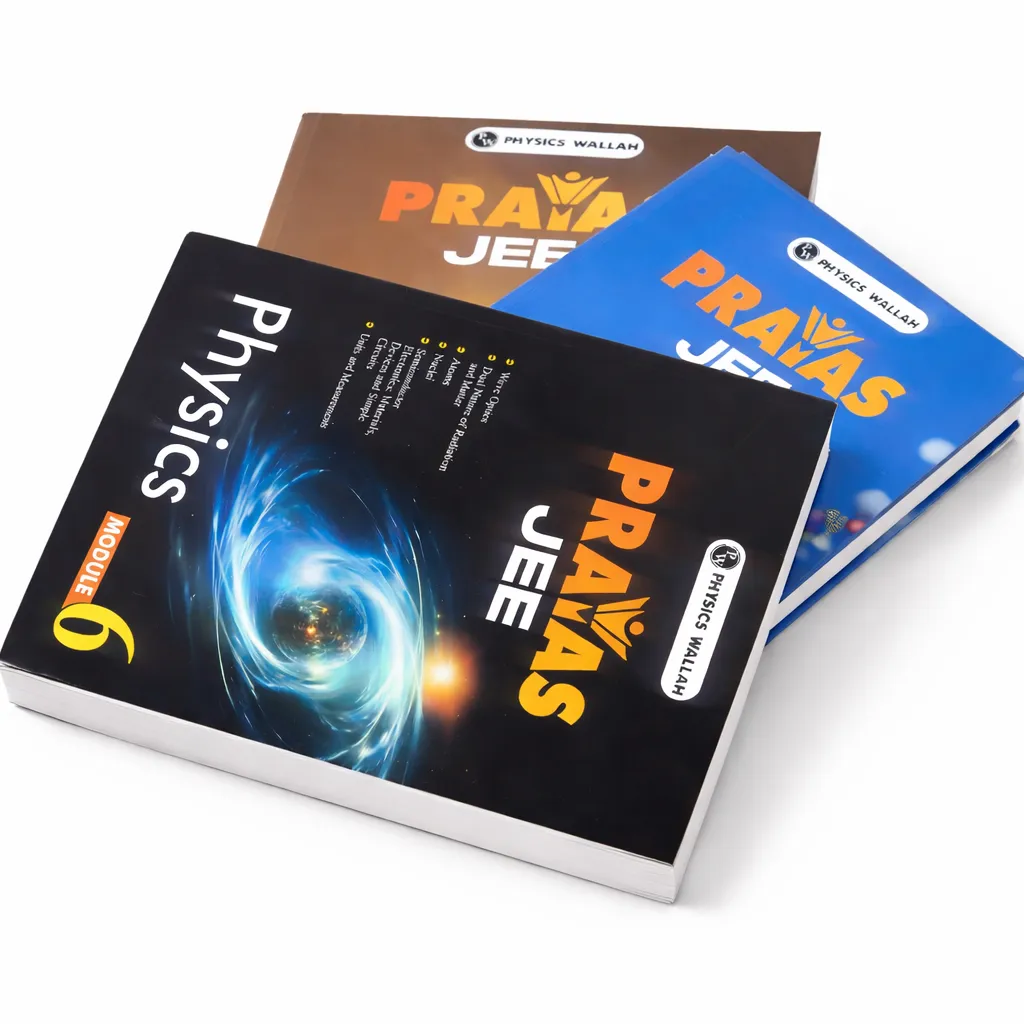
The takeaway: your target is not “attempt everything.” A candidate who attempts 62 questions at 95% accuracy usually outscores one who attempts all 75 at 80% accuracy. Practising this discipline under timed conditions matters more than raw content revision in the final month — which is where a mock-heavy module set like the PW Prayas JEE Modules for 2026 earns its place, because it lets you rehearse selection and time-management, not just theory.
Raw Marks vs Percentile: How NTA Normalization Works
This is the concept that top pages skip and searchers most often confuse. Your “300 marks” is a raw score. Because JEE Main is held across many shifts and days — and no two shifts have identical difficulty — NTA does not rank you on raw marks. It converts raw scores to a percentile (NTA Score) using normalization, so a slightly harder shift isn’t unfairly penalised.
What a percentile actually means
Your percentile tells you the proportion of candidates in your session who scored equal to or below you — it is not the percentage of marks you got. The formula NTA uses is essentially:
Percentile = (Number of candidates with raw score ≤ your score in your session ÷ Total candidates in your session) × 100.
The topper of each shift gets 100 percentile for that shift. Percentiles from all shifts are then merged to form the overall merit list and the final All India Rank.
| Concept | What it is | What it is NOT |
|---|---|---|
| Raw marks | Your +4/-1 score out of 300 | Your final rank |
| Percentile (NTA Score) | Relative standing vs your session | Percentage of marks scored |
| All India Rank | Merit position after merging sessions | Same as your raw score |
Practical implication: chasing a fixed “marks target” is misleading because the raw marks needed for, say, 99 percentile move a little each year with difficulty and candidate volume. Aim for accuracy and consistency across full-length mocks, and let the percentile follow.
Languages / Medium Options in JEE Main 2026
JEE Main 2026 is offered in 13 languages, so medium is rarely a barrier. You select your paper language at the application stage.
| # | Language | # | Language |
|---|---|---|---|
| 1 | English | 8 | Marathi |
| 2 | Hindi | 9 | Odia |
| 3 | Assamese | 10 | Punjabi |
| 4 | Bengali | 11 | Tamil |
| 5 | Gujarati | 12 | Telugu |
| 6 | Kannada | 13 | Urdu |
| 7 | Malayalam | — | — |
A useful detail: regional-language question papers are provided alongside English, so if a translated question is ambiguous, the English version is available on screen as the reference.
Exam-Day Logistics, Shift Timings & Allowed Items
The pattern also includes the operational rules that decide whether your preparation actually converts on the day. Don’t underestimate these — candidates lose attempts every year on logistics, not knowledge.
- Shifts: The exam is typically conducted in two shifts per day — a morning shift and an afternoon shift. Your admit card specifies your exact reporting time.
- Reporting: Reach the centre well before the gate-closing time printed on the admit card; late entry is not permitted.
- Rough sheets: Blank rough sheets are provided at the centre; you must write your name and roll number on each and return all of them before leaving. You cannot carry your own paper.
- Allowed items: Admit card printout, a valid photo ID, and (where required) a passport photo. A transparent water bottle and, for diabetic candidates, permitted food items are generally allowed.
- Prohibited items: Calculators, mobile phones, smart watches, log tables, and any electronic device. An on-screen calculator is not provided for Paper 1 — all numerical work is manual.
Key Highlights of the JEE Main 2026 Exam Pattern
- Paper 1 is a 3-hour CBT with 75 questions and 300 marks.
- Each subject has two sections: 20 MCQs (Section A) + 5 NVTs (Section B), all compulsory.
- Marking is +4 correct, -1 wrong, 0 unattempted — in both sections.
- Section B numerical questions now carry negative marking (2025 onward).
- Paper 2A (B.Arch) is 77 questions/400 marks; Paper 2B (B.Plan) is 100 questions/400 marks; both 3.5 hours.
- Available in 13 languages; two sessions with best score counting.
- Final rank is based on normalized percentile, not raw marks.
Recommended Study Material and Mock Practice
The pattern rewards two things above all: full-syllabus coverage weighted to high-yield topics, and repeated timed practice so that selection and negative-marking discipline become instinct. Printed, well-sequenced modules make revision faster than scattered PDFs, and dedicated mock cycles are what convert knowledge into a percentile. If you are assembling material for 2026, the eSaral IIT JEE complete modules and the class 11+12 PW Prayas JEE module set both align to the current NTA pattern and give you structured chapter-wise practice mapped to the weightages above. Pair them with full-length mocks in the last 8-10 weeks and review every mock for the specific chapters where you bled negative marks.
Common Mistakes Students Make With the Pattern
- Treating NVTs as “safe”: Guessing numericals blindly now costs -1 each — a habit carried over from the pre-2025 optional format.
- Over-attempting: Chasing all 75 questions regardless of confidence, converting a strong paper into an average one through avoidable errors.
- Ignoring Chemistry: It carries the same 100 marks as Physics and Maths but is the most “scoreable” per hour — neglecting it caps your ceiling.
- Confusing marks with score: Fixating on a raw-marks number instead of building the accuracy that drives percentile.
- Practising untimed: Solving chapters without a clock, then freezing on time management in the real 180 minutes.
Conclusion
The JEE Main 2026 exam pattern is stable, transparent, and — once you internalise it — a strategic advantage rather than just a rulebook. Paper 1 is 75 questions and 300 marks across three equally weighted subjects, with +4/-1 marking that now extends fully to the compulsory Section B numericals. Paper 2A and 2B swap in aptitude, drawing and planning components for architecture and planning aspirants. Translate that structure into a disciplined attempt plan, respect negative marking, weight your revision toward the high-yield chapters, and remember that your rank rides on percentile, not raw marks. Prepare against the current pattern — not last year’s — and practise it under the clock until it feels routine.
Frequently Asked Questions
How many questions are there in JEE Main 2026?
JEE Main 2026 Paper 1 (B.E./B.Tech) has 75 questions in total — 25 per subject across Physics, Chemistry and Mathematics, with each subject split into 20 MCQs (Section A) and 5 Numerical Value questions (Section B). Paper 2A (B.Arch) has 77 questions and Paper 2B (B.Plan) has 100 questions.
What is the marking scheme for JEE Main?
Every correct answer earns +4 marks, every incorrect answer loses -1 mark, and unattempted questions score 0. This +4/-1 scheme applies uniformly to all three subjects and to both Section A (MCQs) and Section B (Numerical Value questions) in Paper 1.
Is there negative marking in JEE Main numerical value questions?
Yes. As per the current NTA pattern (from the 2025 session onward), all 5 Numerical Value questions per subject are compulsory and carry -1 negative marking for a wrong answer. The earlier rule of attempting any 5 of 10 optional NVTs with no penalty no longer applies.
What is the total marks in JEE Main Paper 1?
JEE Main Paper 1 carries a total of 300 marks — 100 marks each for Physics, Chemistry and Mathematics, based on 75 questions marked at +4 for correct and -1 for incorrect answers.
How many sections are there in each subject in JEE Main?
Each subject in JEE Main Paper 1 has two sections. Section A has 20 multiple-choice questions (MCQs) and Section B has 5 Numerical Value questions. All 25 questions per subject are compulsory, and both sections carry the same +4/-1 marking.
Are all 5 numerical value questions compulsory in JEE Main 2026?
Yes. The optional-question choice in Section B has been removed, so all 5 numerical value questions in each subject (15 in total across Physics, Chemistry and Mathematics) are compulsory in JEE Main 2026, and each carries negative marking.
What is the duration of the JEE Main exam?
Paper 1 (B.E./B.Tech) is 3 hours (180 minutes) long. Paper 2A (B.Arch) and Paper 2B (B.Plan) each run for 3 hours 30 minutes. Candidates with benchmark disabilities (PwD) are given an additional hour as compensatory time.
What is the difference between JEE Main Paper 1 and Paper 2 pattern?
Paper 1 (B.E./B.Tech) is a 3-hour, 75-question, 300-mark CBT in Physics, Chemistry and Mathematics. Paper 2 keeps Mathematics but replaces Physics and Chemistry with an Aptitude Test and adds either a Drawing test (Paper 2A/B.Arch) or Planning-based questions (Paper 2B/B.Plan). Paper 2 is 400 marks and runs 3 hours 30 minutes, and the B.Arch drawing section is the only part attempted on paper rather than on screen.
Recommended Study Material

Continue Reading
SSC MTS Syllabus 2025: Subject-Wise Topics, Pattern & PDF
The SSC MTS syllabus for the Computer-Based Examination (Paper-I) covers four subjects — Numerical & Mathematical Ability, Reasoning…

NEET 2026 Preparation: Strategy, Timetable & Study Plan
NEET 2026 preparation works best when it is built on three pillars: complete NCERT mastery, daily MCQ practice,…
CAPF Syllabus 2026: Paper 1 & 2, Exam Pattern, PET + PDF
Last updated: June 2026 · Based on the official UPSC CAPF (AC) Examination notification.The CAPF syllabus for the…