WBCS Syllabus 2025: Prelims, Mains, Exam Pattern + PDF
Complete WBCS syllabus 2025 — subject-wise Prelims & Mains topics, exam pattern, marks, optional subjects list, negative marking rules and a free WBCS syllabus PDF to download.

The WBCS syllabus is set by the West Bengal Public Service Commission (WBPSC) and runs across three stages: a 200-mark objective Preliminary exam covering 8 subjects, a descriptive Mains exam of six compulsory papers (plus two optional papers for Group A & B), and a Personality Test worth 100–200 marks by service group. Prelims is qualifying only — your final rank is decided by Mains plus the interview.
This 2025 guide gives you the full subject-wise WBCS syllabus for Prelims and Mains, the exact exam pattern (papers, marks, duration), the complete optional subjects list, marks weightage, a subject-wise booklist, and a free downloadable WBCS syllabus PDF — plus a clean reconciliation of the confusing “old vs new” pattern debate that most top pages get wrong.
WBCS syllabus 2025 at a glance
- Prelims: 1 objective paper, 200 questions, 200 marks, 2½ hours, 8 subjects × 25 marks — qualifying only, with negative marking.
- Mains: 6 compulsory papers (200 marks each); Group A & B add 2 optional papers.
- Interview: 200 / 150 / 100 marks depending on group.
- Bengali is not mandatory — Paper I also allows Hindi, Urdu, Nepali or Santali.
- Negative marking applies in Prelims (one-third of the question’s marks per wrong answer).
WBCS 2025: Exam Overview & Selection Process
The West Bengal Civil Service (Executive) Examination — commonly called WBCS — is the gateway to state administrative, police, finance, and allied services in West Bengal. It is notified and conducted annually by WBPSC. A single examination fills posts across four service groups (A, B, C and D), so one syllabus serves candidates aiming for very different roles.
The selection process has three sequential stages:
- Preliminary Examination — one objective (MCQ) paper of 200 marks, purely a screening test. Marks are not added to the final tally.
- Main Examination — a descriptive written exam. Six compulsory papers are common to all; candidates for Group A and Group B also write two optional-subject papers.
- Personality Test (Interview) — the final stage, carrying 200, 150 or 100 marks depending on the group applied for.
Only candidates who clear the Prelims cut-off are called for Mains; only those who clear Mains are called for the Personality Test. Because Prelims is qualifying, smart aspirants treat it as a filter to cross quickly and invest most descriptive-writing effort in Mains.
WBCS service groups at a glance
| Group | Representative Services | Optional Papers in Mains? | Interview Marks |
|---|---|---|---|
| Group A | WBCS (Exe.), WB Commercial Tax Service, others | Yes (2 papers) | 200 |
| Group B | West Bengal Police Service (WBPS/DSP) | Yes (2 papers) | 200 |
| Group C | Block Development Officer, Joint BDO & allied | No | 150 |
| Group D | Inspector of various state departments & allied | No | 100 |
WBCS Exam Pattern 2025 (Prelims + Mains)
Understanding the WBCS exam pattern before you open a single book prevents wasted effort. Here is the confirmed, currently-operative pattern for the 2025 cycle.
| Stage | Type | Papers | Total Marks | Duration | Nature |
|---|---|---|---|---|---|
| Preliminary | Objective (MCQ) | 1 paper, 200 questions | 200 | 2 hours 30 minutes | Qualifying / screening |
| Mains (Group A & B) | Descriptive + MCQ | 6 compulsory + 2 optional | 1600 | 3 hours per paper | Counted for merit |
| Mains (Group C & D) | Descriptive + MCQ | 6 compulsory | 1200 | 3 hours per paper | Counted for merit |
| Personality Test | Interview | — | 200 / 150 / 100 | — | Counted for merit |
The Preliminary paper carries one mark per question. There is negative marking in the Prelims: as per the WBPSC notification, a deduction of one-third of the marks assigned to a question is made for every wrong answer, so blind guessing hurts. Always confirm the exact deduction ratio in the year’s official advertisement before your attempt.
WBCS Prelims Syllabus 2025 (Subject-Wise, 8 Subjects)
The WBCS prelims syllabus is built around eight subjects, each carrying 25 marks for a total of 200. The paper is broad but shallow — it rewards factual coverage and current awareness rather than deep analysis. Here is the full weightage breakdown.
| # | Subject | Marks | What to expect |
|---|---|---|---|
| 1 | English Composition | 25 | Synonyms, antonyms, idioms & phrases, vocabulary, grammar, error spotting |
| 2 | General Science | 25 | Everyday science — Physics, Chemistry, Biology basics, science & tech in news |
| 3 | Current Events of National & International Importance | 25 | Awards, sports, appointments, schemes, summits, economy news |
| 4 | History of India | 25 | Ancient, medieval, modern India — emphasis on socio-political developments |
| 5 | Geography of India (with special reference to West Bengal) | 25 | Physical, economic & social geography; rivers, soils, climate of WB |
| 6 | Indian Polity & Economy | 25 | Constitution, Panchayati Raj, Union & state government, planning, economy |
| 7 | Indian National Movement | 25 | Nature and character of the 19th-century resurgence, freedom struggle, leaders |
| 8 | General Mental Ability | 25 | Reasoning, logical deduction, series, analogy, basic aptitude |
How to read the Prelims weightage
Because every subject is worth an equal 25 marks, none can be ignored, but the highest-yield clusters are History + Indian National Movement (50 marks combined), Polity & Economy plus Geography (50 marks), and Current Events + General Science (50 marks). English and General Mental Ability (50 marks) are the fastest to score for a prepared candidate and should never be left to chance. The West Bengal-focused geography and history questions are a genuine differentiator — most pan-India aspirants underprepare here, so it is where a WB-specific candidate can pull ahead.
Old vs New WBCS Pattern: Reconciling the 2025 Confusion
If you have been researching the WBCS syllabus 2025, you have probably seen contradictory information. Several popular portals still describe only the traditional single-paper Prelims and eight-paper Mains, while others describe a “new” pattern with a CSAT paper in Prelims and a larger, UPSC-style Mains. Here is the honest reconciliation that no other page states clearly.
The traditional pattern described throughout this guide is the operative, confirmed structure used in recent WBCS cycles. A revised, UPSC-aligned pattern — a two-paper Prelims (GS + CSAT/aptitude) and an expanded descriptive Mains with an essay and additional GS papers, potentially phasing out optional subjects — has been discussed and proposed. However, a proposed pattern only becomes binding from the date it is formally notified in a specific year’s WBCS advertisement. Until you see it in the official notification for the exact cycle you are attempting, prepare for the traditional pattern.
| Element | Traditional / current pattern | Proposed / revised pattern (verify before relying) |
|---|---|---|
| Prelims papers | 1 paper (GS, 200 MCQ, 200 marks) | 2 papers — General Studies + CSAT/aptitude |
| CSAT in Prelims | No separate CSAT paper | Yes, aptitude/CSAT paper introduced |
| Mains compulsory papers | 6 papers | Expanded set (essay + additional GS papers) |
| Optional subject | 2 papers for Group A & B | Proposed to be reduced/removed |
| Effective from | Currently in force | Only from the cycle it is officially notified |
Is there CSAT in WBCS Prelims now?
Under the traditional and currently-operative pattern, there is no separate CSAT paper — aptitude is tested inside the single GS paper through the General Mental Ability subject (25 marks). A dedicated CSAT-style paper is part of the proposed revision. Treat CSAT as “prepare the basics anyway” — the reasoning, comprehension and quantitative skills it demands are useful for the General Mental Ability and Arithmetic sections regardless of which pattern applies.
WBCS Mains Syllabus 2025 (Compulsory Papers, Paper-by-Paper)
The WBCS mains syllabus is where the real merit ranking is decided. All candidates write six compulsory papers of 200 marks each; Group A and Group B candidates add two optional-subject papers. Below is the paper-by-paper structure followed by granular sub-topics that thinner pages leave out.
| Paper | Subject | Marks | Type |
|---|---|---|---|
| Paper I | Bengali / Hindi / Urdu / Nepali / Santali | 200 | Descriptive (letter, précis, composition, translation) |
| Paper II | English | 200 | Descriptive (letter, précis, composition, translation) |
| Paper III | General Studies-I | 200 | Objective (MCQ) |
| Paper IV | General Studies-II | 200 | Objective (MCQ) |
| Paper V | The Constitution of India & Indian Economy (incl. role & functions of RBI) | 200 | Objective (MCQ) |
| Paper VI | Arithmetic & Test of Reasoning | 200 | Objective (MCQ) |
| Paper VII & VIII | Optional subject (two papers) — Group A & B only | 200 each | Descriptive |
Paper I & II — Language and English (topic granularity)
These two papers test working command of a language, not literature. Expect: (a) drafting of a letter on a given point, (b) drafting a report, (c) précis writing from a passage, (d) composition and enlargement of an idea, and (e) translation from English to the chosen language and vice versa. Paper I (the vernacular) and Paper II (English) are effectively qualifying in weight — you must secure the minimum, but scoring is capped by the descriptive marking, so budget just enough time to clear them comfortably.
Paper III & IV — General Studies I & II (sub-topics)
General Studies is split across two papers with heavy West Bengal orientation:
- GS-I: History of India (with emphasis on the freedom movement and Bengal’s role), Geography of India and West Bengal (physical, economic, social), and general science and scientific developments in the news.
- GS-II: Indian polity and the freedom struggle, the Indian economy and planning, current affairs of national and international importance, and India’s role in world affairs, again with West Bengal specifics woven in.
Paper V — Constitution & Indian Economy (sub-topics)
This paper rewards conceptual clarity: making of the Constitution, fundamental rights and duties, DPSP, Union and state executive/legislature/judiciary, centre-state relations, Panchayati Raj, constitutional bodies, plus the Indian economy — national income, agriculture, industry, banking, fiscal and monetary policy, and the role and functions of the Reserve Bank of India.
Paper VI — Arithmetic & Test of Reasoning (sub-topics)
Class-X level arithmetic — number system, HCF/LCM, ratio and proportion, percentage, profit and loss, time and work, time and distance, simple and compound interest, averages, mensuration, and data interpretation — combined with logical and analytical reasoning: series, coding-decoding, analogy, syllogism, direction sense, blood relations and puzzles.
WBCS Mains Exam Pattern & Group-Wise Total Marks
Each Mains paper runs for 3 hours. The number of papers you write — and therefore your maximum written marks — depends on your group.
| Group | Compulsory papers | Optional papers | Written total | Interview | Grand total |
|---|---|---|---|---|---|
| Group A | 6 × 200 = 1200 | 2 × 200 = 400 | 1600 | 200 | 1800 |
| Group B | 6 × 200 = 1200 | 2 × 200 = 400 | 1600 | 200 | 1800 |
| Group C | 6 × 200 = 1200 | — | 1200 | 150 | 1350 |
| Group D | 6 × 200 = 1200 | — | 1200 | 100 | 1300 |
Note the practical takeaway: Papers I and II (language/English) contribute to your qualifying requirement, while the bulk of merit is generated by GS-I & II, Constitution & Economy, Arithmetic & Reasoning, the optional (for A & B), and the interview. Group A and B aspirants should choose an optional they can genuinely score in, because 400 marks is a large, rank-defining slice.
WBCS Optional Subjects List (Group A & B Only)
Only Group A and Group B candidates choose an optional subject, which is examined across two papers of 200 marks each. WBPSC offers a broad list of roughly 30-plus optional subjects spanning humanities, sciences, and professional disciplines. The commonly available WBCS optional subjects list includes:
| Humanities & Languages | Social Sciences & Commerce | Sciences & Professional |
|---|---|---|
| Bengali, Hindi, Sanskrit, English, Pali, Arabic, Persian, Urdu, French | History, Political Science, Sociology, Economics, Commerce, Philosophy, Psychology, Anthropology, Public Administration | Mathematics, Statistics, Physics, Chemistry, Botany, Zoology, Geology, Physiology, Computer Science |
| Comparative Literature | Geography, Law | Agriculture, Animal Husbandry & Veterinary Science, Medical Science, Civil/Mechanical/Electrical Engineering, Management |
Choose an optional based on three filters: your graduation background, availability of quality study material, and overlap with the GS papers (History, Geography, Political Science and Economics optionals recycle a lot of GS effort). Always cross-check the exact list in the current year’s official notification, as WBPSC periodically revises the offered subjects.
WBCS Personality Test (Interview) Marks by Group
The final stage assesses personality, awareness, leadership potential and decision-making. Its weight varies by the group you are shortlisted for.
| Group | Interview Marks | Focus areas |
|---|---|---|
| Group A | 200 | Administrative aptitude, current affairs, WB governance, DAF-based questions |
| Group B | 200 | Situational judgement, law & order awareness, personality |
| Group C | 150 | General awareness, optional/graduation subject, WB-specific issues |
| Group D | 100 | Basic awareness, communication, integrity of purpose |
WBCS Subject-Wise Booklist & Study-Material Mapping
The WBCS syllabus overlaps heavily with the UPSC and other state-PCS General Studies core, so proven GS material — adapted for West Bengal specifics — is the most efficient way to prepare. Here is a practical mapping.
| WBCS area | What to study | Suggested resource |
|---|---|---|
| Polity & Constitution (Prelims + Paper V) | Laxmikanth-style polity, Panchayati Raj, RBI | Concise polity notes |
| Economy (Paper V, GS-II) | National income, banking, fiscal/monetary policy | Focused economy notes |
| Current Events (Prelims + GS-II) | Monthly national/international affairs | Monthly current affairs magazine |
| State-PCS descriptive practice | Structured PCS-style GS booklets | State-PCS printed books |
| Syllabus reference | Latest official syllabus mapping | Dedicated syllabus booklet |
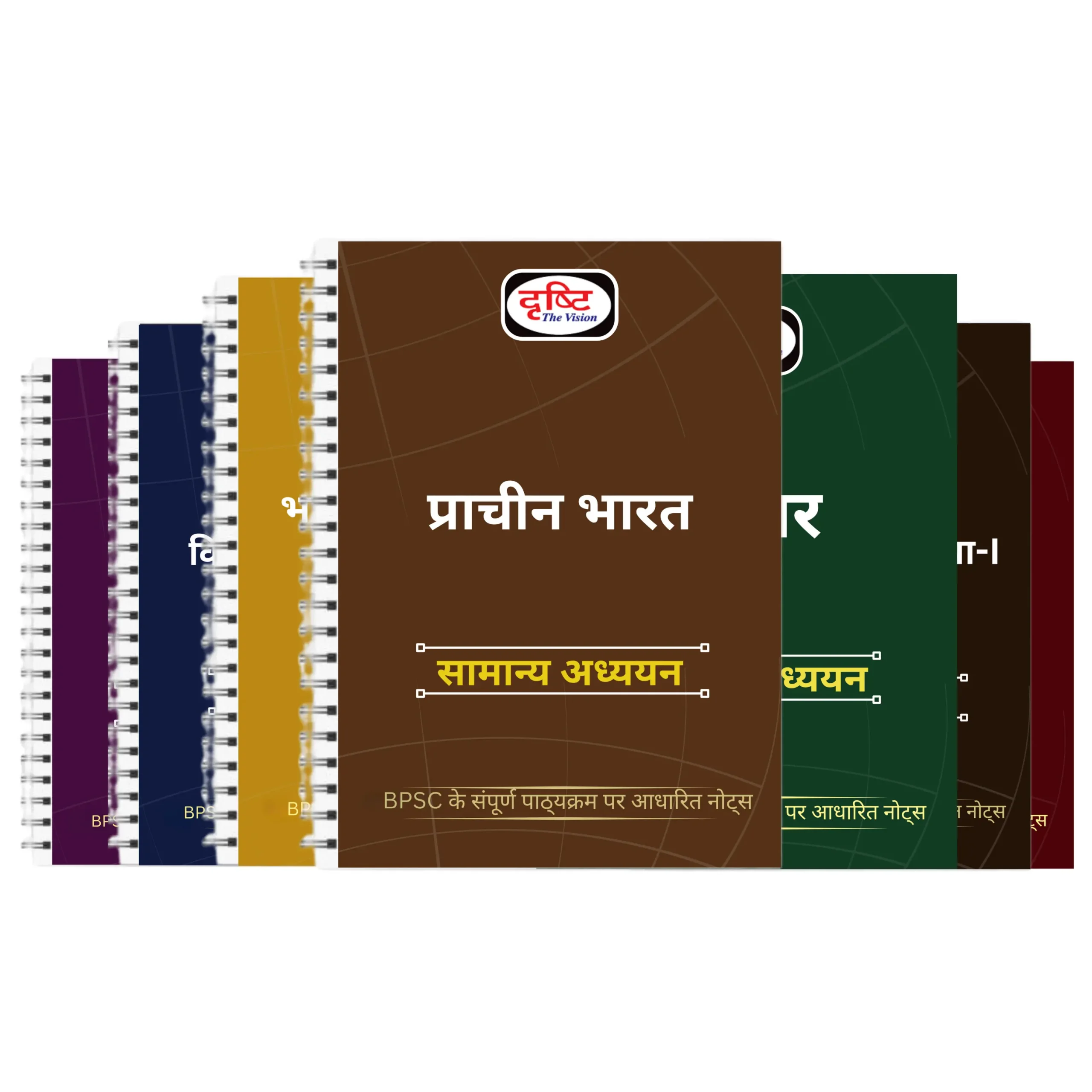
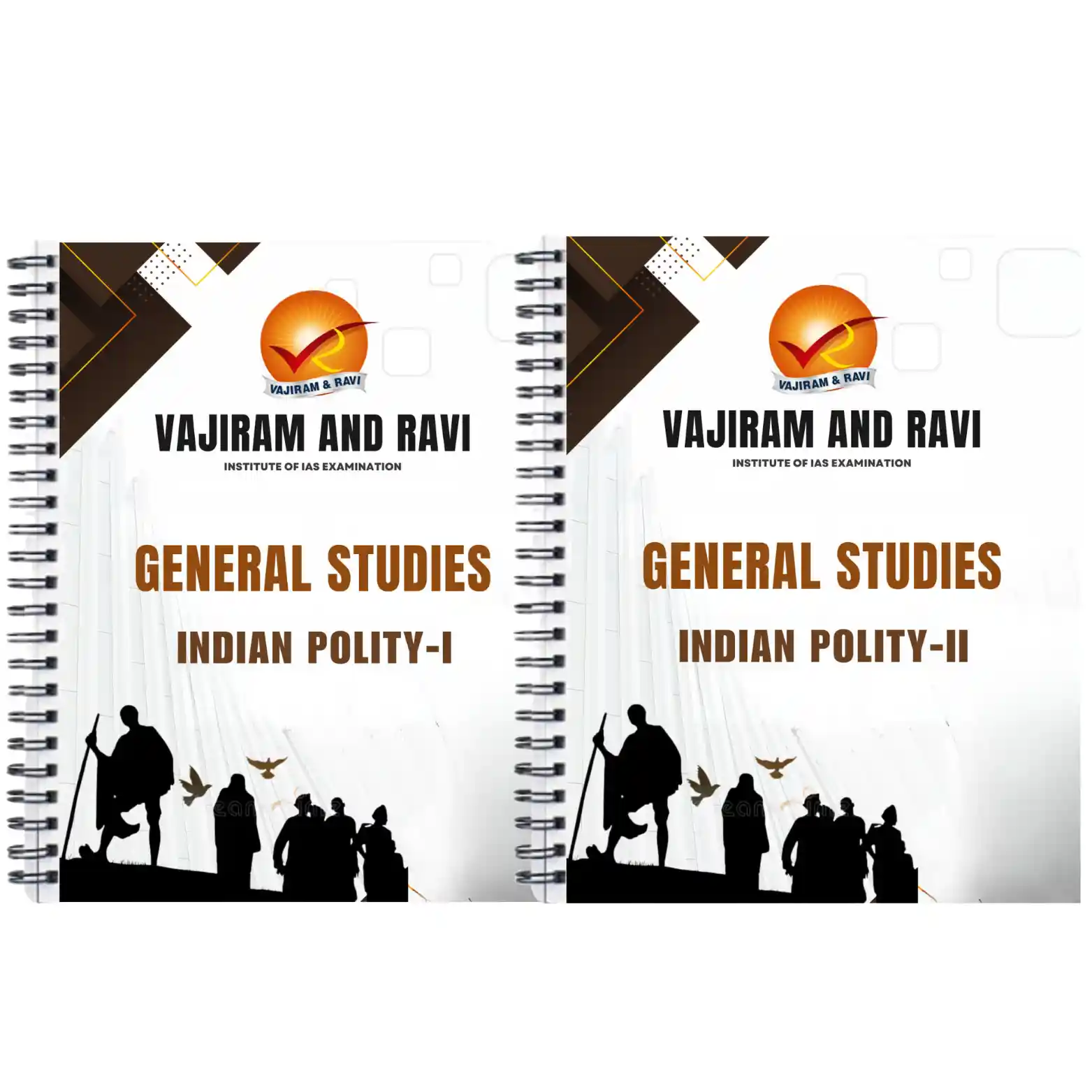
For polity and the Constitution paper, a compact set like these Vajiram Polity notes covers fundamental rights, DPSP, Panchayati Raj and constitutional bodies that recur across Prelims and Mains Paper V. For the economy portions of Paper V and GS-II, structured Vision IAS Economics notes handle national income, banking and RBI functions cleanly. Current Events is a 25-mark Prelims subject and a Mains staple, so a monthly resource such as the Vision IAS January 2026 Current Affairs magazine keeps you exam-ready. If you want a printed, PCS-style GS foundation to model your West Bengal preparation on, the Drishti state-PCS book set shows the depth and answer structure state commissions expect, and a dedicated latest syllabus booklet helps you map every topic before you start.
West Bengal-Specific Content: Your Scoring Edge
WBCS explicitly weights West Bengal in Geography (“with special reference to West Bengal”), in the History and freedom-movement sections (Bengal’s central role — the Bengal Renaissance, Swadeshi movement, partition of Bengal, revolutionary nationalism), and in polity/governance (state administrative structure, Panchayati Raj in WB, state schemes). Build a dedicated WB layer: the physical geography of the state (rivers like the Ganga-Hooghly, Teesta, Damodar; laterite and alluvial soils; the Sundarbans and coastal belt), the state’s demography and economy, and Bengal’s contribution to the national movement. Most candidates neglect this — depth here is where a serious aspirant separates from the pack.
Qualifying Marks, Negative Marking & Language Rules
A few rules decide who survives each stage:
- Prelims is qualifying: you only need to clear the category-wise cut-off; marks do not carry forward.
- Negative marking: the Prelims MCQ paper deducts one-third of the marks assigned to a question for a wrong answer — attempt strategically, not blindly.
- Language papers: Paper I (Bengali/Hindi/Urdu/Nepali/Santali) and Paper II (English) function as qualifying-weight papers; secure the minimum to keep your merit papers valid.
- Is Bengali compulsory? No — Paper I can be attempted in Hindi, Urdu, Nepali or Santali as alternatives to Bengali, so non-Bengali candidates are not shut out.
Always confirm the exact cut-off norms, minimum qualifying percentages and deduction ratio in the specific year’s WBPSC advertisement, as these are periodically fine-tuned.
WBCS Syllabus PDF Download (2025)
The most authoritative WBCS syllabus PDF is the one embedded in WBPSC’s official examination notification/advertisement, published at the commission’s website when the vacancy is announced — it lists the exact Prelims subjects, Mains papers, optional list and marking scheme for that cycle. For revision, save this page as a PDF (use your browser’s Print → Save as PDF) so you have a single, consolidated subject-wise sheet covering Prelims, Mains, the optional list, and the group-wise marks tables above. Whenever the official notification releases, compare it against this guide and update any point the commission has revised.
WBCS Preparation Strategy & Common Mistakes
Turn the syllabus into a plan with these principles:
- Integrate Prelims and Mains: the GS core is shared, so study each subject once to Mains depth and layer Prelims MCQ practice on top.
- Don’t underprepare the WB layer — it is a differentiator hidden inside “General” subjects.
- Choose the optional early (Group A/B) — 400 marks demand months of focused work.
- Practise the descriptive language papers — many strong GS candidates stumble on précis and translation for lack of practice.
- Follow current affairs monthly rather than cramming — Current Events appears in both Prelims and Mains.
- Verify the pattern against the live notification so you never prepare for a structure that does not apply to your cycle.
Common mistakes to avoid: ignoring negative marking and over-attempting the Prelims paper; treating the language papers as an afterthought; picking an optional with poor material availability; and copying a pure UPSC plan without adding West Bengal depth.
Frequently Asked Questions
What is the syllabus of the WBCS exam?
The WBCS syllabus spans three stages: a Preliminary exam of eight subjects (English Composition, General Science, Current Events, History of India, Geography of India with West Bengal focus, Indian Polity & Economy, Indian National Movement, and General Mental Ability), a Mains exam of six compulsory papers (Language, English, GS-I, GS-II, Constitution & Indian Economy, and Arithmetic & Reasoning) plus two optional papers for Group A & B, and a Personality Test.
What is the new WBCS exam pattern for 2025?
The currently-operative 2025 pattern is a single 200-mark objective Prelims and a six-paper compulsory Mains (with two optional papers for Group A & B). A revised, UPSC-style pattern with a two-paper Prelims (including CSAT) and an expanded Mains has been proposed, but it only applies from the cycle in which WBPSC formally notifies it — always confirm against the official advertisement.
How many papers are there in WBCS Mains?
Group A and Group B candidates write eight papers — six compulsory (Language, English, GS-I, GS-II, Constitution & Economy, Arithmetic & Reasoning) plus two optional-subject papers. Group C and Group D candidates write only the six compulsory papers. Every paper carries 200 marks and runs for 3 hours.
Is there CSAT in WBCS Prelims now?
Not under the currently-operative pattern. There is no separate CSAT paper today — aptitude is tested within the single 200-mark GS Prelims paper through the General Mental Ability subject (25 marks). A dedicated CSAT/aptitude paper is part of the proposed revision and would only apply from the cycle WBPSC formally notifies it, so verify the live advertisement before assuming CSAT is in force.
What are the optional subjects in WBCS?
Optional subjects apply only to Group A and Group B, who write two optional papers of 200 marks each. WBPSC offers roughly 30-plus options, including Bengali, Hindi, Sanskrit, English and other languages; History, Political Science, Sociology, Economics, Commerce, Philosophy, Psychology, Anthropology, Public Administration, Geography and Law; and Mathematics, Statistics, Physics, Chemistry, Botany, Zoology, Geology, Physiology, Computer Science, Agriculture, Medical Science, Engineering and Management. Confirm the exact list in the current year’s notification.
Is there negative marking in WBCS?
Yes. In the WBCS Preliminary objective paper, one-third of the marks assigned to a question are deducted for each wrong answer, so avoid random guessing. Confirm the exact deduction ratio in the current year’s WBPSC notification before your attempt.
Is Bengali compulsory for the WBCS exam?
No. The compulsory language paper (Paper I) can be attempted in Bengali, Hindi, Urdu, Nepali or Santali, so non-Bengali speakers can choose an alternative language and are not disadvantaged in eligibility.
Is the WBCS syllabus the same as UPSC?
No, but they overlap heavily in the General Studies core — polity, economy, history, geography, current affairs and science. WBCS differs in its West Bengal focus, its objective GS Mains papers, its language/English papers, and its optional-subject structure, so UPSC material is a strong base that must be supplemented with West Bengal-specific study.
Recommended Study Material
Continue Reading
NEET Exam Pattern 2026: Marks, Questions & Marking Scheme
The NEET exam pattern for 2026 is a single 3-hour (180-minute) pen-and-paper test of 180 compulsory questions carrying…
JPSC Syllabus 2025: Prelims, Mains Pattern + PDF Download
The JPSC syllabus for 2025 covers the Combined Civil Services Examination (CCSE) across three stages: a Preliminary exam…
KPSC Syllabus 2026: KAS Prelims, Mains & Exam Pattern (+ PDF)
The KPSC syllabus for the KAS (Gazetted Probationers) exam is built around three stages: an objective Prelims (two…