TNPSC Group 1 Syllabus 2026: Prelims, Mains + PDF
Complete TNPSC Group 1 syllabus 2026 — unit-wise Prelims & Mains topics, exam pattern, marks, weightage, Samacheer Kalvi book mapping and PDF download in English & Tamil.

The tnpsc group 1 syllabus covers a three-stage selection — a Preliminary Examination (200 objective questions, 300 marks), a Main Written Examination (a qualifying Tamil paper plus three descriptive General Studies papers of 250 marks each), and an Oral Test/Interview of 100 marks — conducted by the Tamil Nadu Public Service Commission for the Combined Civil Services Examination-I. Prelims tests General Studies at degree standard plus Aptitude & Mental Ability at SSLC standard, while the Mains ranks candidates on modern history, polity, economy, geography, science & technology, Indian society and Tamil Nadu-specific units. This guide gives the complete unit-wise syllabus, exam pattern, marks distribution, previous-year weightage, a Samacheer Kalvi book mapping and how to download the official PDF in English and Tamil.
Last updated: 14 August 2026. Marks, stages and unit names below follow the TNPSC Combined Civil Services Examination-I notification. Exam dates change every cycle — always cross-check the latest notification on tnpsc.gov.in before you finalise your plan.
TNPSC Group 1 Exam Overview at a Glance
TNPSC Group 1 — formally the Combined Civil Services Examination-I (CCSE-I) — is the most prestigious recruitment run by the Tamil Nadu Public Service Commission (TNPSC). It fills posts such as Deputy Collector, Deputy Superintendent of Police (DSP), Assistant Commissioner (Commercial Taxes), District Registrar and District Employment Officer. The selection is a clean three-stage funnel: Prelims → Mains → Interview. Prelims is purely a screening test — its marks are not added to the final tally — while the Mains (750 marks) and the Oral Test (100 marks) decide your rank out of 850.
| Particular | Detail |
|---|---|
| Exam name | Combined Civil Services Examination-I (Group 1) |
| Conducting body | Tamil Nadu Public Service Commission (TNPSC) |
| Stages | Prelims → Mains → Oral Test (Interview) |
| Prelims marks | 300 (200 questions, screening only) |
| Mains marks | 750 (3 papers × 250) + Tamil qualifying paper |
| Interview marks | 100 |
| Final selection basis | Mains (750) + Interview (100) = 850 marks |
| Negative marking | No |
| Medium | Tamil & English |
| Optional subjects | None (all Mains papers are General Studies) |
| Notification 2026 | Verify on tnpsc.gov.in |
TNPSC Group 1 Exam Pattern 2026 (All Three Stages)
Understanding the tnpsc group 1 exam pattern before touching the syllabus saves months of misdirected effort. Prelims is one 3-hour objective paper; the Mains is three long-form descriptive papers written by hand; the Oral Test is a personality assessment. Here is the consolidated, printable pattern table aspirants can save — the single side-by-side view most top pages never put in one place.
| Stage | Paper | Type | Questions | Marks | Duration | Counts in final rank? |
|---|---|---|---|---|---|---|
| Prelims | General Studies + Aptitude | Objective (MCQ) | 200 | 300 | 3 hours | No (screening) |
| Mains | Tamil Eligibility Test | Descriptive | — | Qualifying (min 40%) | 3 hours | Qualifying only |
| Mains | Paper I – General Studies | Descriptive | — | 250 | 3 hours | Yes |
| Mains | Paper II – General Studies | Descriptive | — | 250 | 3 hours | Yes |
| Mains | Paper III – General Studies | Descriptive | — | 250 | 3 hours | Yes |
| Interview | Oral Test / Personality | Face-to-face | — | 100 | — | Yes |
Key rule: There is no negative marking at any stage, so attempt all 200 Prelims questions. The Tamil Eligibility Test in the Mains is compulsory — you must score at least 40% (roughly 40/100) to have your three GS papers evaluated, but its marks are not added to your total. For 2026, plan around this exact structure and treat any circulating “pattern change” as rumour until it appears in an official TNPSC notification.
TNPSC Group 1 Prelims Syllabus (Part A + Part B)
The tnpsc group 1 prelims syllabus is split into two parts inside the single 200-question paper. Part A is General Studies at degree standard; Part B is Aptitude & Mental Ability at SSLC (Class 10) standard. The bulk of your effort goes to Part A, which mirrors much of the UPSC and other State PCS general studies canon, with an added Tamil Nadu layer.
Part A — General Studies (Degree Standard)
| Unit | Topics covered |
|---|---|
| Unit I – General Science | Scientific knowledge & scientific temper, physics, chemistry, botany, zoology, applications of science, environment & ecology, health & nutrition |
| Unit II – Current Events | National & international current affairs, latest schemes, sports, awards, appointments, economic & political news |
| Unit III – Geography | Physical geography of India & Tamil Nadu, monsoon, rivers, soils, minerals, natural resources, agriculture, transport, disaster management |
| Unit IV – History & Culture of India | Indus Valley to modern India, art & architecture, religious movements, Vijayanagara, Mughals, British rule, Indian culture & heritage |
| Unit V – Indian Polity | Constitution, Preamble, fundamental rights & duties, Union & State governments, judiciary, Panchayati Raj, elections, corruption & RTI |
| Unit VI – Indian Economy | Nature of the Indian economy, Five-Year Plans, national income, banking, taxation, rural & social welfare, Tamil Nadu economy |
| Unit VII – Indian National Movement | Freedom struggle, national leaders, role of Tamil Nadu, Non-Cooperation, Civil Disobedience, Quit India, communalism & Partition |
| Unit VIII – History, Culture & Socio-political Movements in Tamil Nadu | Dravidian movement, Self-Respect movement, Justice Party, social reformers, Tamil literature, Sangam age |
Part B — Aptitude & Mental Ability (SSLC Standard)
Part B is the fastest place to bank marks. Topics include simplification, percentages, ratio & proportion, HCF/LCM, time & work, time & distance, area & volume, logical reasoning, number series, coding-decoding, and basic data interpretation. Because these questions are formula-driven and predictable, most toppers target near-full marks here to offset tougher General Studies units. A daily 30-minute drill on two or three of these topics is usually enough to keep the whole section sharp through the year.
TNPSC Group 1 Mains Syllabus (Unit-Wise, All 3 Papers)
The tnpsc group 1 mains syllabus is where ranks are made. Three descriptive papers of 250 marks each demand structured, point-wise answers with a Tamil Nadu perspective. Below is the unit-wise breakdown most pages summarise but rarely enumerate.
Mains Paper I
| Unit | Focus area |
|---|---|
| Modern History of India & Indian Culture | British expansion, 1857 revolt, socio-religious reform, national movement, post-independence consolidation, Indian art & heritage |
| General Aptitude & Administrative Ability | Decision-making, problem-solving, data handling, basic numeracy for administration |
| Role & Impact of Science & Technology | Science & tech in the development of India and Tamil Nadu, space, defence, IT, biotechnology, energy |
Mains Paper II
| Unit | Focus area |
|---|---|
| Indian Polity & Emerging Political Trends | Constitution, governance, world political trends affecting India, federalism, welfare mechanisms |
| Indian Society, Globalisation & Social Justice | Social issues, women & child welfare, communalism, regionalism, secularism, globalisation’s impact on society |
| Environment & Human Rights | Ecology, biodiversity, climate change, sustainable development, environmental laws, human rights framework |
Mains Paper III
| Unit | Focus area |
|---|---|
| Current Events of National & International Importance | Policy, economy, science, sports and geopolitics from the past 12–18 months |
| Indian Economy & Tamil Nadu Economy | Planning, resource mobilisation, poverty & unemployment, global economy’s impact, Tamil Nadu’s economic model & schemes |
| Geography & Socio-political Movements in Tamil Nadu | Geography of India & Tamil Nadu, Dravidian & Self-Respect movements, Tamil society, culture & heritage |
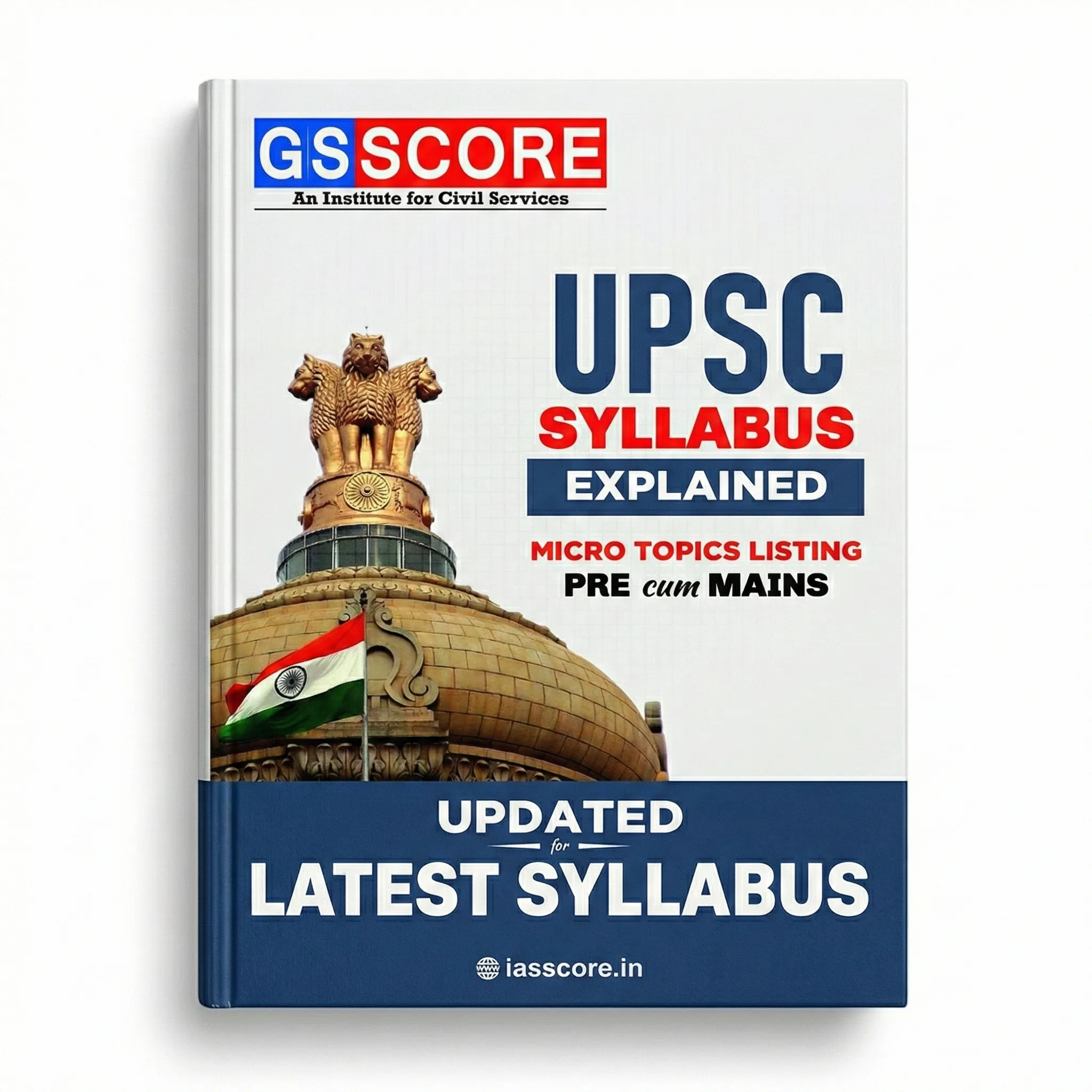
A high-quality syllabus reference booklet keeps this structure on your desk while you plan revision. Many aspirants pair a printed syllabus map like the GS Score Latest Syllabus Booklet with their answer-writing practice so no unit slips through — the polity, economy and modern-history overlap with UPSC makes such material directly usable for TNPSC preparation too.
Prelims vs Mains — Consolidated Marks & Time Table
Aspirants constantly ask for one clean, save-and-print comparison of the two written stages. Here it is — the consolidated view engineered for your study wall.
| Feature | Prelims | Mains |
|---|---|---|
| Number of papers | 1 (objective) | 3 GS + 1 Tamil (qualifying) |
| Question type | MCQ | Descriptive (hand-written) |
| Total marks | 300 | 750 (ranked) |
| Marks per paper | 300 | 250 each |
| Duration per paper | 3 hours | 3 hours |
| Standard | Degree (Part A) + SSLC (Part B) | Degree |
| Negative marking | No | No |
| Role in final rank | Screening only | Fully counted |
Previous-Year Weightage: Which Units Carry the Most Marks
Top pages list units but rarely tell you where the questions actually cluster. Based on past Prelims trends, here is an indicative weightage to prioritise your revision. Treat these as planning estimates, not guarantees — TNPSC varies emphasis year to year.
| Prelims unit | Approx. share of questions | Priority |
|---|---|---|
| General Science | 18–22% | High |
| Aptitude & Mental Ability (Part B) | 12–15% | High (scoring) |
| Indian Polity | 12–15% | High |
| Tamil Nadu History, Culture & Movements | 10–14% | High |
| Geography | 8–12% | Medium |
| Indian Economy | 8–12% | Medium |
| History & Indian National Movement | 8–10% | Medium |
| Current Events | 8–10% | High (continuous) |
The takeaway: General Science, Polity, Aptitude and the Tamil Nadu units together decide most Prelims outcomes. Current affairs cuts across every paper, which is why a disciplined monthly magazine habit matters — a resource like the Vision IAS Current Affairs Magazine (January 2026) is a compact way to keep national and international events consolidated month by month.
Tamil Nadu-Specific Micro-Topics You Cannot Skip
This is the single biggest differentiator between a TNPSC Group 1 candidate and a generic civil-services aspirant. The Tamil Nadu layer runs through both Prelims (Unit VIII) and Mains (Paper III). Here are the actual sub-topics — enumerated, not just named.
| Theme | Micro-topics to master |
|---|---|
| Dravidian & Social Movements | Justice Party, Self-Respect Movement, Periyar E.V. Ramasamy, anti-Hindi agitations, Dravidar Kazhagam, DMK formation |
| Tamil Society & Reformers | Caste reform, temple-entry movements, Vaikom, women’s empowerment, social reformers of Tamil Nadu |
| Sangam Age & Literature | Sangam polity, Chera-Chola-Pandya, Thirukkural, Silappathikaram, Tamil literary heritage |
| TN Geography | Rivers (Cauvery, Vaigai, Thamirabarani), monsoon pattern, coastal & delta zones, minerals, agriculture |
| TN Economy & Schemes | Industrial corridors, MSMEs, welfare schemes, state budget priorities, human development indicators |
Weave these into your answers as concrete examples: a Mains answer on social justice that cites the Self-Respect Movement or Tamil Nadu’s reservation history reads far stronger than one built on generic national points. Examiners reward that state-rooted specificity.
Syllabus-to-Book Mapping (Samacheer Kalvi / State Board Standards)
Buyers of study material want to know exactly which textbook covers which unit. Tamil Nadu State Board (Samacheer Kalvi) books are the widely-used backbone of TNPSC preparation, supplemented by NCERTs for depth. This mapping — missing from almost every ranking page — tells you what to read for each syllabus unit.
| Syllabus unit | Primary source | Supplement |
|---|---|---|
| General Science | Samacheer Kalvi Science, Classes 6–10 | NCERT Science 6–10 |
| History & INM | Samacheer Kalvi History, Classes 9–12 | NCERT Modern India (Spectrum) |
| Geography | Samacheer Kalvi Geography, Classes 9–12 | NCERT Geography 11–12 |
| Indian Polity | Samacheer Kalvi Political Science, Classes 11–12 | Laxmikanth / Polity notes |
| Indian Economy | Samacheer Kalvi Economics, Classes 11–12 | NCERT Economics + current data |
| Tamil Nadu units | Samacheer Kalvi Tamil Nadu History & Social Science | State-specific current affairs |
| Aptitude (Part B) | Samacheer Kalvi Maths, Classes 6–10 | Any SSLC-level aptitude book |
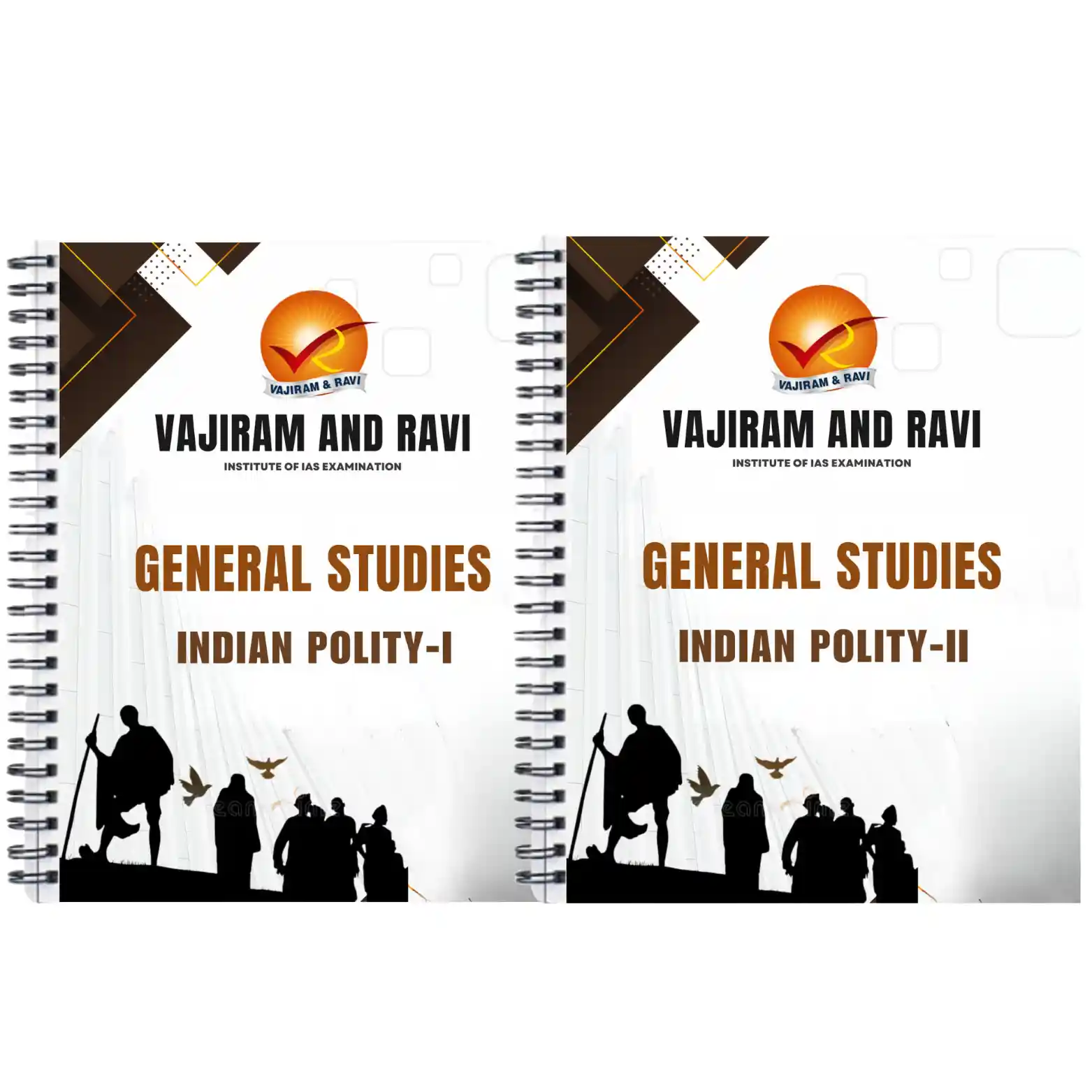
For the polity and economy units that overlap heavily with national civil-services standards, structured printed notes accelerate revision. Aspirants often supplement Samacheer Kalvi with focused sets such as Vajiram Polity Notes for the constitutional and governance portions, since the conceptual coverage carries over cleanly to the TNPSC Mains descriptive answers.
How to Download the TNPSC Group 1 Syllabus PDF (English & Tamil)
You can get the tnpsc group 1 syllabus pdf download in both languages directly from the source. Here is the simple route.
- Go to the official TNPSC portal: tnpsc.gov.in.
- Open the Syllabus section (under Candidates / Examinations).
- Select Combined Civil Services Examination-I (Group 1).
- Choose the English PDF or the tnpsc group 1 syllabus in tamil PDF.
- Download and save both versions for offline planning.
Tamil-medium aspirants should keep the Tamil PDF as the primary reference and the English PDF as a cross-check, since terminology in polity and science can differ between the two. Bookmarking both means you always answer in the exact terminology TNPSC uses in its question papers. Because the Commission occasionally revises unit wording between cycles, re-download the PDF whenever a fresh notification is released rather than relying on a copy saved from a previous year.
Preparation Strategy & Recommended Books
A syllabus is only useful when converted into a plan. Here is a realistic, stage-linked approach that maps directly onto the units above.
A practical 3-phase timeline
| Phase | Duration | Focus |
|---|---|---|
| Foundation | Months 1–4 | Samacheer Kalvi + NCERT across all static units; build notes |
| Prelims sprint | Months 5–7 | MCQ practice, Aptitude drills, PYQ solving, revision |
| Mains & interview | Months 8–12 | Answer writing, Tamil Nadu depth, current affairs, mock tests |
Recommended books & sources
- Static: Samacheer Kalvi (Classes 6–12), NCERTs, Laxmikanth for Polity.
- Current affairs: The Hindu and Dinamani daily; a consolidated monthly magazine for revision.
- Practice: Previous-year papers and topic-wise MCQs to internalise TNPSC’s question style.
Solving previous-year questions is the highest-return habit for any objective stage. A topic-wise PYQ compilation such as the Forum IAS Prelims PYQ Toolkit trains you to spot recurring patterns — a discipline that transfers directly to TNPSC Prelims, where General Science and Polity questions repeat in familiar shapes.
Answer-writing for the Mains
The three GS papers are hand-written and time-pressured — roughly 250 marks in 180 minutes — so structure beats volume. Open with a crisp definition or context line, develop the body in labelled points or short paragraphs, add one Tamil Nadu example wherever the question allows, and close with a forward-looking or balanced conclusion. Practise at least a few full-length answers a week from month eight onward; the muscle memory of writing within the time limit is what separates ranked candidates from those who merely know the syllabus.
Common Mistakes TNPSC Group 1 Aspirants Make
- Ignoring Tamil Nadu units: the Dravidian movement, Tamil society and TN economy are near-guaranteed marks — never treat them as an afterthought.
- Under-preparing Part B Aptitude: SSLC-level questions are the easiest full-mark zone, yet many candidates neglect them.
- Skipping answer-writing: the Mains rewards structure and Tamil Nadu perspective, not raw recall.
- Treating Prelims marks as final: Prelims only screens; your rank depends entirely on Mains + Interview.
- Relying on outdated dates: always verify notification and exam dates on the official portal rather than secondary pages.
Frequently Asked Questions
What is the syllabus for TNPSC Group 1?
The TNPSC Group 1 syllabus spans three stages. Prelims covers General Studies (General Science, Geography, History, Polity, Economy, Indian National Movement and Tamil Nadu topics) at degree standard plus Aptitude & Mental Ability at SSLC standard. The Mains has three descriptive General Studies papers covering modern history, polity, economy, science & technology, environment, Indian society and Tamil Nadu-specific units, followed by a 100-mark interview.
Is there negative marking in TNPSC Group 1?
No. There is no negative marking in the TNPSC Group 1 Prelims or Mains, so you should attempt every one of the 200 objective Prelims questions. Unattempted questions simply score zero, whereas an educated guess carries no penalty.
How many papers are there in TNPSC Group 1 Mains?
The Mains has three descriptive General Studies papers of 250 marks each (750 marks total), plus a compulsory Tamil Eligibility Test that is qualifying only. You must score at least 40% in the Tamil paper for your three GS papers to be evaluated.
What is the exam pattern for TNPSC Group 1 2026?
The pattern has three stages: a 3-hour objective Prelims of 200 questions for 300 marks (screening only), a Mains of three descriptive GS papers of 250 marks each plus a qualifying Tamil paper, and a 100-mark Oral Test. Final selection is based on Mains (750) + Interview (100) = 850 marks, with no negative marking. Confirm the exact dates in the official 2026 notification on tnpsc.gov.in.
Is TNPSC Group 1 tougher than UPSC?
UPSC is generally considered tougher due to its national competition, wider syllabus and optional subjects. However, TNPSC Group 1 is highly competitive within Tamil Nadu and adds a demanding Tamil Nadu-specific and Tamil-language component. The static syllabus overlaps significantly, so UPSC-standard material for polity, economy and history is directly useful for TNPSC.
Are there optional subjects in TNPSC Group 1?
No. Unlike UPSC, TNPSC Group 1 has no optional subjects. All three Mains papers are General Studies, which means every candidate studies the same syllabus — an advantage for focused, uniform preparation.
Which books are best for TNPSC Group 1 preparation?
Build the foundation on Tamil Nadu State Board (Samacheer Kalvi) books for Classes 6–12, which cover science, history, geography, polity, economy and the Tamil Nadu units. Supplement with NCERTs and Laxmikanth for polity depth, a modern-history reference such as Spectrum, a monthly current-affairs magazine for the continuous events portion, and topic-wise previous-year question compilations for practice. Use the syllabus-to-book mapping table above to match each unit to its primary source.
How do I download the TNPSC Group 1 syllabus PDF in Tamil?
Visit the official TNPSC website (tnpsc.gov.in), open the Syllabus section, select Combined Civil Services Examination-I (Group 1), and download the Tamil-medium PDF. Keep the English PDF alongside it so you can cross-check technical terminology in polity and science units.
Recommended Study Material


Continue Reading
IBPS PO Syllabus 2026: Prelims & Mains Pattern + PDF
The IBPS PO syllabus covers three subjects in Prelims (English Language, Quantitative Aptitude and Reasoning Ability) and five…
UGC NET Political Science Syllabus 2026: Unit-Wise + PDF
In short: the ugc net political science syllabus has two papers — Paper 1 (General Aptitude, 50 questions…
Bank PO Preparation 2026: Strategy, Syllabus & Study Plan
Bank PO preparation in 2026 comes down to three things: a clear grip on the IBPS/SBI PO exam…