UPPCS Syllabus 2026: Prelims, Mains, Pattern & PDF Download
Complete UPPCS syllabus 2026 — Prelims & Mains exam pattern, subject-wise topics, the new UP-specific GS-V & GS-VI papers, PYQ weightage, booklist and a free PDF in Hindi & English.

The UPPCS syllabus covers a three-stage selection process — Prelims (two objective papers of 200 marks each), Mains (eight compulsory descriptive papers totalling 1500 marks), and a Personality Test of 100 marks. The biggest change for 2026 is that the optional subject has been removed from the Mains and replaced by two new Uttar Pradesh-specific General Studies papers (GS-V and GS-VI). This guide gives you the full subject-wise Prelims and Mains syllabus, the latest exam pattern, PYQ weightage, a booklist mapped to each topic, and a free syllabus PDF in both Hindi and English.
Quick facts — UPPCS 2026 at a glance:
- Conducting body: Uttar Pradesh Public Service Commission (UPPSC)
- Stages: Prelims → Mains → Interview (Personality Test)
- Prelims: 2 objective papers — GS Paper-I (merit-deciding) + CSAT Paper-II (qualifying, 33%)
- Mains: 8 compulsory descriptive papers, 1500 marks; no optional subject
- New in 2026: GS-V and GS-VI — two Uttar Pradesh-focused papers worth 400 marks
- Interview: 100 marks · Final merit: 1600 marks · Medium: Hindi or English
- Negative marking: Yes, 1/3 mark per wrong answer in Prelims
UPPCS — officially the Combined State/Upper Subordinate Services Examination conducted by the Uttar Pradesh Public Service Commission (UPPSC) — recruits candidates for posts such as SDM, Deputy Collector, DSP, BDO, and Assistant Commissioner. Because the pattern now mirrors UPSC far more closely, aspirants preparing for the civil services can reuse a large chunk of their material. Below we break down every stage in the detail that most ranking pages skip.
UPPCS Syllabus 2026: Exam Overview & Selection Process
The UPPCS 2026 examination follows the same three-stage structure the UPPSC has used since its 2018 reforms, but with the crucial 2026 optional-subject change layered on top. Understanding how marks flow through each stage is the first step to planning your preparation.
- Stage 1 — Preliminary Examination: Two objective (MCQ) papers — General Studies Paper-I and CSAT Paper-II. Screening stage only; marks are not added to the final merit.
- Stage 2 — Main Examination: Eight compulsory descriptive papers totalling 1500 marks. This is where the merit is largely decided.
- Stage 3 — Personality Test (Interview): 100 marks. Final merit = Mains (1500) + Interview (100) = 1600 marks.
| Stage | Type | Papers | Total Marks | Counted in Merit? |
|---|---|---|---|---|
| Prelims | Objective (MCQ) | 2 (GS + CSAT) | 400 | No (qualifying/screening) |
| Mains | Descriptive | 8 compulsory | 1500 | Yes |
| Interview | Personality Test | 1 | 100 | Yes |
| Final Merit | Mains + Interview | — | 1600 | — |
One point aspirants often miss: your Prelims score has no bearing on the final rank. It only decides whether you reach the Mains. Once you qualify, the slate is wiped clean and your rank rests entirely on the 1500-mark Mains plus the 100-mark interview.
UPPCS Prelims Exam Pattern 2026
The uppcs exam pattern 2026 for the Preliminary stage consists of two papers held on the same day. Both are objective, carry 200 marks, and run for two hours each. General Studies Paper-I decides who qualifies for the Mains, while CSAT Paper-II is only qualifying — you need 33% to clear it.
| Paper | Subject | Marks | Questions | Duration | Nature |
|---|---|---|---|---|---|
| Paper-I | General Studies | 200 | 150 | 2 hours | Merit-deciding |
| Paper-II | CSAT (Aptitude) | 200 | 100 | 2 hours | Qualifying (33%) |
Negative marking: Yes — one-third (0.33) of the marks assigned to a question is deducted for every wrong answer in both papers. Unattempted questions carry no penalty, so intelligent, evidence-based guessing is worthwhile only when you can eliminate at least two options.
Because Paper-II (CSAT) is merely qualifying at 33%, most successful candidates invest 70–80% of their Prelims effort in GS Paper-I. But do not ignore CSAT — every year aspirants with strong GS scores are knocked out simply for failing to touch the 33% CSAT cut-off after the passage-heavy shift in recent papers.
UPPCS Prelims Syllabus: Subject-Wise Topics (with PDF)
The Prelims GS Paper-I syllabus is deliberately broad. Below is the granular, sub-topic-level breakdown that aspirants actually search for when they look up the uppcs prelims syllabus pdf. We have grouped it under the official heads.
General Studies Paper-I — Detailed Heads
| Subject Head | Key Sub-Topics |
|---|---|
| Current Events | National & international current affairs, government schemes, sports, awards, summits, appointments |
| History of India & Indian National Movement | Ancient (IVC, Vedic, Mauryan, Gupta), Medieval (Delhi Sultanate, Mughals, Bhakti-Sufi), Modern India, 1857 revolt, Gandhian era, freedom struggle |
| Indian & World Geography | Physical, social & economic geography of India & the world; rivers, monsoon, agriculture, minerals, industries, UP geography |
| Indian Polity & Governance | Constitution, political system, Panchayati Raj, public policy, rights issues, Union & State legislature, judiciary |
| Economic & Social Development | Sustainable development, poverty, inclusion, demographics, social sector initiatives, budgeting, banking |
| Environment & Ecology | Environmental ecology, biodiversity, climate change, conservation — general awareness not requiring subject specialisation |
| General Science | Everyday science, Physics, Chemistry, Biology basics, science & technology developments |
| Uttar Pradesh Specific | UP-focused current affairs, geography, economy, history and polity (an increasing share of the paper) |
CSAT Paper-II Syllabus
The CSAT paper tests aptitude rather than knowledge. Because the passages have become longer and denser, reading speed is the single biggest differentiator. The syllabus covers:
- Comprehension (English & Hindi passages)
- Interpersonal skills including communication skills
- Logical reasoning and analytical ability
- Decision-making and problem-solving
- General mental ability
- Basic numeracy — numbers and their relations, orders of magnitude (Class X level)
- Data interpretation — charts, graphs, tables, data sufficiency (Class X level)
A structured CSAT test series is the fastest way to hit the qualifying mark comfortably; the Vision IAS CSAT Test Series and Vajiram CSAT Complete Booklet Set both mirror the comprehension-heavy pattern UPPSC now follows.
UPPCS Mains Exam Pattern 2026: The Big Change
The uppcs mains syllabus 2026 is where the most significant reform has landed. As per the revised pattern, UPPSC has removed the optional subject entirely and replaced it with two new General Studies papers dedicated to Uttar Pradesh. The Mains now consists of eight compulsory descriptive papers totalling 1500 marks, each three hours long, and can be attempted in Hindi or English medium.
| Paper | Subject | Marks | Duration |
|---|---|---|---|
| Paper 1 | General Hindi | 150 | 3 hours |
| Paper 2 | Essay | 150 | 3 hours |
| Paper 3 | General Studies-I | 200 | 3 hours |
| Paper 4 | General Studies-II | 200 | 3 hours |
| Paper 5 | General Studies-III | 200 | 3 hours |
| Paper 6 | General Studies-IV | 200 | 3 hours |
| Paper 7 | General Studies-V (UP Special) | 200 | 3 hours |
| Paper 8 | General Studies-VI (UP Special) | 200 | 3 hours |
| Total | 1500 Marks | ||
This is a decisive shift towards a UPSC-style, GS-driven Mains. For aspirants it means two things: the syllabus is now more standardised and predictable, and a strong command of Uttar Pradesh’s history, geography, economy and governance is no longer optional — it is worth a full 400 marks. Because paper structures can be updated between cycles, always confirm the paper count and marks against the official UPPSC notification for your specific 2026 attempt before finalising your plan.
UPPCS Mains Syllabus: Paper-by-Paper Micro-Breakdown
Most ranking pages list the paper names and stop there. Here is the granular topic breakdown of each Mains paper so you can map your reading precisely.
Paper 1 — General Hindi (150 marks)
Tests functional command of Hindi: precis writing, reading comprehension and answering questions, official/formal letter and note drafting, expansion of ideas, and grammar (synonyms/antonyms, one-word substitution, idioms, sentence correction). This is a scoring paper that requires only steady practice.
Paper 2 — Essay (150 marks)
Three sections; candidates write one essay from each. Themes typically cover (A) literature, culture, social & moral issues; (B) polity, economy, national & international affairs; and (C) science, environment, technology, agriculture, industry. Structured practice with model essays — such as the Vajiram Essay Notes — sharply improves scores here.
Paper 3 — General Studies-I
- History of India and Indian culture
- Indian National Movement and freedom struggle
- Post-independence consolidation and reorganisation
- Geography of the world and society; physical geography
- Salient features of Indian society, diversity, role of women, population and associated issues
Paper 4 — General Studies-II
- Indian Constitution — features, amendments, basic structure
- Union & State functions, separation of powers, parliament and state legislatures
- Governance, transparency, accountability, e-governance, Right to Information
- Welfare schemes, social justice, health, education, poverty and hunger
- India and its neighbourhood; international relations and institutions
Paper 5 — General Studies-III
- Indian economy — planning, resource mobilisation, growth, development
- Inclusive growth, budgeting, agriculture, food processing, land reforms
- Science & technology, IT, space, biotechnology, IPR
- Environment, biodiversity, disaster management
- Internal security, cyber security, money laundering, border management
Paper 6 — General Studies-IV (Ethics)
- Ethics and human interface, attitude, aptitude, emotional intelligence
- Contributions of moral thinkers and philosophers
- Public/civil service values and ethics in public administration
- Probity in governance, codes of conduct, citizen’s charters
- Case studies on the above themes
Papers 7 & 8 — General Studies-V & VI (Uttar Pradesh Special)
These two new papers are the heart of the 2026 reform, and the area top pages barely detail. Between them they carry 400 marks focused entirely on Uttar Pradesh:
- UP History & Culture: ancient and medieval sites, freedom movement in UP, art, architecture, festivals, folk traditions, literature and notable personalities of the state.
- UP Geography: physiography, rivers (Ganga, Yamuna, Ghaghara), climate, soils, agriculture, irrigation, minerals and natural resources.
- UP Economy: agriculture and allied sectors, industries (sugar, leather, handloom), MSMEs, ODOP scheme, infrastructure, human resources and employment.
- UP Governance & Administration: state polity, Panchayati Raj in UP, urban local bodies, state welfare schemes, e-governance initiatives and public policy.
Study these from the UPPSC-notified topic list plus state-specific manuals and current affairs; standard national GS notes will not cover UP economy or ODOP-level detail.
UPPCS Interview / Personality Test (100 Marks)
The final stage is a Personality Test worth 100 marks conducted by a UPPSC board. It is not a test of knowledge but of suitability for public service. The board assesses mental alertness, critical assimilation, balanced judgement, depth and range of interests, social cohesion, leadership, and intellectual and moral integrity. Expect questions from your detailed application form (DAF) — educational background, home district, hobbies — plus current affairs and Uttar Pradesh-specific issues. Because it carries 100 of the 1600 final-merit marks, a strong interview can meaningfully lift your rank.
UPPCS vs UPSC Syllabus: What Material Can You Reuse?
This is the highest-value question for cost-conscious aspirants, and one most syllabus pages ignore. After the 2026 reform the UPPCS Mains structure closely resembles UPSC’s — GS-I to GS-IV map almost directly onto UPSC GS Papers I–IV, including the Ethics paper. That means the bulk of UPSC preparation material is directly reusable.
| Component | UPPCS 2026 | UPSC CSE | Overlap |
|---|---|---|---|
| Prelims GS | 150 Qs, 200 marks | 100 Qs, 200 marks | Very high — same subjects |
| CSAT | Qualifying 33% | Qualifying 33% | Identical concept |
| Mains GS I–IV | 4 papers, 200 each | 4 papers, 250 each | High — near-identical topics |
| Ethics (GS-IV) | Yes | Yes | High |
| Optional subject | Removed | Retained (500 marks) | UPPCS is lighter here |
| UP-specific GS V & VI | 2 papers, 400 marks | None | UPPCS only |
| Language/Essay | General Hindi + Essay | Compulsory language + Essay | Moderate |
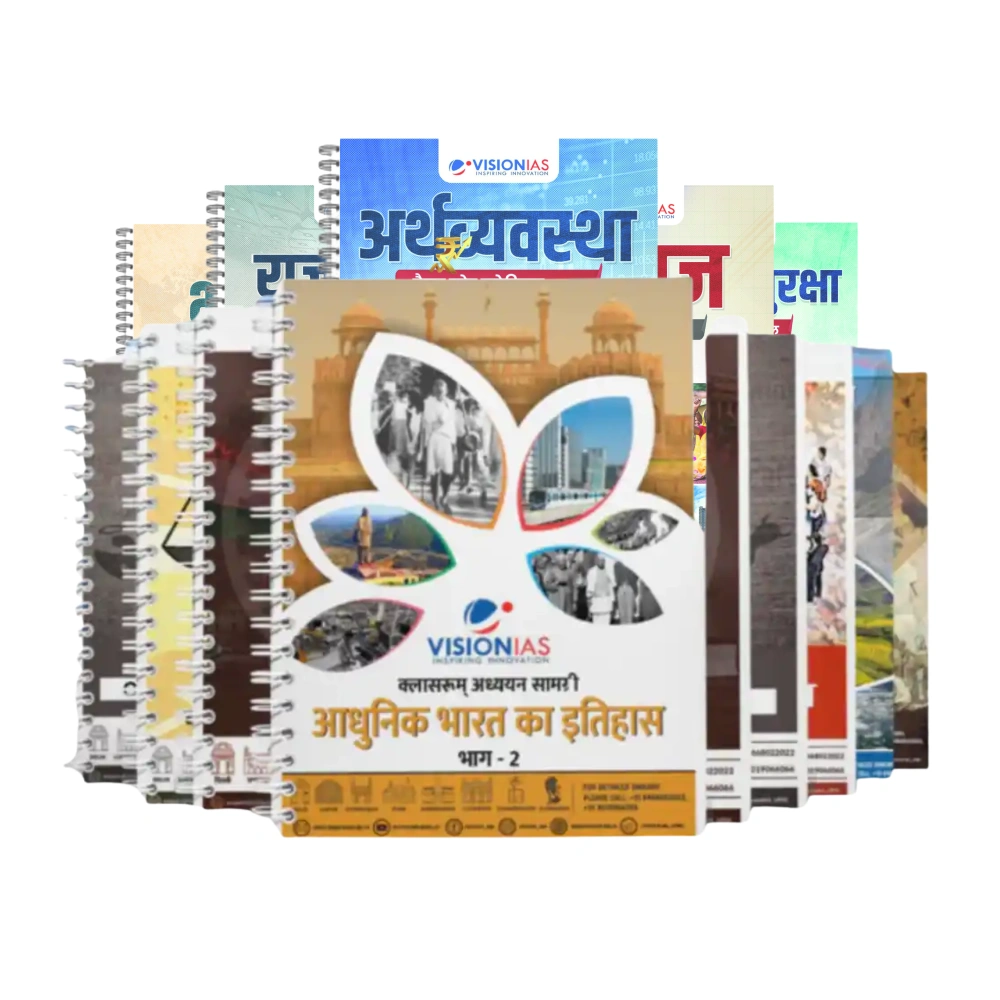
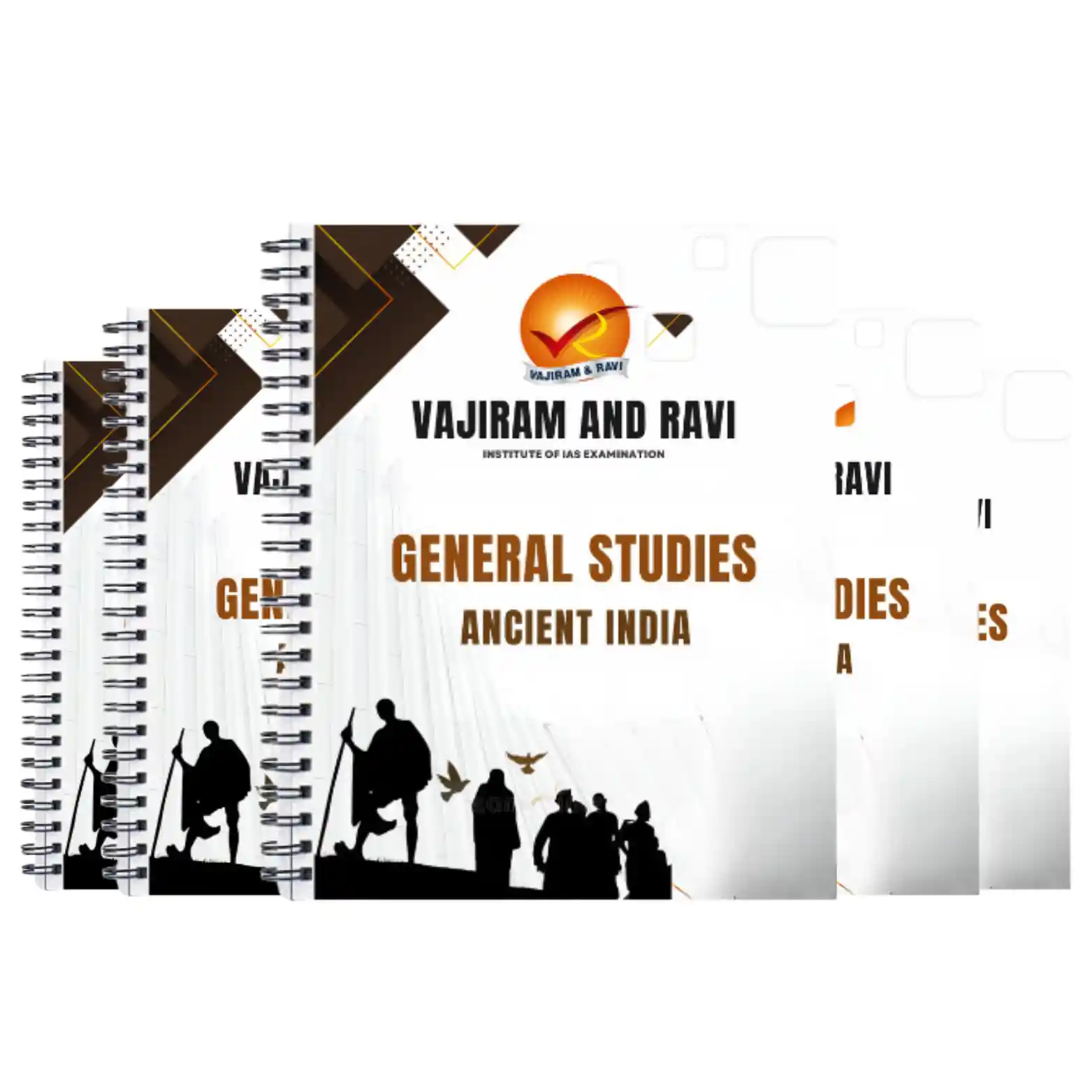
Practically, a candidate can use the same GS notes for both exams. Comprehensive sets such as the Vajiram and Ravi Study Material (27 booklets) or the Vision IAS GS Notes in Hindi (54 booklets) cover GS-I to GS-IV thoroughly. You then add a focused UP-specific layer for GS-V and GS-VI. This is far cheaper than buying separate UPPCS-only material for every subject.
PYQ Weightage & Topic Priority Analysis
Analysing UPPSC Prelims papers from recent years reveals a stable weightage pattern that should shape your revision priority. The indicative distribution below helps you allocate hours where marks concentrate.
| Subject (Prelims GS) | Approx. Weightage | Priority |
|---|---|---|
| History & Culture (incl. UP) | 18–22% | High |
| Geography (India + UP) | 15–18% | High |
| Polity & Governance | 12–15% | High |
| Economy & Social Development | 12–15% | High |
| Current Affairs | 12–15% | High |
| General Science | 10–12% | Medium |
| Environment & Ecology | 6–8% | Medium |
The clear takeaway: History, Geography, Polity, Economy and Current Affairs together account for roughly three-quarters of the paper, and Uttar Pradesh-specific questions cut across every one of them. These percentages are indicative trends from past papers, not a fixed blueprint, so treat them as a guide to sequencing rather than a guarantee. A topic-wise PYQ resource like the Forum IAS Prelims PYQ Toolkit (1992–2025) lets you see exactly which sub-topics recur, so you revise by frequency rather than guesswork.
Best Books & Study Material Mapped to the UPPCS Syllabus
The gap on most syllabus pages is that they never tell you what to read for each head. Here is a syllabus-to-material map covering both Hindi and English medium.
| Syllabus Area | Recommended Material |
|---|---|
| Full GS (Prelims + Mains), Hindi medium | Vision IAS GS Notes Hindi / Drishti IAS Hindi Study Material |
| Full GS, English medium | Vajiram & Ravi Study Material / Drishti IAS English Booklets |
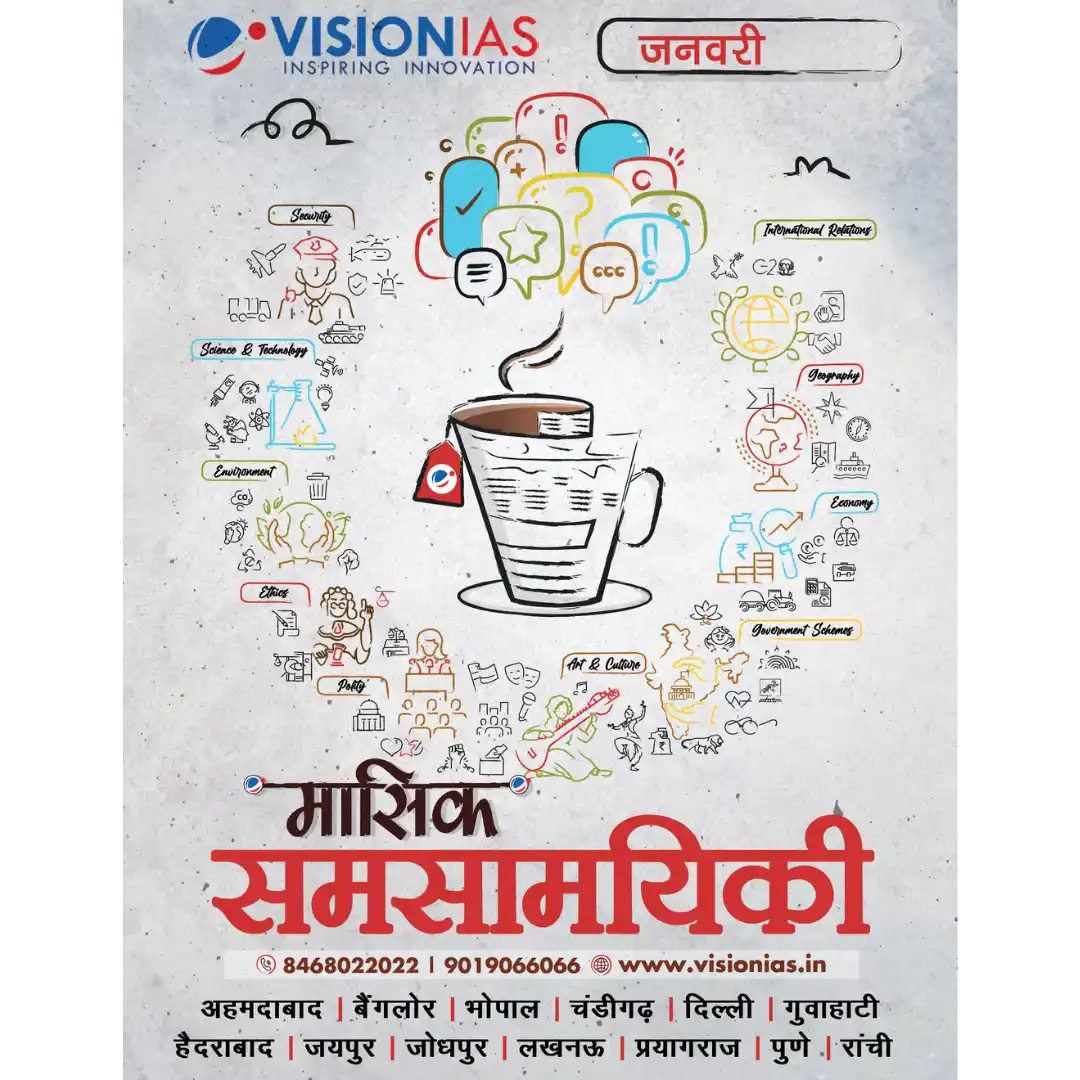
| Current Affairs | Vision IAS Monthly Magazine (Hindi/English) |
| Ethics (GS-IV) | Drishti IAS Ethics Notes |
| Economy | Vision IAS Economics Notes |
| Polity | Vajiram Polity Notes |
| CSAT | Vajiram CSAT Booklet Set / CSAT Test Series |
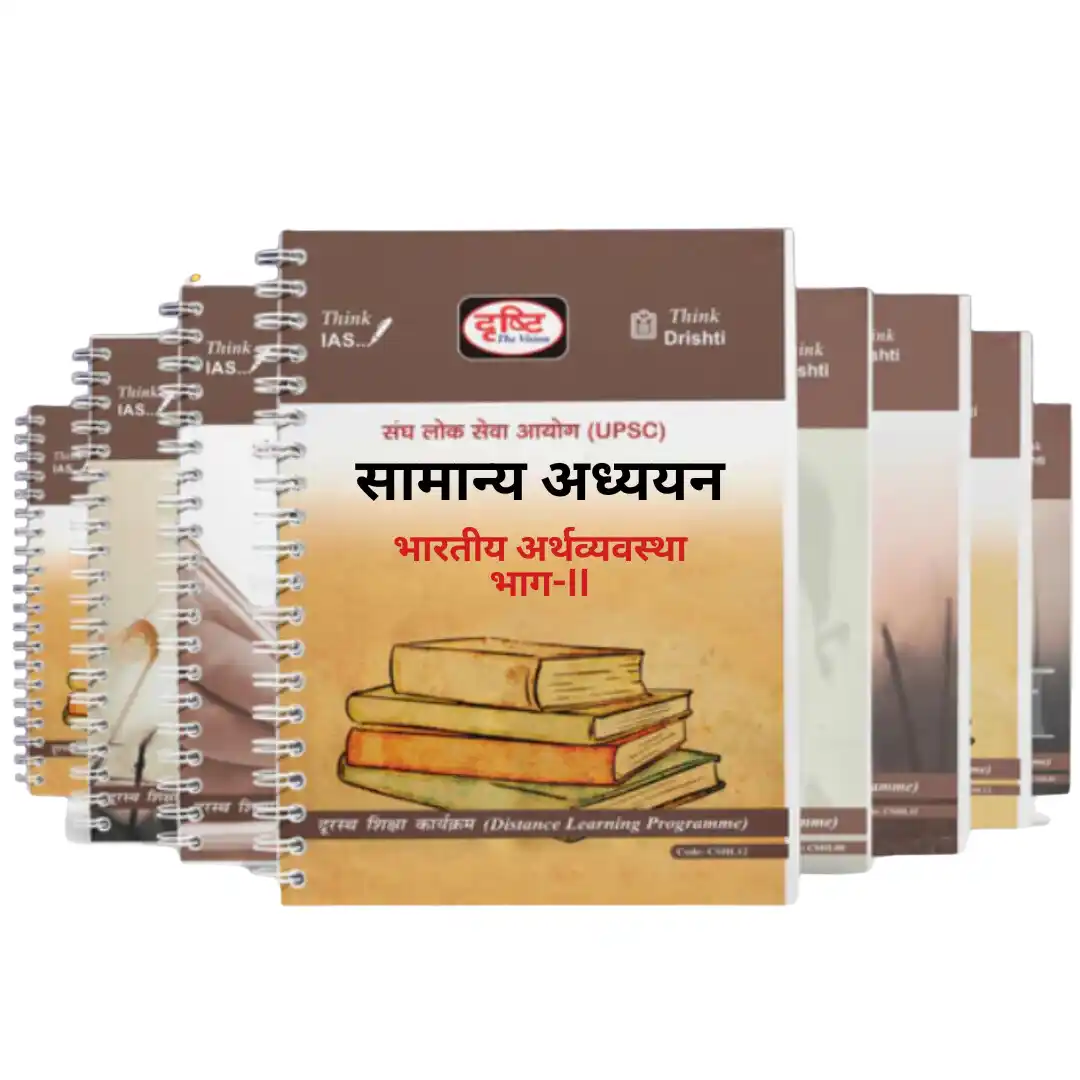
Hindi-medium aspirants are often underserved, so it is worth flagging strong options: the Drishti IAS Hindi Study Material (18 booklets) is a compact, exam-focused set, while the Vision IAS Hindi GS Notes 2026-27 offer broader coverage for those wanting depth. Pair either with the monthly Vision IAS Current Affairs Magazine (Hindi) to keep the current-events head — worth 12–15% of Prelims — continuously updated.
UPPCS Preparation Strategy & 8–12 Month Study Plan
Most first-time serious aspirants clear UPPCS with 8–12 months of disciplined preparation, assuming 6–8 hours of daily study. Here is a phased timeline that sequences the syllabus into a realistic schedule.
| Phase | Duration | Focus |
|---|---|---|
| Phase 1: Foundation | Months 1–3 | NCERTs + standard GS notes for History, Polity, Geography, Economy; begin newspaper reading |
| Phase 2: Core Building | Months 4–6 | Complete GS syllabus + UP-specific GS V & VI; start answer writing for Mains |
| Phase 3: Prelims Sprint | Months 7–8 | CSAT practice, full-length Prelims mock tests, PYQ revision, current affairs consolidation |
| Phase 4: Mains Intensive | Months 9–11 | Daily answer writing, essay & Hindi practice, UP topics revision, Mains test series |
| Phase 5: Interview | Month 12 | DAF preparation, mock interviews, current & UP affairs |
Weekly rhythm that works
- Static syllabus: 4–5 hours daily across two subjects
- Current affairs: 1 hour daily (newspaper + monthly magazine)
- Answer writing: 2–3 answers daily once the Mains phase begins
- Weekly test: one full sectional or mock test every Sunday
- Revision: keep the last day of each week for consolidation
Common mistakes to avoid
- Ignoring CSAT until the last month and then missing the 33% cut-off
- Treating UP-specific GS V & VI as an afterthought despite their 400 marks
- Collecting too many sources instead of revising one set multiple times
- Delaying answer-writing practice until after Prelims
To validate your preparation under timed conditions, a Prelims test series such as the Vision IAS Prelims Test Series 2026 and a Mains series like the Vision IAS Mains Test Series 2026 replicate the real exam pressure and expose weak areas early.
UPPCS Syllabus PDF Download (Hindi & English)
You can complete your uppcs syllabus pdf download directly from the UPPSC website — it is free of cost and not gated behind any sign-up. Follow these steps to get the syllabus in Hindi (uppsc syllabus in hindi) or English:
- Visit the official UPPSC portal: uppsc.up.nic.in
- Open the “Candidate Segment” or “Syllabus” section
- Select “Combined State / Upper Subordinate Services Examination”
- Download the notified PDF — the same document carries both Hindi and English versions of the syllabus
- Save it and, if you want the Hindi text on its own, use your PDF reader’s page-range export to keep only the Hindi pages
Always cross-check the syllabus and pattern against the latest official notification for the specific 2026 cycle, since UPPSC periodically revises marks and paper structure. Treat the official PDF as the single source of truth and use coaching notes only to study the topics it lists.
Frequently Asked Questions
What is the syllabus of UPPCS 2026?
The UPPCS 2026 syllabus spans three stages: Prelims (General Studies + CSAT, objective, 400 marks), Mains (eight compulsory descriptive papers — General Hindi, Essay and GS-I to GS-VI, totalling 1500 marks), and a Personality Test of 100 marks. The key 2026 update is the removal of the optional subject and the addition of two Uttar Pradesh-specific GS papers (GS-V and GS-VI).
Is optional subject removed from UPPCS Mains?
Yes. As per the 2026 pattern the optional subject has been removed from the UPPCS Mains. In its place UPPSC has introduced two new General Studies papers, GS-V and GS-VI, focused entirely on Uttar Pradesh’s history, culture, geography, economy and governance, together worth 400 marks. Confirm this against the latest official notification before your attempt.
How many papers are there in UPPCS Mains?
There are eight compulsory papers in the UPPCS Mains: General Hindi (150), Essay (150) and General Studies I to VI (200 marks each), adding up to 1500 marks. Each paper is descriptive, three hours long, and can be attempted in Hindi or English medium.
Is UPPCS and UPSC syllabus the same?
They are not identical but overlap heavily after the 2026 reform. UPPCS Prelims and GS Mains Papers I–IV closely mirror the UPSC syllabus, so most UPSC GS material is reusable. The differences: UPPCS has no optional subject, adds two UP-specific GS papers, and its Mains papers carry 200 marks each versus 250 in UPSC.
What is the CSAT qualifying percentage in UPPCS Prelims?
CSAT (Paper-II) in UPPCS Prelims is qualifying in nature and requires a minimum of 33% — that is 66 out of 200 marks. Scoring above 33% is essential; the marks are not added to the merit, but failing to reach the cut-off disqualifies you regardless of your GS score.
How to download the UPPCS syllabus PDF in Hindi?
Go to the official UPPSC portal at uppsc.up.nic.in, open the Candidate Segment or Syllabus section, select the Combined State / Upper Subordinate Services Examination, and download the notified PDF. The same official document contains both Hindi and English versions, so the uppsc syllabus in hindi comes bundled — no separate download or sign-up is needed. To keep only the Hindi pages, use your PDF reader’s page-range export.
Is there negative marking in the UPPCS exam?
Yes, in the Prelims. Both objective papers (GS Paper-I and CSAT Paper-II) deduct one-third (0.33) of a question’s marks for every wrong answer; unattempted questions carry no penalty. The descriptive Mains papers and the interview have no negative marking, since they are not multiple-choice.
How many months are needed to prepare for UPPCS?
Most serious aspirants need 8–12 months of focused preparation at 6–8 hours per day to cover the full syllabus, practise answer writing, and complete a test series. Beginners with no prior UPSC-style base should plan closer to 12 months, while those already preparing for UPSC can often adapt in 6–8 months.
Recommended Study Material
Continue Reading
TNPSC Group 1 Syllabus 2026: Prelims, Mains + PDF
The tnpsc group 1 syllabus covers a three-stage selection process — an objective Preliminary exam (200 questions, 300…
RRB JE Syllabus 2025: CBT 1 & CBT 2 Subjects, Pattern & PDF
The RRB JE syllabus is split across two computer-based tests: CBT 1 covers Mathematics, General Intelligence & Reasoning,…
JEE Main Exam Pattern 2026: Marks, Sections & Marking Scheme
The JEE Main exam pattern for 2026 keeps Paper 1 (B.Tech) at 75 questions worth 300 marks, split…