UPSC CSAT Syllabus 2026: Topic-Wise + PDF, Pattern & Weightage
Full upsc csat syllabus 2026: 7 official components, topic-wise maths & reasoning, exam pattern, 33% qualifying marks, PYQ weightage + free topic-wise PDF.

The upsc csat syllabus covers seven official components — comprehension, interpersonal & communication skills, logical reasoning & analytical ability, decision-making & problem-solving, general mental ability, basic numeracy (Class X level) and data interpretation (Class X level). CSAT is Paper 2 of UPSC Prelims (General Studies Paper 2). It is a qualifying paper: you must score at least 33% (66.67 out of 200 marks) to have your GS Paper 1 evaluated for the cut-off. Marks in CSAT are not added to your Prelims merit — but fail it, and your entire attempt is over regardless of how well you did in Paper 1.
This guide gives you the exact official wording, the decoded topic-wise breakdown, a 2015–2025 PYQ trend analysis, section-wise weightage, a non-maths student strategy, a curated booklist and a free downloadable topic-wise CSAT syllabus PDF. It is based on the UPSC Civil Services (Preliminary) notification syllabus plus published year-wise paper analyses, and is written for the 2026 attempt. Bookmark it — it is built to be the single reference you actually study from.
What Is CSAT (GS Paper 2) in UPSC Prelims?
CSAT stands for Civil Services Aptitude Test. Introduced in 2011, it is the second paper of the UPSC Civil Services Preliminary Examination and is formally titled General Studies Paper 2. While GS Paper 1 tests your knowledge of history, polity, economy, geography, environment, science and current affairs, CSAT tests your aptitude — reading comprehension, reasoning, and basic quantitative skills at roughly Class X level.
Since 2015, CSAT has been a purely qualifying paper. This means it is a pass/fail gate. Your score is not counted toward the Prelims cut-off or the final merit list — but you must clear the 33% threshold to be considered for GS Paper 1 evaluation. Every year, thousands of aspirants who score well in GS Paper 1 are eliminated purely because they treated CSAT as an afterthought and failed to cross 66.67 marks. That is the single most important thing to internalise before you read the syllabus.
UPSC CSAT Syllabus 2026: The 7 Official Components
The upsc csat syllabus 2026 is unchanged from the components UPSC has notified for years. Here is the exact official wording from the UPSC notification, mapped against the decoded topic list that coaching institutes teach — so you can clearly tell what is official versus coaching-added.
| # | Official UPSC Wording | Decoded / What You Actually Study |
|---|---|---|
| 1 | Comprehension | Reading passages (English) + inference, tone, assumption, main idea questions |
| 2 | Interpersonal skills including communication skills | Situation/communication-based passages (rarely direct questions now) |
| 3 | Logical reasoning and analytical ability | Syllogism, statements & conclusions, cause-effect, assertion-reason, arguments |
| 4 | Decision-making and problem-solving | Situational judgement questions (no negative marking on these) |
| 5 | General mental ability | Coding-decoding, blood relations, seating, series, analogy, direction, puzzles |
| 6 | Basic numeracy (numbers and their relations, orders of magnitude) — Class X level | Number system, percentages, averages, ratio, profit & loss, time-work-distance, SI/CI, geometry, mensuration, probability |
| 7 | Data interpretation (charts, graphs, tables, data sufficiency) — Class X level | Tables, bar/line/pie charts, caselets, data sufficiency |
Note: Component 2 (interpersonal & communication skills) has effectively disappeared as a standalone question type since around 2014 — UPSC now folds it into comprehension passages. It remains in the official upsc prelims gs paper 2 syllabus, but you should not spend dedicated study time on it.
CSAT Exam Pattern and Qualifying Marks
Understanding the csat exam pattern and qualifying marks is non-negotiable, because the structure directly shapes your attempt strategy. CSAT is an offline, OMR-based objective paper.
| Parameter | Detail |
|---|---|
| Paper | General Studies Paper 2 (CSAT) |
| Total questions | 80 MCQs |
| Total marks | 200 |
| Marks per question | 2.5 |
| Duration | 2 hours (2 hr 40 min for eligible PwBD candidates) |
| Negative marking | 1/3 of marks (−0.833 per wrong answer) |
| Mode | Offline, OMR sheet |
| Nature | Qualifying only |
| Qualifying marks | 33% = 66.67 marks (i.e., ~27 correct out of 80) |
| Medium | English & Hindi (bilingual paper) |
Because of the −0.833 penalty, you cannot blind-guess your way to 66.67. To be safe, target roughly 30–32 correct answers to build a buffer against silly mistakes and negative marking. Decision-making questions typically carry no negative marking, so always attempt all of them.
What happens if you fail CSAT? Your GS Paper 1 sheet is not evaluated. It does not matter if you scored 130 in Paper 1 — a 60 in CSAT ends your attempt. This is why every serious aspirant now schedules dedicated CSAT practice.
UPSC CSAT Maths Syllabus (Topic-Wise, Class X Level)
The upsc csat maths syllabus falls under “basic numeracy” and “data interpretation.” Despite the “Class X level” tag, post-2022 questions have been calculation-heavy and time-consuming. Here is the complete topic list with expected question load.
| Maths Topic | What It Covers | Typical Qs/Year |
|---|---|---|
| Number System | HCF/LCM, divisibility, remainders, factors, unit digit | 3–5 |
| Percentages | Percentage change, comparisons | 1–2 |
| Averages | Simple & weighted averages, age problems | 1–2 |
| Ratio & Proportion | Partnerships, mixtures, proportion | 1–2 |
| Profit & Loss | Discount, markup, marked price | 1 |
| Time, Work, Speed & Distance | Trains, boats-streams, pipes-cisterns, relative speed | 2–4 |
| Simple & Compound Interest | SI, CI, growth | 0–1 |
| Geometry & Mensuration | Area, perimeter, volume, angles, triangles | 1–3 |
| Permutation, Combination & Probability | Basic counting, simple probability | 1–2 |
| Data Interpretation | Tables, bar/pie/line graphs, caselets, data sufficiency | 4–8 |
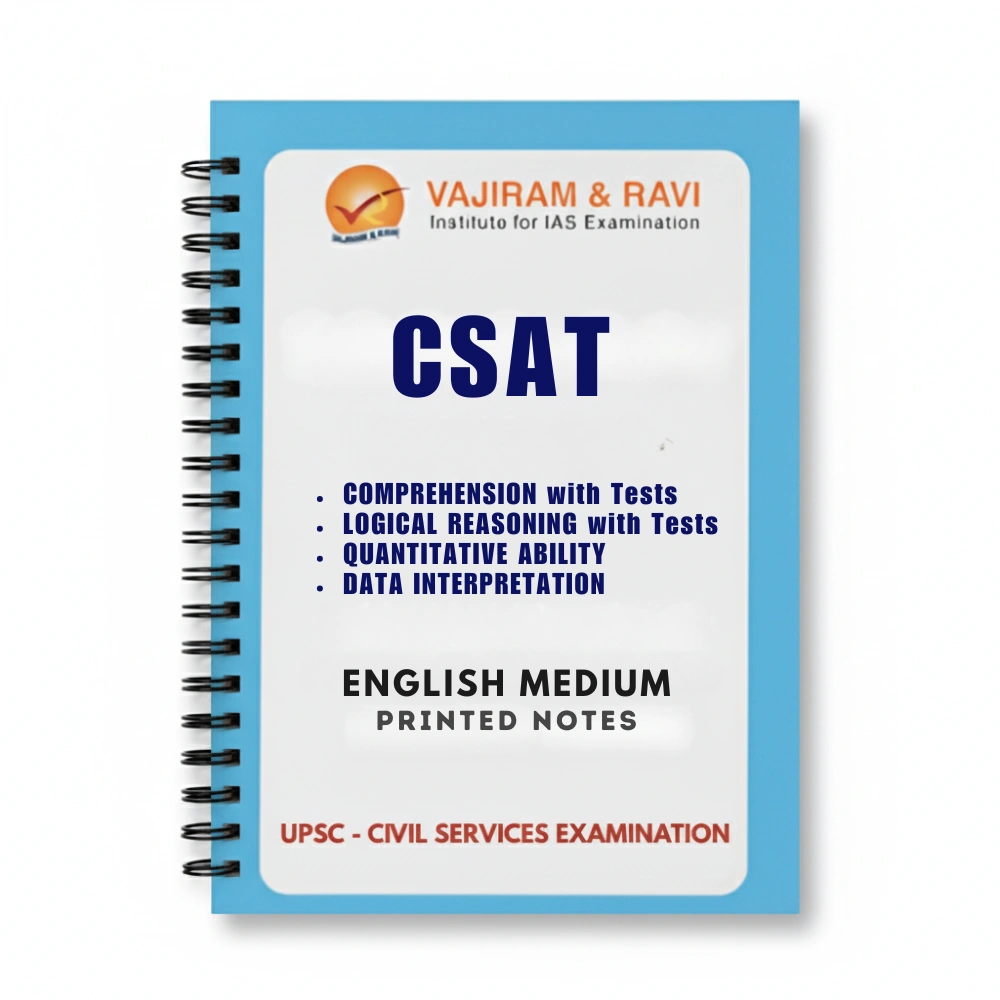
Highest-ROI maths clusters: number system, time-speed-distance, data interpretation and basic algebra/arithmetic word problems. Master these and you cover the bulk of the quantitative section. A curated formula-and-practice resource such as the Vajiram CSAT Complete Booklet Set with Practice Questions maps neatly onto this topic list.
UPSC CSAT Reasoning Syllabus (Topic-Wise)
The upsc csat reasoning syllabus spans “logical reasoning & analytical ability” and “general mental ability.” This is the highest-scoring section for most aspirants because questions are logic-driven, not knowledge-driven, and require little calculation.
| Reasoning Topic | Question Type | Typical Qs/Year |
|---|---|---|
| Syllogism | Statements & conclusions, Venn-based deduction | 1–3 |
| Coding-Decoding | Letter/number coding patterns | 1–2 |
| Blood Relations | Family tree, relationship puzzles | 1–2 |
| Seating & Arrangement | Linear, circular, matrix-based puzzles | 2–4 |
| Series | Number, letter and alphanumeric series | 1–2 |
| Analogy | Word/number analogy | 0–1 |
| Venn Diagrams | Set-based logic and categorisation | 1–2 |
| Direction Sense | Distance & direction tracking | 1–2 |
| Puzzles & Analytical Reasoning | Multi-condition ordering, ranking, grouping | 2–4 |
| Statements, Assumptions & Arguments | Critical reasoning, cause-effect, assertion-reason | 1–3 |
For humanities and non-maths students especially, reasoning is your safety net. It is learnable within 4–6 weeks and reliably delivers 15–20 marks with accuracy.
Reading Comprehension: The Real Backbone of CSAT
Comprehension is by far the largest section of the upsc prelims gs paper 2 syllabus, and since 2022 it has decided who qualifies. Passages are drawn from economics, polity, philosophy, environment, science and social-issue writing — often abstract, argument-dense editorial-style prose.
Short vs Long Passages
UPSC mixes short passages (a single paragraph, one question) with long passages (multiple paragraphs, 2–3 questions each). Long passages give the best return on reading time because one careful read yields multiple answers. Question types include main idea, inference, assumption, tone, author’s view and “what can be logically concluded.”
Bilingual Passage Strategy (Hindi Medium)
The paper is bilingual — every passage appears in both English and Hindi, except the English-comprehension passages, which appear only in English. Hindi-medium aspirants often find translated passages slightly awkward, so read each passage in whichever language you process fastest and cross-check tricky option wording against the other language when both are given. Hindi-medium candidates should still build an English reading habit, since roughly 25–30 marks hinge on English comprehension. Drishti’s Hindi study material and bilingual current-affairs magazines help build that comfort.
PYQ Trend Analysis 2015–2025: Where Marks Actually Concentrate
Almost no ranking page does real year-wise PYQ analysis. Here is an approximate breakdown of question distribution by section across the qualifying-era papers. Numbers are indicative (based on published paper analyses; UPSC does not release official topic tags).
| Year | Comprehension | Reasoning + Mental Ability | Maths + DI | Overall Difficulty |
|---|---|---|---|---|
| 2015–2018 | 26–30 | 25–30 | 22–28 | Moderate |
| 2019 | ~28 | ~27 | ~25 | Moderate |
| 2020 | ~30 | ~28 | ~22 | Moderate |
| 2021 | ~27 | ~26 | ~27 | Moderate-Hard |
| 2022 | ~26 | ~24 | ~30 | Very Hard |
| 2023 | ~27 | ~25 | ~28 | Hard |
| 2024 | ~28 | ~26 | ~26 | Moderate-Hard |
| 2025 | ~28 | ~26 | ~26 | Hard |
The takeaway: comprehension and reasoning together consistently supply 50–55 of the 80 questions — the clear majority of marks. Maths and DI supply the remaining 25–30. If you secure comprehension and reasoning, you are already within touching distance of 66.67 before attempting a single hard sum.
How CSAT Got Tougher After 2022
2022 was the inflection point. UPSC front-loaded lengthy, calculation-heavy maths and DI sets and made comprehension passages more abstract. Qualifying rates dropped sharply, and “safe attempts” fell — the number of questions you can attempt confidently shrank while accuracy became more decisive. The lesson from the post-2022 trend: accuracy beats volume. Solving 45 questions at 75% accuracy clears the bar more reliably than attempting 65 questions and bleeding marks to negatives.
Which Topics Have the Highest Weightage in CSAT?
If you want a one-line answer to the most common weightage query: reading comprehension is the single highest-weightage area (roughly 26–30 questions), followed by logical reasoning and general mental ability (~24–28), with basic numeracy and data interpretation together making up the remaining ~25–30. Within maths, data interpretation and number system carry the most questions; within reasoning, seating/puzzles and syllogism dominate. That ordering — comprehension first, reasoning second, arithmetic/DI third — is the backbone of every strategy below.
Section-Wise Weightage and Minimum-Target Strategy
Here is a concrete blueprint to guarantee 66+ marks, designed especially for non-maths and humanities aspirants who fear the quantitative section.
| Section | Approx Qs | Priority | Target Attempts | Target Correct |
|---|---|---|---|---|
| Reading Comprehension | 26–30 | Highest | 24 | 18 |
| Reasoning & Mental Ability | 24–28 | High | 20 | 15 |
| Basic Numeracy | 12–16 | Medium | 8 | 5 |
| Data Interpretation | 4–8 | Medium | 4 | 3 |
| Decision-Making | 3–6 | Always attempt (no negative) | All | 3 |
Doing the math on the “target correct” column: 18 + 15 + 5 + 3 + 3 = 44 correct ≈ 110 marks before negatives — comfortably above the 66.67 cut-off with a large safety buffer. Notice you can effectively skip the hardest half of the maths section and still clear.
Which Topics to Skip and Which Are Highest ROI
Highest ROI (never skip): comprehension, syllogism, seating/puzzles, blood relations, number system, data interpretation basics, decision-making. Safe to deprioritise if weak at maths: compound interest, permutation-combination beyond basics, complex probability, heavy mensuration. The strategy is not to be strong everywhere — it is to be reliable where the marks are dense.
How a Non-Maths / Humanities Student Can Clear CSAT
This is the single most-searched CSAT worry, and the answer is: absolutely yes. Thousands of arts, commerce and humanities graduates clear CSAT every year without touching hard maths. The plan:
- Lead with comprehension + reasoning — they need no maths and supply 50+ questions.
- Learn only Class X arithmetic — number system, percentages, averages, ratio, time-speed-distance. Ignore advanced topics.
- Master data interpretation shortcuts — DI is scoring and needs only basic percentage/ratio skills.
- Take timed sectional tests weekly — CSAT failure is usually a time-management failure, not a knowledge gap.
- Attempt all decision-making questions — free marks with no negative penalty.
A dedicated Vision IAS CSAT Test Series or the Drishti IAS CSAT Test Series builds the exam-hall temperament that raw reading cannot. Simulating the 2-hour, 80-question pressure is what converts a nervous non-maths student into a confident qualifier.
Best Books for UPSC CSAT Preparation (Section-Mapped)
Most pages vaguely say “Arihant/TMH/NCERT.” Here is a section-mapped booklist so every purchase serves a purpose.
| Section | Recommended Resource | Purpose |
|---|---|---|
| Full CSAT (all sections) | Vajiram CSAT Complete Booklet Set with practice questions | One-stop theory + practice |
| Comprehension | Daily editorial reading + previous years’ papers | Build reading speed & inference |
| Maths & Numeracy | Class X NCERT Maths + a quantitative aptitude book | Fundamentals & formulas |
| Reasoning | A verbal/non-verbal reasoning book + puzzle practice | Pattern familiarity |
| Data Interpretation | DI chapter from any aptitude book + mock DI sets | Speed with graphs/tables |
| Full-length practice | CSAT test series (Vision/Drishti) | Exam simulation & time management |
| PYQ practice | Topic-wise PYQ toolkit (1992–2025) | Trend-based revision |
For focused PYQ-driven revision, the Forum IAS UPSC Prelims Toolkit with topic-wise PYQs (1992–2025) lets you practise exactly the question patterns UPSC repeats — the fastest way to internalise CSAT difficulty. Pair it with the Vajiram CSAT Complete Notes for theory-to-practice coverage.
Sample CSAT Practice Questions (Feel the Difficulty)
To gauge the real difficulty level, try these representative questions before you build your plan.
Reasoning: If in a certain code MONDAY is written as OQPFCA, how is FRIDAY written? (Each letter shifts +2.) Answer: HTKFCA.
Numeracy: A train 150 m long crosses a pole in 15 seconds. What is its speed? Answer: 150/15 = 10 m/s = 36 km/h.
Comprehension (inference type): “Economic growth without job creation deepens inequality.” Which assumption underlies this? Answer: growth alone does not automatically distribute benefits to all sections.
Notice the pattern: none of these need advanced maths — they need clarity, speed and accuracy. That is CSAT in one line.
Free Downloadable CSAT Resources
Beyond just the syllabus, here is what you should download and keep on your desk. You can save this page as your csat syllabus topic wise pdf (use your browser’s Print > Save as PDF on this article to capture the full topic-wise tables in one file), and build the companion sheets below:
- Topic-wise syllabus checklist — tick off each of the 7 components and their sub-topics as you finish them.
- 90-day CSAT plan — Weeks 1–4: comprehension + reasoning; Weeks 5–8: numeracy + DI; Weeks 9–12: full-length tests + revision.
- Formula sheet — one page covering percentages, TSD, SI/CI, ratio, mensuration and DI shortcuts.
Print the tables in this article — the maths, reasoning, weightage and exam-pattern tables together form a complete topic-wise CSAT syllabus PDF you can revise from in one glance.
CSAT Preparation Tips and Common Mistakes
- Do not leave CSAT for the last month. Post-2022 difficulty means it needs at least 2–3 months of steady effort.
- Practise reading long passages daily — comprehension is a skill built over weeks, not crammed.
- Take at least 15–20 full-length mocks in exam conditions. Analyse each for time leaks.
- Never blind-guess — with −0.833 negative marking, guessing hurts more than skipping.
- Attempt the paper by strength, not sequence — do your strongest section first to bank marks and calm nerves.
- Always attempt decision-making questions — no negative marking makes them free.
Frequently Asked Questions
What is the syllabus of UPSC CSAT?
The UPSC CSAT syllabus has seven official components: comprehension; interpersonal and communication skills; logical reasoning and analytical ability; decision-making and problem-solving; general mental ability; basic numeracy at Class X level; and data interpretation at Class X level. It is General Studies Paper 2 of UPSC Prelims and is a qualifying paper.
How many questions are asked from maths in CSAT?
Basic numeracy and data interpretation together typically account for about 25–30 of the 80 questions, i.e. roughly one-third of the paper. The rest is comprehension and reasoning, so a non-maths student can clear CSAT without mastering advanced quantitative topics.
Is CSAT qualifying or counted in the final merit?
CSAT is purely qualifying. Its marks are not added to your Prelims cut-off score or the final merit list. You only need to score 33% to pass, after which your GS Paper 1 is evaluated for the actual cut-off. But failing CSAT ends your attempt entirely.
What are the qualifying marks (cut-off) for CSAT?
You must score at least 33% of 200 marks, which is 66.67 marks — roughly 27 correct answers out of 80. Because of 1/3 negative marking, aim for around 30–32 correct answers to build a safe buffer above the cut-off.
Which topics have the highest weightage in CSAT?
Reading comprehension has the highest weightage, at roughly 26–30 questions, followed by logical reasoning and general mental ability at about 24–28. Basic numeracy and data interpretation together supply the remaining 25–30. Within maths, data interpretation and number system carry the most questions; within reasoning, seating/puzzles and syllogism appear most often.
Is there negative marking in CSAT?
Yes. Every wrong answer deducts one-third of that question’s marks, i.e. −0.833 marks. Decision-making and problem-solving questions are the exception and usually carry no negative marking, so you should attempt all of them.
How can a non-maths / humanities student clear CSAT?
Yes, and it is common. Lead with comprehension and reasoning, which together supply 50+ questions and need no maths, then learn only Class X arithmetic (number system, percentages, averages, ratio, time-speed-distance) plus basic data-interpretation shortcuts. Attempt every decision-making question for penalty-free marks, and take weekly timed mocks — most CSAT failures are time-management failures, not knowledge gaps.
Which books are best for UPSC CSAT preparation?
A complete CSAT booklet set with practice questions (such as the Vajiram CSAT set), Class X NCERT maths for fundamentals, a reasoning/aptitude book, topic-wise PYQs, and a dedicated CSAT test series for full-length practice. Test series and PYQ practice matter more than theory, given the post-2022 difficulty.
Recommended Study Material


Continue Reading
WBCS Syllabus 2025: Prelims, Mains, Exam Pattern + PDF
The WBCS syllabus is set by the West Bengal Public Service Commission (WBPSC) and runs across three stages:…
BPSC Syllabus 2026: Prelims, Mains, Optional + PDF
The BPSC syllabus covers a three-stage Combined Competitive Examination (CCE): a single 150-mark objective Prelims (General Studies), a…
MPSC Syllabus 2025: Prelims, Mains, New Pattern + Marathi/English PDF
The MPSC syllabus for the Rajyaseva (State Services) exam covers three stages — Prelims (2 objective papers, 400…